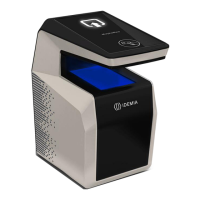
This is the default mode for terminals fitted with a contactless smartcard reader.
For further information, please see the "Multi-factors method" section in the MorphoWave Compact
Administration Guide.
5.1.5 > Proxy mode
The Proxy mode is an operating mode where the access control main application is located in a distant
system. This is not a standalone mode like Identification and Authentication modes.
It means that the terminal becomes a slave of the host system application. The access control application
is running on the host system and uses MorphoWave Compact terminal high level functions:
Identification function
Authentication function
Read data on a contactless card
Access control result signal command
The MorphoWave Compact terminal is driven through an Ethernet (or Wi-Fi™) link using TCP, SSL or TLS
protocol.
The MorphoWave Compact terminal acts as a server: it is either waiting for a command or executing a
command.
The commands allowed by the MorphoWave Compact terminal are described in the MorphoWave
Compact Host System Interface Specification document.
For further details about SSL or TLS on the MorphoWave Compact terminal, please refer to the
MorphoWave Compact Administration Guide.
5.1.6 > External database mode (also called polling mode)
When external database mode is activated, the MorphoWave Compact terminal does not verify user
template in its local database. This mode is useful when the user templates are stored in external
database.
When authentication is initiated on the terminal, the terminal will poll the user ID to external controller. On
polling out the ID, the corresponding template (if exists) is fetched from the external database and is
authenticated against user’s biometric on the terminal. Once the template request is posted to the external
database, the terminal shall wait for the finger template from the external database to start authentication.
Further process shall be same as authentication.
Polling Process using buffer:
The user’s input ID will be queued in the terminal’s queue, which is polled by external application.
External application waits for the User ID by polling the buffer. After getting an ID, it will search the
template in database and send template to terminal for further authentication.
The user is authenticated by the external device and granted access accordingly.
MorphoWave Compact terminal also has distant commands to retrieve polling buffer status and polling
buffer data. Refer to the MorphoWave Compact Host System Interface Specification document.
How to Activate?
External database mode can be activated through Webserver > Complete Configuration, by setting
“ucc.enable_external_database” parameter to 1. Only an admin user can activate polling mode. You can


 To Next Page