30
10.2 Load batteries
NOTE:
Also note the loading instructions for batteries
• in the user manual of “G40”,
• in the user manual of charging unit,
• on front and rear of charging unit.
For care and maintenance of mechanical compo-
nents of batteries see chapter 10.1.
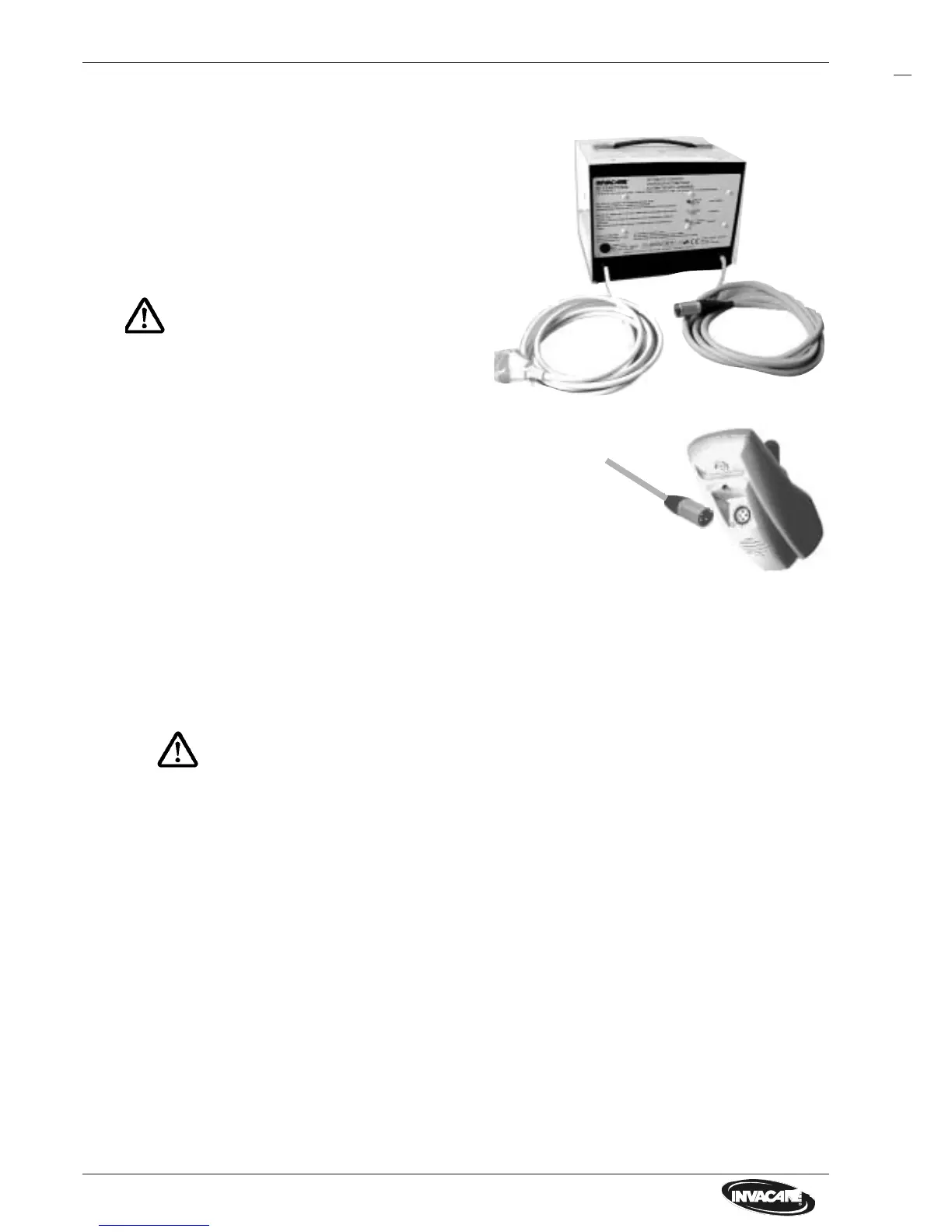
Charging
cable
Mains cable
INVACARE-Charging unit
CAUTION:
• Exercise care when checking / loading. Avoid
short circuit at battery poles.
> Danger of short circuit <
Charging plug
Charging socket
Remote
• Status display at remote flashes 7
times (deep discharging)?
• Status display at remote flashes 8
times (excess voltage )?
• Measure voltage of batteries:
- Voltage under 11,5V?
- Voltage under 8V?
(Battery deep discharged.)
Different voltage
(Tolerance ±0,2 V) at both batte-
ries?
> Measure battery voltage.
> Charging unit defective.
See chapter 10.3.
> Load with original charging
unit
> Pre-load with unregulated
charging unit up to 9V.
(Description see below.)
> Replace batteries.
Check Action
Loading process
NOTE:
• Processing during loading of batteries with INVACARE-charging unit:
Also see user manual of G40.
• Pay attention to connecting order of INVACARE-charging unit:
First connect charging plug, then mains plug.
• Deep discharged batteries can not be loaded with INVACARE-charging unit.
• If batteries are not loaded completely they must be replaced.
• During full loading the display “full loading” on charging unit must light.
When a charging voltage of 28 V is reached, also the LED´s at remote flash.
The voltage of a single battery shall amount during full loading and in room temperature
(ca. 20 - 22°C) 14 ±0,2 V.
CAUTION:
• During loading batteries must not lie on side or stand edgewise. The batterypoles must show
upwards.
• At G40 with ACS use only gelbatteries (loading power maximal 7 A).
Wetbatteries (loading power max. 10 A) overload cables.
• Batteries and charging unit must be set out ambient temperature because the loading is also
controlled with temperature sensors. Elongated cables and different locations of charging unit
and batteries cause faulty loading.





 To Next Page