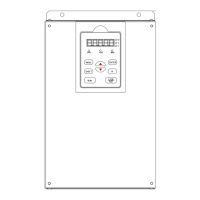
(numeric display
operation)
Multi-speed
control: 0 [rpm]
Multi-speed control
1 [rpm]
Multi-speed control
2 [rpm]
Multi-speed control
3 [rpm]
Note: If you need to set the target speed precisely, it is required to set Din_Speed0, Din_Speed1, Din_Speed2
and Din_Speed3 with a host computer. The four data units are internal units and are suitable for users who
are familiar with drivers. Din_SpeedX_RPM indicates the data after converting Din_SpeedX into the unit of
rpm to facilitate users. Conversion involves both the reading and writing processes, and does not require
calculation by users.
Example 7-10: Internal multi-speed control
Requirement: You need to define the digital input ports DIN6 and DIN7 as internal speed control, DIN1 as
driver enabling and DIN2 as operation mode control of the driver (the mode is “3” when the driver is valid, and
is “-3” when the driver is invalid). For detailed requirements, see Table 7-25. For the setting method, see
Table 7-26.
Table 7-25 Requirements on internal multi-speed control
To execute the multi-step 1 speed (100 rpm)
To execute the multi-step 2 speed (200 rpm)
To execute the multi-step 3 speed (300 rpm)
To execute the multi-step 3 speed (400 rpm)
To enable the driver, and lock the motor shaft
To control operation modes of the driver (the mode is “3”
when the driver is valid, and is “-3” when the driver is
invalid)
Table 7-26 Setting methods for internal multi-speed control
Set to 000.1
(Driver enable)
Set to 000.4
(control over operation modes of drivers)
Set to 010.0
(internal speed control 0)
Set to 020.0
(internal speed control 1)
Set to 0.003 (3) mode
(speed mode with acceleration/deceleration)
Set to 0.003 (-3) mode
(instantaneous speed mode)



 To Next Page