29
Item Method Discard limit or criteria Action
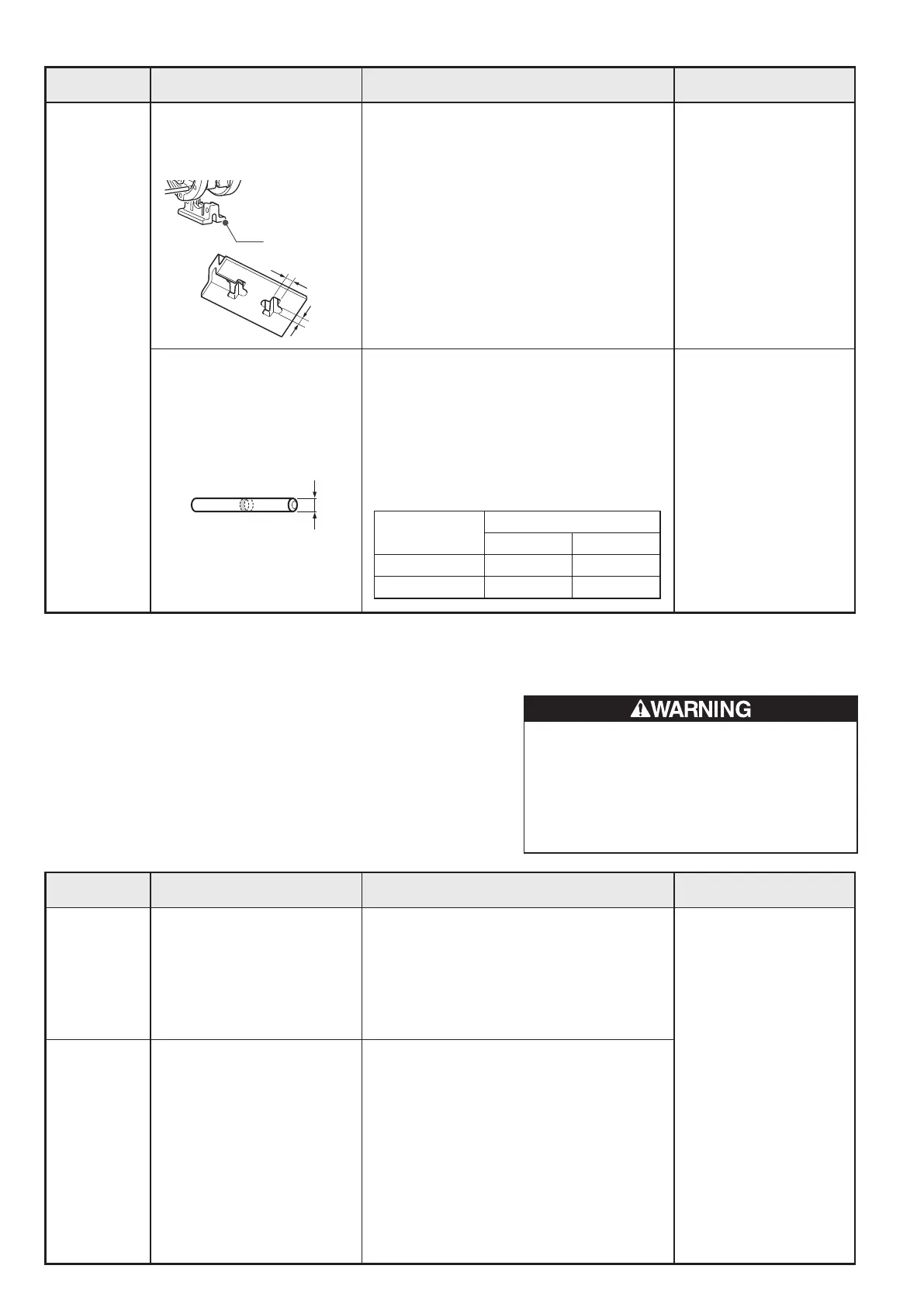
Others Visually check the
deformation of the Chain
Guide.
• Should be free of crushed grooves,
deformations or cracks.
Replace the Chain
Guide.
Visually check and measure
the deformation, abrasion and
corrosion (rust) of the End
Pin with a vernier caliper.
• The End Pin should be free of signicant
deformation.
• Should be free of aws or deformations.
• Should be free of signicant corrosion (rust).
(Measure dimension d.)
Replace the End Pin.
Item Method Discard limit or criteria Action
No load
test
Repeat lifting and lowering a
few times.
• The Chain Hoist should be operated with a
light pulling force.
• The Chain Hoist should have regular click
sounds of Pawl when lifting.
Disassemble the Chain
Hoist to verify that the
hoist is assembled
properly and the
components are free of
defects.
Rated
load test
Lift and lower the rated load
for 20 to 30cm.
Perform the items in the
"Basic function" of Frequent
Inspection.
• The Chain Hoist should have regular click
sounds of Pawl and run smoothly when
lifting.
• The sound should be at a constant level with
no irregular clicks.
• The Chain Hoist should make no sound
when lowering.
• It should be free of a heavy pulling force.
• It should be free of slip in braking.
Chain Guide
When the periodic inspection is
completed, perform a preoperational
test to check that the hoist operates
correctly.
Failure to do so may result in death or severe injury.
Preoperational Test
Rated load (t)
End Pin diameter (mm)
Standard Limit
0.25 3.9 3.7
0.5
5 4.8


 To Next Page