ELECTRICAL CONNECTIONS 3
19
OPTISONIC 8300
www.krohne.com03/2020 - 4008065101 - QS OPTISONIC 8300 R01 en
100...230 VAC (tolerance range for 100 VAC: -15% / +10%)
100...230 VAC (tolerance range for 100 VAC: -15% / +10%)100...230 VAC (tolerance range for 100 VAC: -15% / +10%)
100...230 VAC (tolerance range for 100 VAC: -15% / +10%)
• Note the power supply voltage and frequency (50...60 Hz) on the nameplate.
• The protective ground terminal PE
PEPE
PE of the power supply must be connected to the separate U-
clamp terminal in the terminal compartment of the signal converter
24 VDC (tolerance range: -55% / +30%)
24 VDC (tolerance range: -55% / +30%)24 VDC (tolerance range: -55% / +30%)
24 VDC (tolerance range: -55% / +30%)
24 VAC/DC (tolerance range: AC: -15% / +10%; DC: -25% / +30%)
24 VAC/DC (tolerance range: AC: -15% / +10%; DC: -25% / +30%)24 VAC/DC (tolerance range: AC: -15% / +10%; DC: -25% / +30%)
24 VAC/DC (tolerance range: AC: -15% / +10%; DC: -25% / +30%)
• Note the data on the nameplate!
• For measurement process reasons, a functional ground FE
FEFE
FE must be connected to the
separate U-clamp terminal in the terminal compartment of the signal converter.
• When connecting to functional extra-low voltages, provide a facility for protective separation
(PELV) (according to VDE 0100 / VDE 0106 and/or IEC 60364 / IEC 61140 or relevant national
regulations)
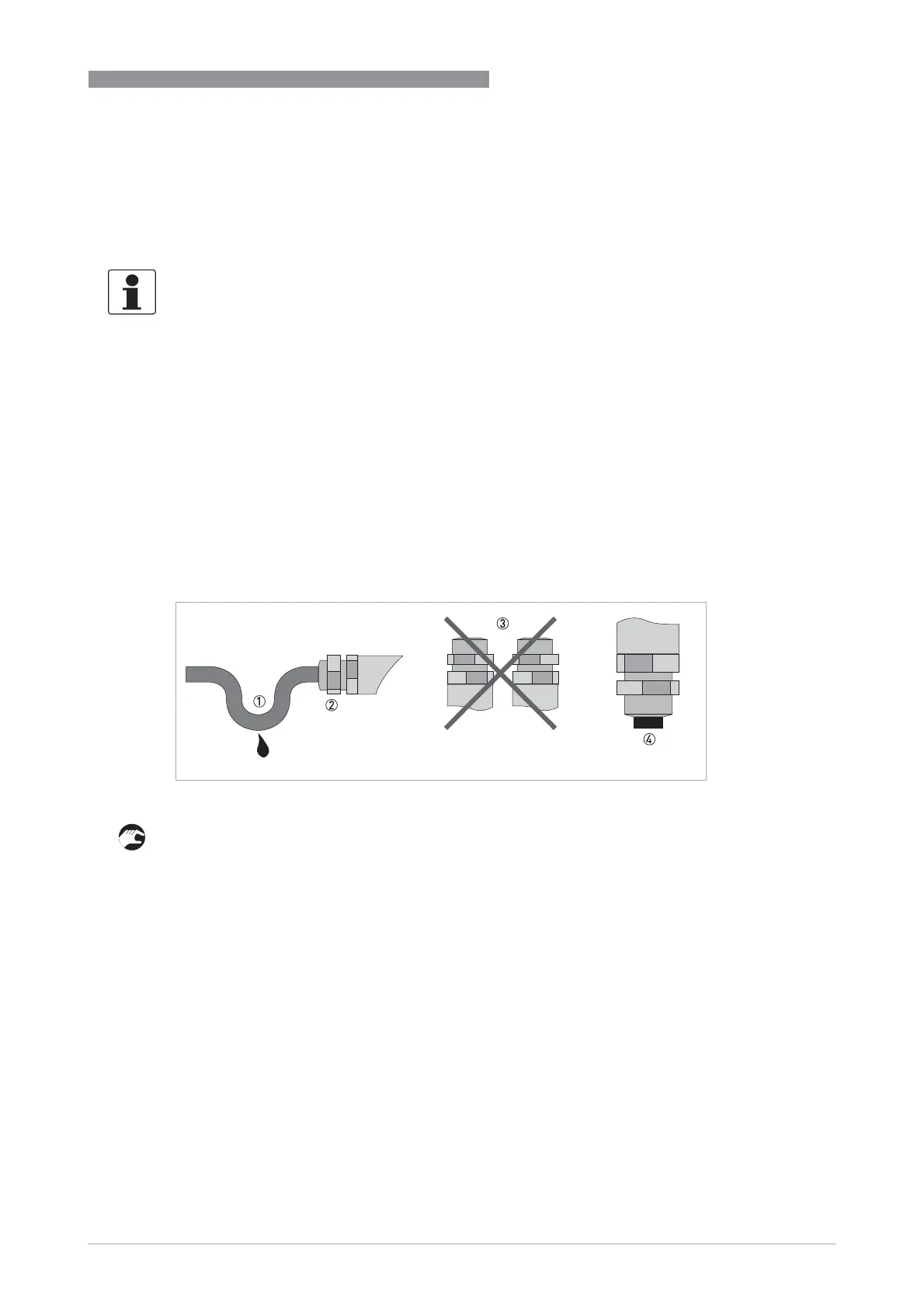
3.4 Laying electrical cables correctly
1 Lay the cable in a loop just before the housing.
2 Tighten the screw connection of the cable entry securely.
3 Never mount the housing with the cable entries facing upwards.
4 Seal cable entries that are not needed with a plug.
INFORMATION!
240 VAC + 5% is included in the tolerance range.
Figure 3-5: Protect housing from dust and water







 To Next Page