L-ACOUSTICS V-DOSC Manual Version 4 6/29/2005 Page 142 of 158
APPENDIX 1:
WHY DO SEPARATED SOUND SOURCES INTERFERE?
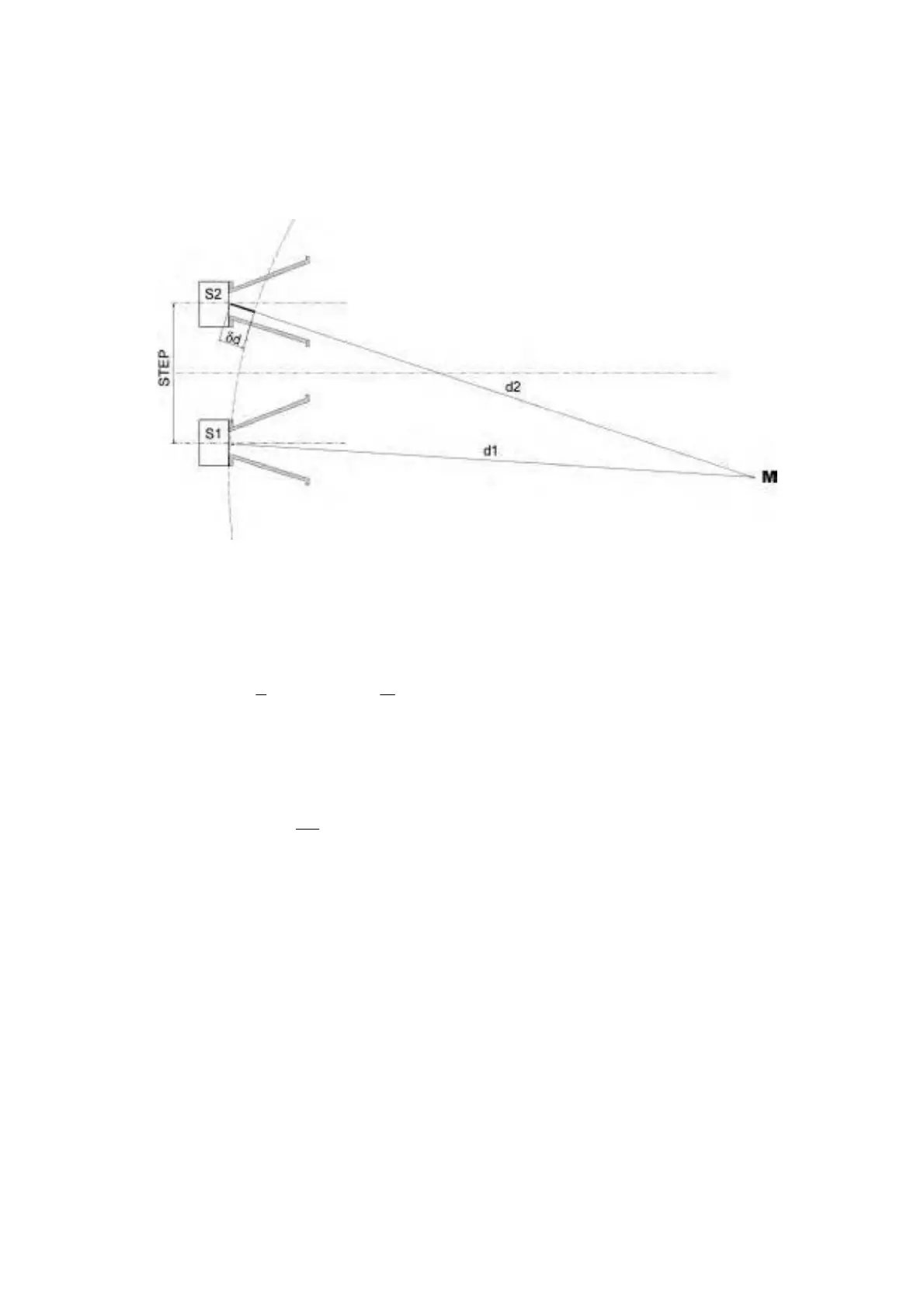
When two sources are physically separated, the different arrival times of the wavefronts
radiated by the individual sources cause frequency- and position-dependent constructive and
destructive interference.
Figure 101: The Interference Problem
If P
1
is the sound pressure produced by S
1
at point M, and P
2
the pressure produced by S
2
at
point M, the complex sound pressure P
m
resulting from the addition of the two speakers at point
M is calculated as:
If both sources radiate the same pressure P and the real part of the complex sound pressure at
M is considered at time t=t
1
=d
1
/c, the expression simplifies to:
where the path length difference d
2
-d
1
= δd.
From the simplified expression, it is seen that the second source causes a frequency dependent
phase shift given by: δϑ = 2π f δd/c. When δϑ=(2n + 1)π, where n=0,1,2,3…= integer,
pressure cancellations occur, since cos(2n +1)π = -1.
As a result, pressure cancellation occurs for frequencies that satisfy the condition:
2f δd/c = 2n + 1 where n is an integer.
δ
π+=
c
d
f2cos1P
P
m
e
P
e
P
P
c
d
2
tfj2
2
c
d
1
tfj2
1
m
−π−π
+=



 To Next Page