L-ACOUSTICS V-DOSC Manual Version 4 6/29/2005 Page 150 of 158
APPENDIX 5:
THE BORDER BETWEEN FRESNEL AND FRAUNHOFER
REGIONS
This appendix summarizes theory presented in “Sound Fields Radiated by Multiple Sound Source
Arrays”, AES preprint n°3269 (presented at the 92nd AES convention in Vienna, March 1992).
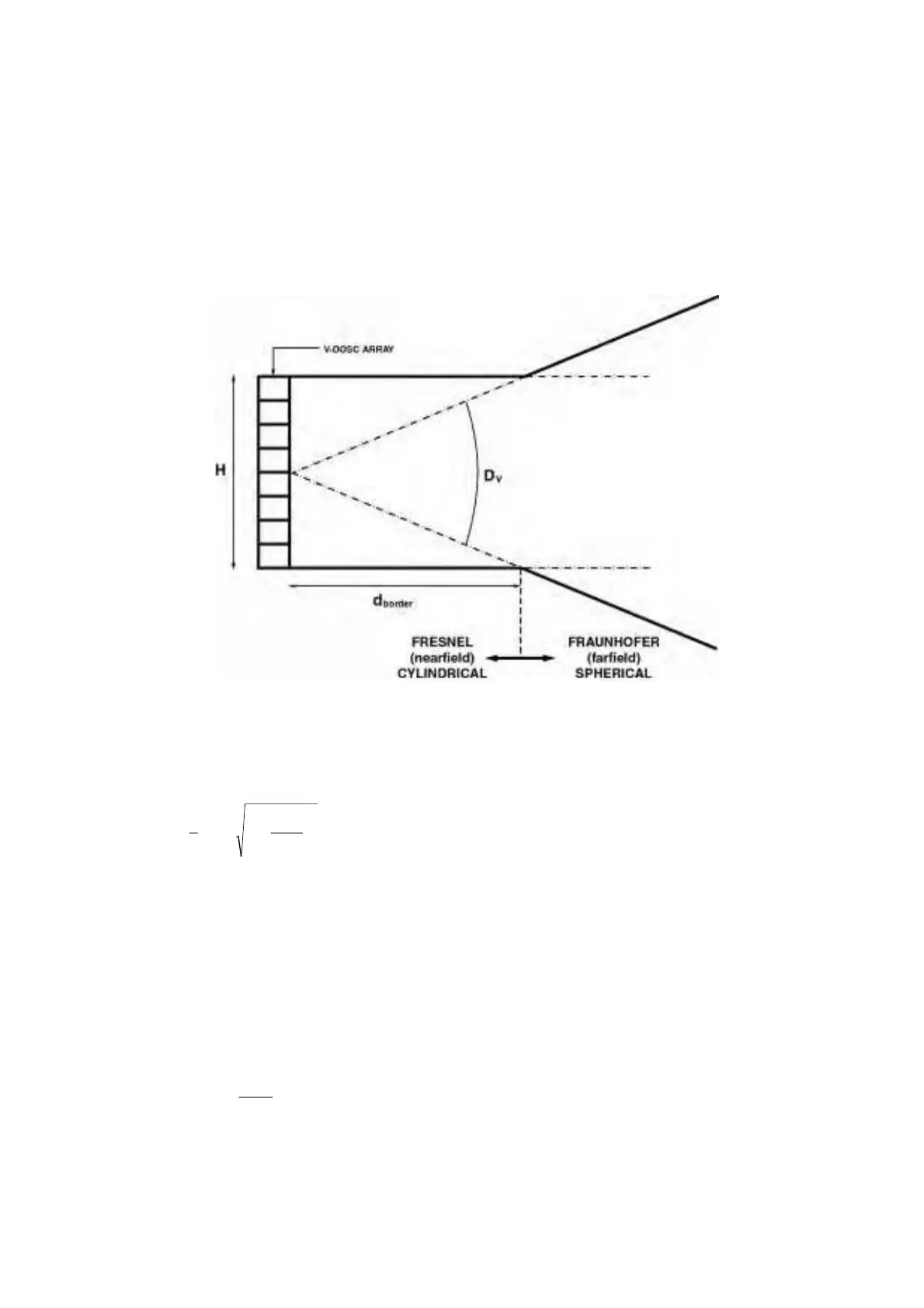
Let's assume that the V-DOSC array is flat and radiates a cylindrical wavefront. The emerging
wave will progressively expand to a spherical wave at a certain distance, which depends on both
the frequency and the height of the array.
Figure 111: Illustration of the Fresnel and Fraunhofer regions
The border between CYLINDRICAL (near field = Fresnel) and SPHERICAL (far field =
Fraunhofer) zones can be expressed as:
where:
H = height of the array (in m)
F = frequency expressed in kilohertz
d
border
= extension of the cylindrical soundfield with respect to the source (in m)
In the Fresnel region, the wavefront is cylindrical and expands only in the horizontal dimension
(nominally 90° for V-DOSC). The height of the wavefront is equal to the height of the array.
In the Fraunhofer region, the wavefront is spherical and expands in both horizontal & vertical
dimensions. The horizontal coverage angle is nominally 90° and the vertical coverage angle is
where D
v
is the vertical coverage angle angle in (°).
The two following tables display data for d
border
and D
v
, with respect to the number of
arrayed V-DOSC enclosures:
−=
HF3
1
FH
d
2
2
border
1
2
3
=
−
HF3
6.0
sin2
D
1
V



 To Next Page