1-2 Echo Liquid Handler User Manual
1.1 Acoustic Droplet Ejection
Acoustic droplet ejection (ADE) technology is the process of transferring
nanoliter volumes of liquid using acoustic energy. The Echo liquid handler
uses this technology to transfer fluid droplets from a source microplate to a
receiving surface.
The following is a simplified sequence of ADE events:
1. The Echo liquid handler creates an analog RF (radio frequency) wave.
2. The RF wave is amplified and transmitted to a focused acoustic
transducer, which transforms the RF wave into an acoustic pulse.
3. This acoustic pulse is transmitted into the fluid in the source
microplate well, causing the fluid to form a droplet that travels
upwards.
4. The droplet is captured by the receiving surface, which may be an
inverted destination microplate well or a flat substrate. Surface
tension of the fluid keeps it on the receiving surface.
For more information about Acoustic Droplet Ejection Technology, see
Appendix A
.
1.1.1 How does the Echo system work?
The Echo liquid handler uses the following basic steps to transfer liquid:
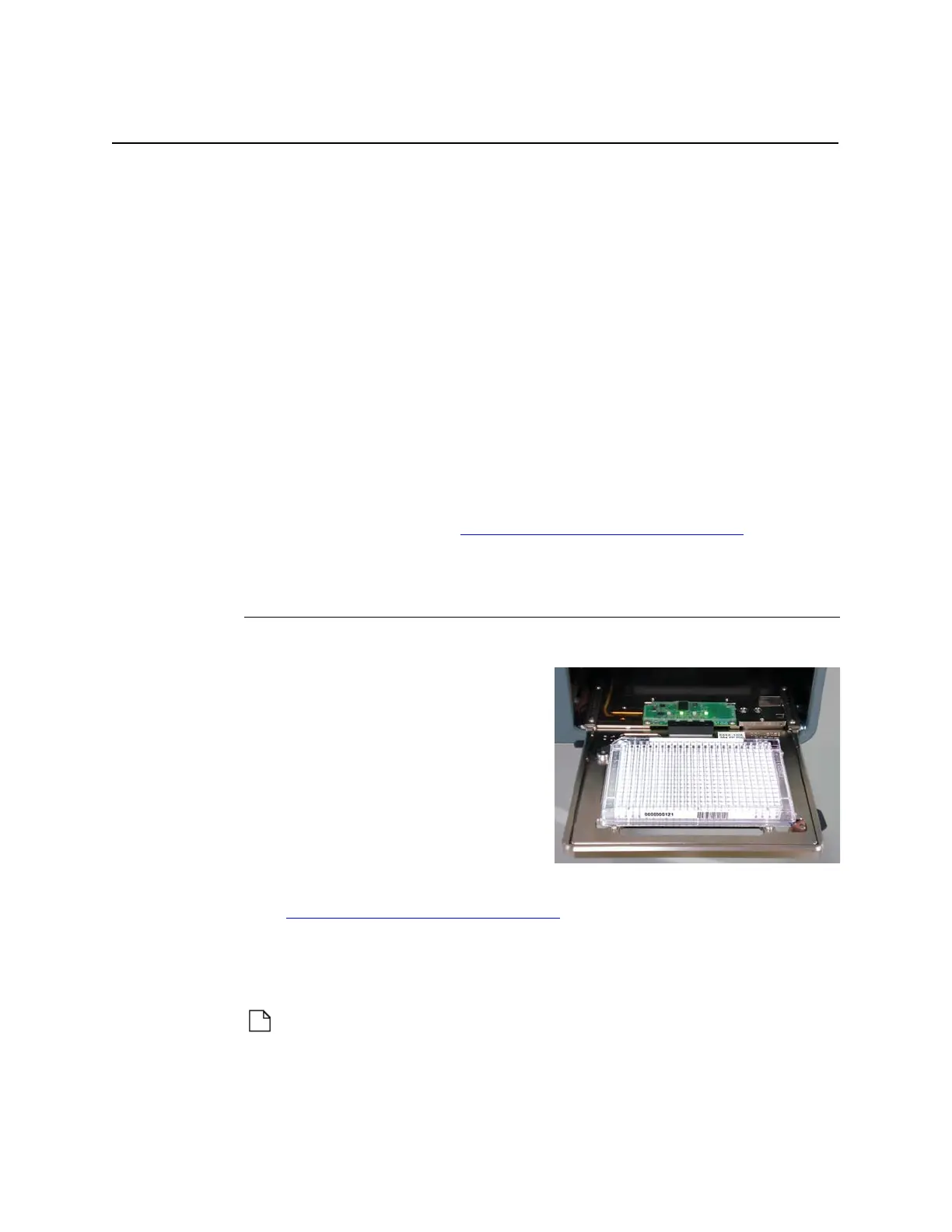
1. The robot (or operator) loads the
source microplate into the Echo
liquid handler. This step can also
be performed by a robot.
The Echo liquid handler retracts
the source microplate, then
surveys and measures the fluid
height in each well.
For aqueous solutions, the
reported value options will vary by fluid type. For more details, see
“
Diagnostic Survey” on page 5-39.
For DMSO-based solutions, the software reports DMSO/water
concentration (Echo 550 and Echo 555 only).
Note:
Loading source microplate



 To Next Page