EMERGENCIES
© 2003-2018 Ken Cook Co.
SECTION
4
Bass l
4 - 5
• The operator should immediately reduce speed and determine whether or
not to come to a full stop or circle around.
– If stopped, throw a flotation device (Type IV is best, but any can be
used) to the victim, shut down the engines, and throw the victim a line
if necessary.
– If circling around, assign one passenger to throw a flotation device as
a marker, keep the victim in sight and continuously point to the victim.
Carefully navigate back to the victim, staying at a safe distance, and
position the boat safely to retrieve the victim. Keep current, wind and
waves in mind so the victim drifts toward the boat. Shut down the
engines and throw the victim a line if necessary.
• Move passengers to the rescue side of the boat to assist the victim back
into the boat.
• Avoid going into the water to assist the victim unless there is no other way
to retrieve the victim. If a rescuer must go into the water, the rescuer
should be wearing a life jacket. The rescuer should also be prepared for
the possibility of being pulled under water by the victim if the victim is
panicking.
CAPSIZING AND FLOODING
A boat may capsize or flood when
least expected. Formulate a plan in
advance in case of capsizing or
flooding. Review the following
guidelines:
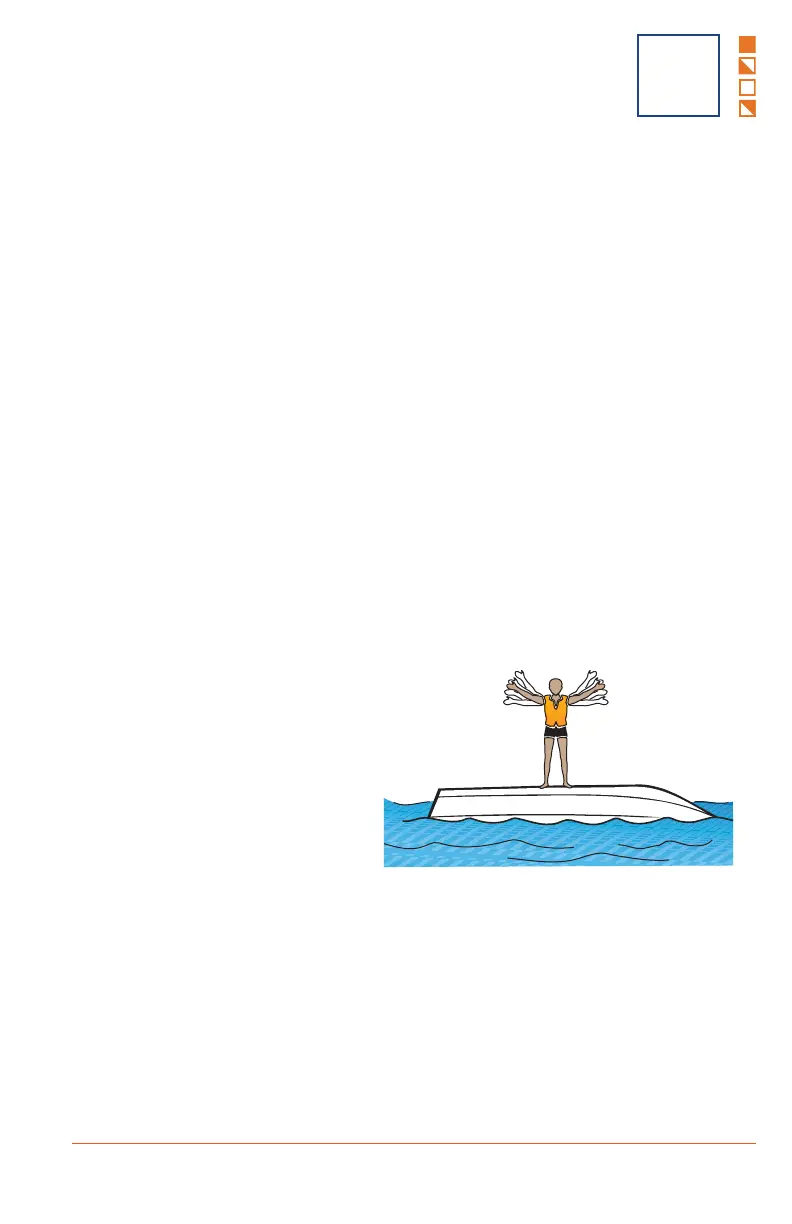
• If the boat capsizes, locate
all passengers and guide
them to a safe flotation
device or the forward hull if
the boat is floating upside
down.
• If possible, provide life jackets to all persons in the water and assess them
for alertness and injuries.
• STAY WITH THE BOAT! Climb up on the hull and try to get assistance.
• Do not try to swim to shore, as it can be farther than it appears.
If the boat starts to flood, slow the boat to a safe speed and stop as quickly as
possible. Activate the bilge pump(s) immediately. Try to locate the cause of the
flooding. If the cause is not readily apparent or not easily corrected, head for shore
or shallow water as quickly as possible and call for help.



 To Next Page