Need help?
Do you have a question about the Leckey Squiggles Stander and is the answer not in the manual?
Defines the product's purpose to assist children in standing, as part of a supported weight-bearing program.
Lists suitable conditions like Cerebral Palsy and age groups (1-5) for home or classroom use.
Classifies the stander as a Class I Medical Device, detailing compliance with EU/UK regulations and EN 12182.
Informs users to report serious incidents to the manufacturer and competent authorities.
Warns about toppling on slopes, finger entrapment in moving parts, and ensuring user security with harnesses.
Highlights finger pinch risks during adjustments and emphasizes daily component and operational checks before use.
Advises on trip hazards with powered chassis and safe cleaning methods using non-abrasive cleaners.
Explains warranty conditions, intended use, recommendations, and a three-year warranty period.
Recommends a written record for all setups, reissues, and annual inspections for this medical device.
Recommends training for users on specific manual sections by a competent person, with record-keeping.
Stresses reading instructions, never leaving users unattended, using approved components, and ceasing use if issues arise.
Details securing harnesses first, keeping tools away from children, and locking castors for stability.
Emphasizes locking angle adjustment levers and securing components within reach to prevent choking hazards.
Advises against use on uneven surfaces, keeping product away from heat, and regular cleaning with non-abrasive cleaners.
Lists conditions like spinal deformities, contractures, fracture risk, and pressure sores as precautions for use.
Identifies contraindications such as unresolved pain or severe hip/knee flexion contractures beyond the stander's limits.
Guides on carefully opening the box, verifying all parts, and notes the inclusion of a multi-tool for adjustments.
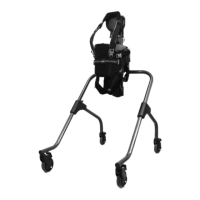
Explains folding/unfolding the Pivot Chassis for storage/transport, with finger safety precautions.
Details attaching the stander to the Pivot chassis, ensuring secure locking pin engagement.
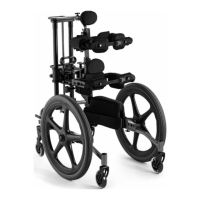
Guides on attaching the stander to the Easel chassis, including pedal and locking pin engagement.
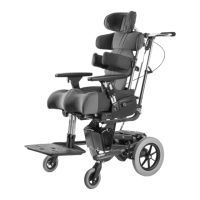
Explains attaching the stander to the Mobile chassis using pedal, locking pin, and central spine.
Guides on attaching the suspension system for different wheel sizes, using bolts and nuts.
Describes how to attach/remove wheels via a button mechanism, ensuring brakes are off.
Details attaching Leckey and Whitmyer head supports by releasing levers and securing the stem.
Explains inserting the attachment bolt and retention plate into sandals, fastening with screws.
Guides on placing sandals, securing with washers/knobs, and adjusting positions.
Details attaching tray arms to brackets, meshing plastic teeth, and ensuring alignment.
Explains how the tray cover clips onto the tray by placing it over the top.
Covers inserting tray tubes, tightening knobs, and ensuring cutout orientation for prone/supine use.
Describes inserting grab rail brackets, securing with knobs, and sleeving tubes into the structure.
Explains central placement, tab feeding, snapping fasteners, and Velcro attachment for cushions.
Details sliding cushions on, sleeve buckles through slots, and securing Velcro straps.
Describes clipping the chest support's male buckle into the female buckle of lateral supports.
Guides on sliding pelvic harness sides over supports, sleeving buckles, and securing with Velcro straps.
Explains attaching hip support around pelvic harness as an additional safety measure.
Details attaching knee pads by clipping buckles, ensuring correct orientation of the front cover.
Describes placing the spine cap over the support and looping plastic around adjustment knobs.
Explains placing cushion on head support plate and snapping fasteners.
Details attaching the flat headrest cushion by placing it on the support plate and snapping fasteners.
Guides on sliding lateral covers on and attaching Velcro straps.
Explains measuring child's height from feet to axilla to set chest support height.
Details adjusting overall height by loosening bolts, sliding stem, and retightening.
Describes adjusting chest/hip supports for angle/depth using knobs.
Explains loosening a knob to adjust lateral support width.
Guides on adjusting pelvic harness by pulling Velcro straps.
Details changing chest harness width via Velcro straps.
Explains raising sternum pad for thoracic extension or lowering chest support.
Describes independently positioning knee cups using knobs.
Guides on adjusting knee pads by lifting fabric panel and setting belt length.
Details adjusting headrest positions using hand knobs.
Explains adjusting lateral width of flat headrest using a plastic knob.
Guides on positioning feet in sandals and securing Velcro straps.
Describes setting footplate angle for plantarflexion/dorsiflexion using an allen bolt.
Details converting the stander from supine to prone standing.
Explains converting the stander from prone to supine standing.
Describes adjusting tray height using knobs on the central spine.
Guides on adjusting tray depth by sliding tubes and angle by setting the tray.
Outlines daily checks, locking castors, and releasing straps for safe transfers.
Explains opening chest/hip support harnesses by unclipping one buckle.
Details removing knee pads by unclipping buckles and ensuring plastic buckles are engaged.
Guides on positioning feet in sandals and securing Velcro straps.
Describes adjusting tray height using knobs on the central spine.
Guides on adjusting tray depth by sliding tubes and angle by setting the tray.
Explains setting grab rail depth by loosening a knob and height by sliding the rail.
Details adjusting mobile chassis angle by loosening knobs, pressing popper, and retightening.
Guides on adjusting suspension system height for larger wheels using nuts and bolts.
Explains how to lock/unlock brakes on the mobile chassis by pushing levers.
Describes adjusting pivot chassis angle by releasing a locking pin and pressing a lever.
Details adjusting easel chassis angle by loosening knobs, pressing poppers, and sliding tubes.
Explains folding the easel chassis flat for storage by adjusting the outer frame.
Recommends warm water and non-abrasive detergent for upholstery, using a 'wipe & dry' technique.
Advises soap/water or spray for daily cleaning, damp cloth for chassis, avoiding solvents.
Lists daily checks: knobs/bolts, upholstery, castors, and Velcro straps.
Outlines annual inspection of components, chassis mechanisms, and castors by a competent person.
Includes visually checking product structure for weld fatigue or cracking and maintaining inspection records.
Advises product assessment, compatibility checks, and technical inspection before re-issuing.
Recommends disinfecting products before re-issuing using automated systems or wipes.
States servicing must be done by trained, competent persons; directs international service enquiries.
Lists product/accessory codes for stander, chassis, and accessories like sandals, trays, headrests.
Provides codes for cushions, headrests, lateral supports, and wheels, noting colour options.
Lists ages, max user weight, user height, chest/hip dimensions, and chassis weights.
Details footplate angle capabilities and mobile chassis footprints with/without wheels.
Provides dimensions for pivot chassis angle, tray height, footprints, easel chassis, and support frame.
Explains symbols for Medical Device, Read Instructions, CE mark, Warning, Manufacturer, Serial Number, Product Code.
Defines symbols for Max occupancy weight, Date of Manufacture, Indoor use only, and Latex free.
Explains symbols for UDI, machine wash, tumble dry, do not iron, do not bleach, handwash, do not dry clean.
 General
| Product Type | Stander |
|---|---|
| Brand | Leckey |
| Model | Squiggles Stander |
| Foldable | No |
| Colors Available | Various colors |
| Wheel Options | Optional wheels available |
| Adjustability | Height adjustable |

 To Next Page