Sonicator Plus 930 Instruction Manual— Rev.J_09/13/17
43
Section 7—Ultrasound
Theory of Operation
7.1 Introduction to Ultrasound
Ultrasound is a form of acoustical vibration occurring at frequencies too high to be
perceived by the human ear. The limit for the audible range is at about 20 kHz.
Frequencies above this level are considered ultrasound. The range 700 kHz to 1.1 MHz
appeared during early investigative work to be best suited to clinical applications. Most
therapeutic ultrasound devices operate at frequencies within this range. Recent studies
have been conducted utilizing a frequency of 3 MHz. Since 3 MHz allows ultrasound
transmission only 1/3 the depth of 1 MHz, it has been used for the treatment of more
superficial structures.
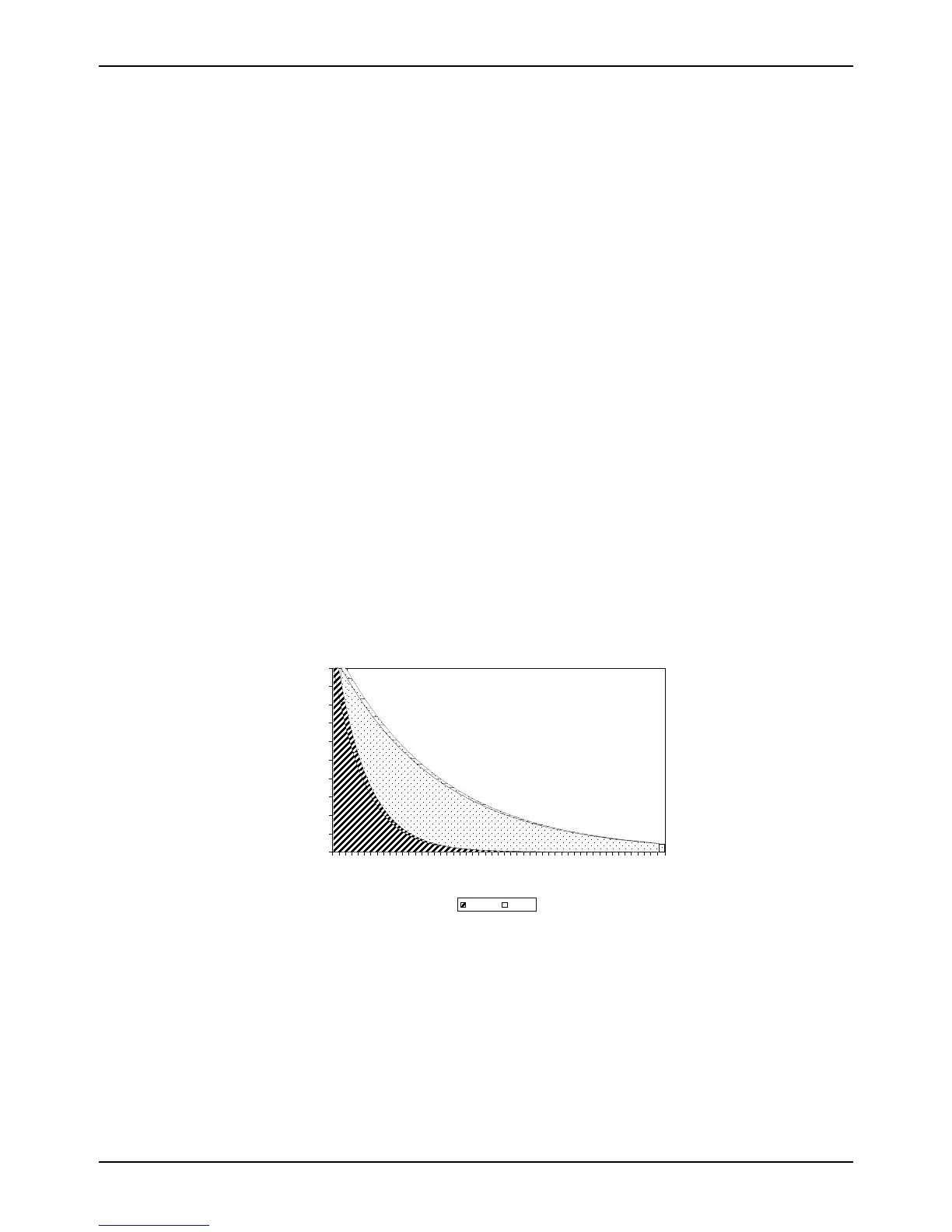
Figures 7.1, 7.2, 7.3 and 7.4 illustrate the relative depths of penetration of 1 and 3 MHz.
Since the body is actually composed of a variety of tissues, the depth of penetration will
depend on the amount of each tissue in the path of the ultrasound beam. Quite frequently,
the presence of bone in the ultrasound beam will be the limiting factor in determining the
actual depth to which the ultrasound beam will reach. This is best illustrated in Figure 7.4.
In the fingers and toes, ultrasound can pass around the bone to the opposite surface of the
digit. In this case, if the intensity is high enough, the patient may report heat or discomfort
on the surface opposite the ultrasound application.
012345
0
10
20
30
40
50
60
70
80
90
100
Ultrasound Remaining
Per Cent
Tissue Depth
Centimeters
3.3 MHz 1 MHz
Figure 7.1—Ultrasound Absorption, Skin



 To Next Page