Sonicator Plus 930 Instruction Manual— Rev.J_09/13/17
45
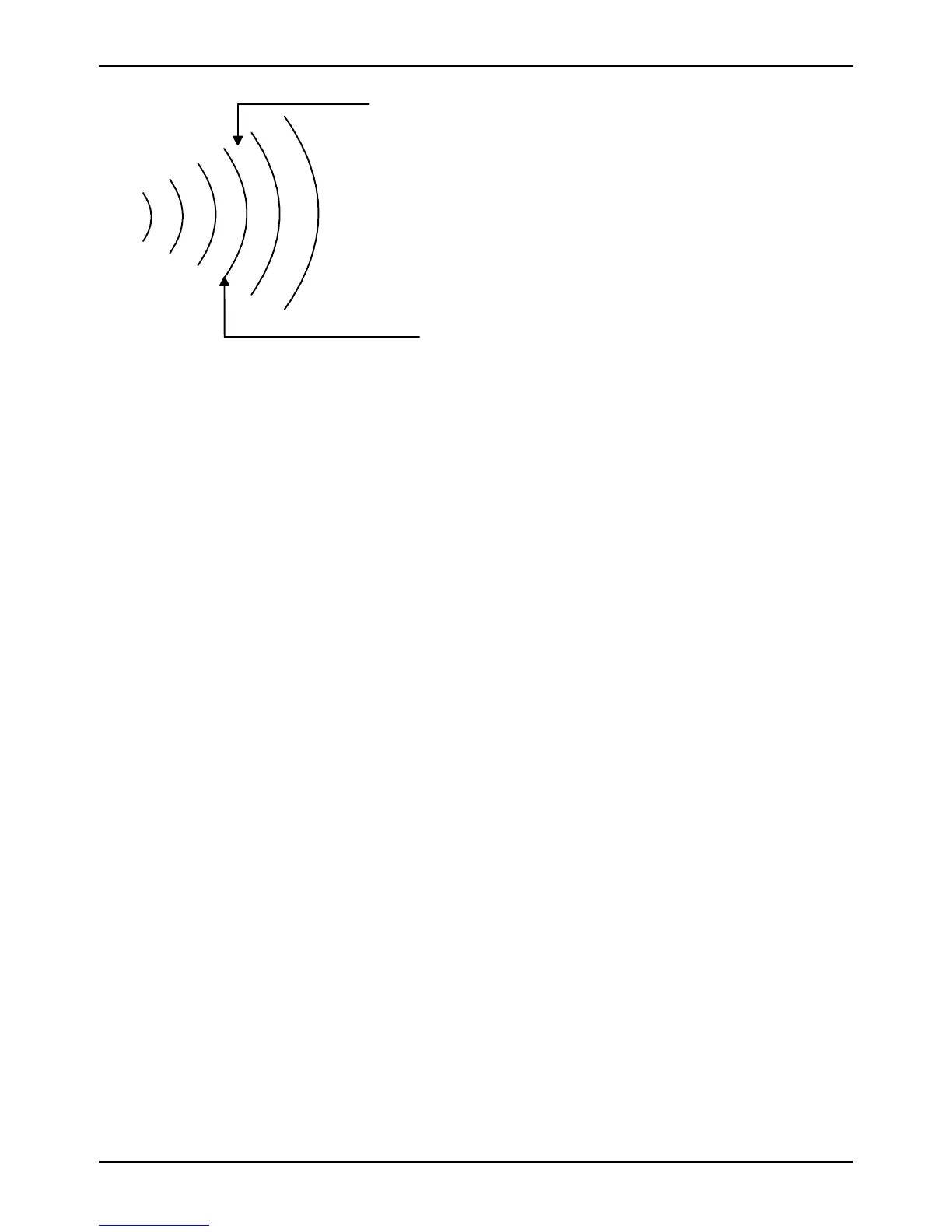
Areas of compression and rarefaction of the
molecules form high frequency sound waves.
Ultrasound exhibits certain beaming properties
and can be reflected, refracted, scattered or
absorbed. In passing through media, it is
attenuated and the absorbed energy is
transformed into heat. The attenuation coefficient
for longitudinal waves in liquid and soft tissues is
high, producing the phenomenon at bone surfaces
known as selective heating.
Figure 7.5—High Frequency Sound Waves
Clinical ultrasound is produced through the reverse piezoelectric effect. Electricity is
carried from a radio frequency source to an electrode in contact with the surface of a
specially cut crystal. The electrical charges applied to the crystal surface produce
mechanical vibrations, or the so-called reverse piezoelectric effect.
The crystal may be natural or synthetic and may be salt, quartz, polycrystalline or ceramic.
When this crystal is in resonance with the driving oscillator, optimum conversion from
electrical to mechanical energy is achieved. The Sonicator Plus 930 uses a barium titanate
ceramic for all of its transducers.
Ultrasonic power is expressed in watts (W), or watts per square centimeter (W/cm²).
Average intensity (W/cm²) is obtained by measuring the total output of the applicator (in
watts) and then dividing it by the size of the effective radiating area of the applicator. The
ERA (effective radiating area) is indicated on the label of each Mettler applicator. Please
note: the ERA is different from the overall dimension of the applicator face.
Ultrasound waves need a medium for their transmission and that is accomplished by
using a proper coupling agent. This coupling layer between the transducer and body
surface will assist in the propagation of the mechanical vibrations and prevent loss of
transmission.
Once the coupling agent is applied to the body surface, the applicator placed in contact
and the desired output selected in total watts, or watts per square centimeter, the
technique of application is by means of circular or stroking movement. In the circular
method, the sound head of the applicator is moved in slow and circular overlapping
movements. In the stroking, or “paintbrush” method, slow back and forth strokes are
used, again with slight overlapping. Motion with either technique should be slow enough
to insure proper energy absorption yet fast enough to eliminate excessive amounts of
absorption that could produce periosteal pain. Some references recommend that the
treatment area covered by this moving technique be two to three times the effective
radiating area of the transducer for every five minutes of exposure.
Compression
Rarefaction



 To Next Page