19
7.0 Batteries / charging
The Mini Crosser should be charged whenever it is not in use. The type of charger supplied by
the manufacturer is automatic – it disconnects once the batteries have been fully charged. The
charger only consumes current while the batteries are being charged. The charger can therefore
be left connected until the Mini Crosser is used again.
The charger will fl ash until it has fi nished charging. It will then be lit up continuously.
If the Mini Crosser is stored over a lengthy period of time, it is suffi cient to charge it once a
month. During storage the batteries must always be kept fully charged because they will be da-
maged by long-term storage in discharged condition.
On the next page you can see how to connect the charger to the scooter. Also refer to the manu-
facturer’s instructions for the charger in question, which explain how the charger shows that the
scooter is fully charged.
The Mini Crosser scooter uses closed, maintenance-free GEL batteries (Exide 12 V/56 Ah or
Trojan 12 V/71 Ah). They do not normally give off any gas, and must not be fi lled with water. Only
GEL-type batteries may be used for Mini Crosser T models.
Please note that the capacity of the batteries declines over time and at low temperatures. In prac-
tice, this means that a vehicle with old batteries will have a lower range than when its batteries
were new.
Battery capacity at -10˚C is about half the corresponding capacity at +20˚C.
The battery manufacturer recommends that batteries should be charged at a temperature from
+10˚C to +30˚C to achieve the charging time stated under “Technical Data”. Charging time is
about 60% longer at a temperature of 5º Celsius by comparison with charging at 20˚ Celsius. This
is because from a purely chemical point of view it is more diffi cult for batteries to absorb current
at low temperatures. To prevent batteries from running down completely, we recommend char-
ging them in a heated room. If this is not possible every day, it is a good idea to charge your Mini
Crosser in a heated room once a week.
New batteries do not achieve their full capacity until they have been run down and re-charged
about 20 times.
Used batteries should be given to your supplier or the local environmental waste disposal facility.
Be careful how you handle leaky batteries – they contain corrosive acids bound in a gel substan-
ce.
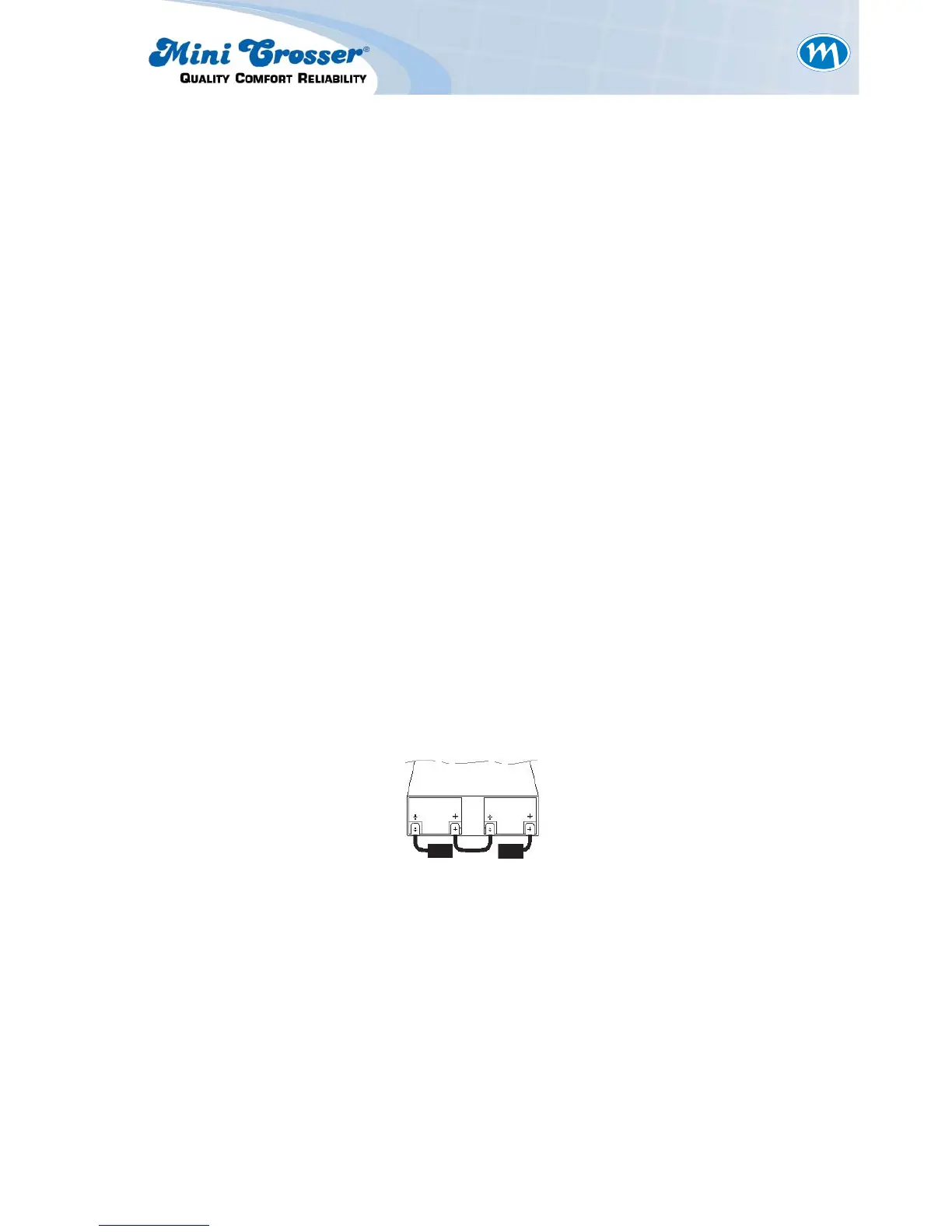
It is important to install the batteries correctly. Battery poles and snap locks are marked +/-. They
should be installed as shown in the sketch below. Make sure that the snap locks are closed pro-
perly. For the same reason the poles must not be burred.



 To Next Page