6.
NORME DI FUNZIONAMENTO • OPERATING PROCEDURES
ENGLISHITALIANO
- 148 -
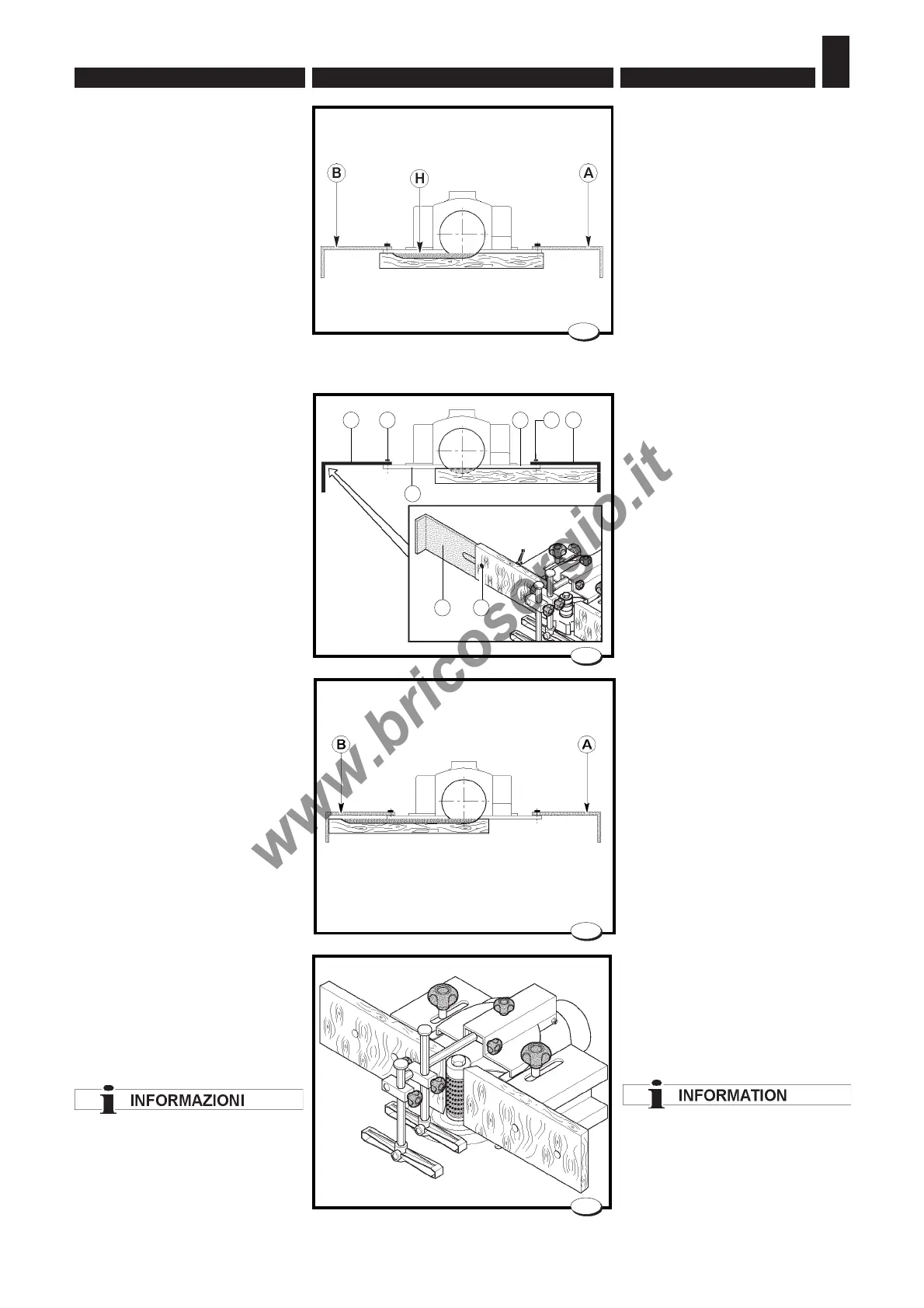
Per fresature non passanti (H fig.29
) e lavorazioni di pezzi corti, è indi-
spensabile creare sulla guida in in-
gresso e su quella in uscita, delle
battute antirigetto A e B (non in do-
tazione).
Queste devono essere fissate con
le viti C sulle guide D (fig. 30).
Per la lavorazione operare nel se-
guente modo:
– predisporre la macchina;
– avviare l'albero toupie;
– appoggiare il legno contro la bat-
tuta A e spingerlo contro la fresa;
– avanzare con il pezzo fino alla
battuta B (fig. 31).
Levigatura (fig. 32)
Questa lavorazione richiede bas-
se velocità di rotazione dell'albero
toupie.
Questa è l'unica lavorazione che
va eseguita con una velocità di
rotazione di 1400 / 1700 giri/
min.
63_062_0.tif
31
028_108_0.tif
C C AB
D
C
•
B
32
028_107_0.tif
30
For dead milling cuts (H fig. 29)
and the machining of short pieces,
it is necessary to fit the stops A
and B (not supplied) onto the input
fence and the half–fence.
The stops must be fastened
ontothe fences D by means of the
screws C (fig. 30).
To perform the machining,
proceed as follows:
– prepare the machine;
– start the moulder shaft;
– rest the wood piece against the
stops A and push it against the
milling cutter ;
– move the piece forward to the
stop B (fig. 31).
Sanding (fig. 32)
This operation requires low
moulder spindle rotation speed.
T
his is the only machining
which should be carried out at
a revolving speed of 1400 /
1700 r.p.m.
29
63_061_0.tif
D


 To Next Page