20 MCP15-500.7
Refrigerant charge can be verified by checking both superheat
and subcooling. B- and C-Cabinet units have one circuit and
D-Cabinet units have two circuits. The following procedure is
to be done for each refrigeration circuit.
1. Check the evaporator coil to be sure there are no
obstructions to airflow.
2. From the Modine Control System controller interface,
create a call for cooling. If the unit has the hot gas reheat
option, the hot gas reheat valves must be closed.
3. The unit must be operated at near to full load operation
before checking the refrigerant charge. The unit operation
should be stabilized, typically after 10-15 minutes of
operation.
4. Measure subcooling as follows:
a. Read the gauge pressure at the liquid line test port (refer
to the figures on pages 32 through 35). Note the
saturation temperature on the gauge.
b. Measure the temperature of the liquid line at a point
near where the pressure reading was taken.
c. Subtract the measured liquid line temperature from the
saturation temperature to determine the liquid
subcooling. For units without the hot gas reheat option,
the subcooling should be 10-15°F. For units with the hot
gas reheat option, the subcooling should be 5-15°F.
5. Measure the superheat as follows:
a. Read the gauge pressure at the suction line close to the
compressor. Note the saturation temperature on the
gauge.
b. Measure the temperature of the suction line at a point
near where the pressure reading was taken.
IMPoRtANt
1. All refrigeration checks must be made by a qualified
R-410A refrigeration technician.
2. Do not release refrigerant to the atmosphere. When
adding or removing refrigerant, all National, State/
Province, and local laws must be followed.
WARNING
Do not overcharge the refrigeration system. This can lead
to elevated compressor discharge pressure and possibly
flooding the compressor with liquid.This may result in
compressor failure not covered under warranty.
CAUtIoN
START-UP PROCEDURE - CONTINUED
Checking Refrigerant Charge
This unit contains R-410A high pressure refrigerant.
Hazards exist that could result in personal injury or death.
Installation, maintenance, and service must only be
performed by an HVAC technician qualified in R-410A
refrigerant and using proper tools and equipment. Due to
much higher pressure of R-410A refrigerant, DO NOT USE
service equipment or tools designed for refrigerants other
than R410A.
WARNING
c. Subtract the saturated temperature from the measured
suction line temperature to determine the evaporator
superheat. The superheat should be 8-12°F.
6. Determine if the system is undercharged or overcharged
and correct as follows:
a. Undercharged: Typically, superheat is too high and
subcooling is too low. Refrigerant should be added.
b. Overcharged: Typically, superheat is too low and
subcooling is too high. Refrigerant should be removed.
7. After adding or removing refrigerant, allow the system to
stabilize for 10-15 minutes before making any other
adjustments.
8. Repeat the steps above until the subcooling and superheat
are within the range specified.
9. Repeat the above procedure for the 2nd circuit on
D-Cabinet units.
10. Once the correct charge has been established, operate the
unit reheat mode to verify correct operation.
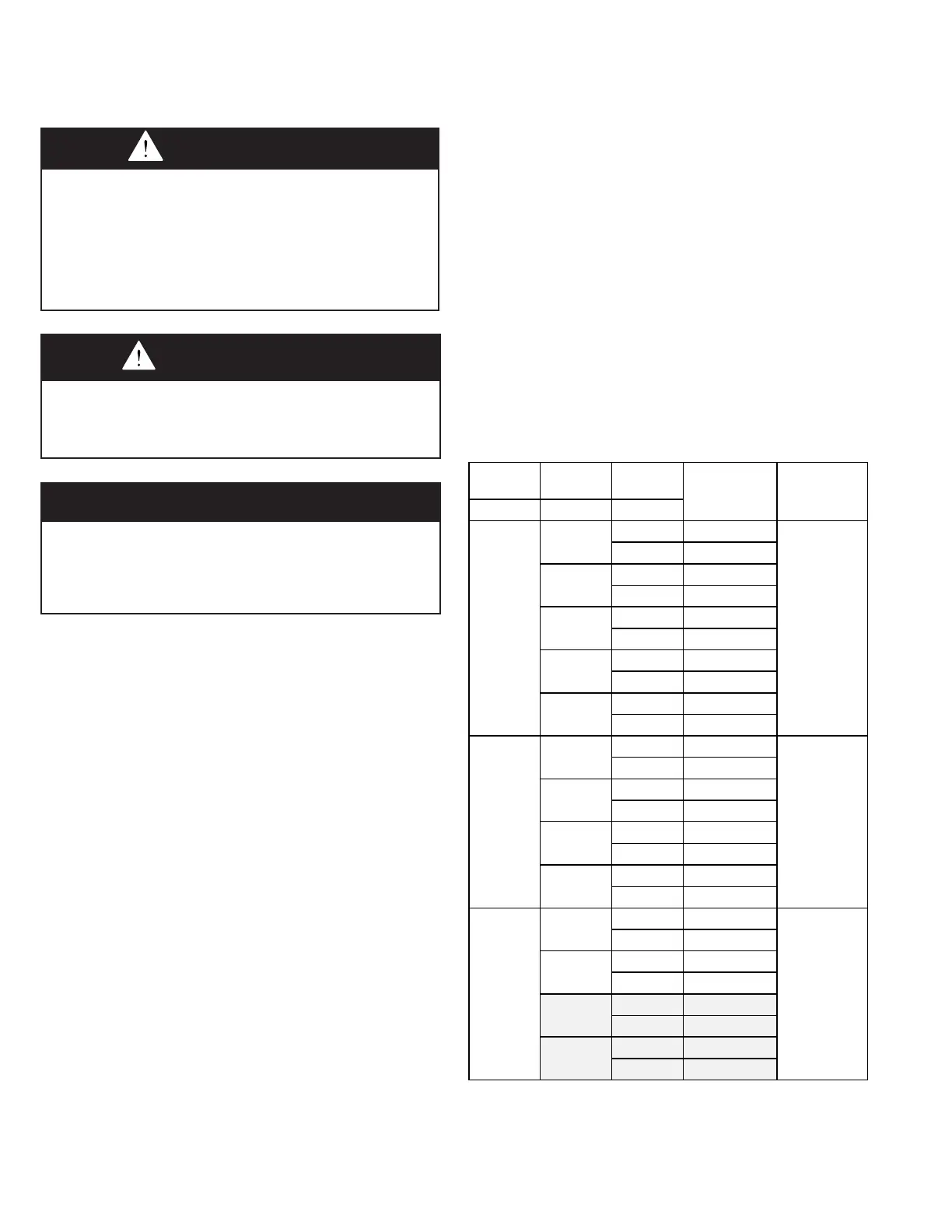
Table 20.1 - Refrigerant Charge
Casing Size Unit Tons
Hot Gas
Reheat
Refrigerant
Charge per
Circuit (lbs.) # of CircuitsDigit 6 Digits 4-5 Digit 10
B
07
0 17.0
1
1 or 2 20.0
10
0 17.0
1 or 2 20.5
13
0 23.0
1 or 2 28.5
15
0 24.0
1 or 2 28.5
20
0 28.5
1 or 2 35.5
C
15
0 35.0
1
1 or 2 39.0
20
0 37.0
1 or 2 42.0
26
0 38.0
1 or 2 44.0
30
0 39.0
1 or 2 46.0
D
30
0 34.5
2
1 or 2 45.0
40
0 36.0
1 or 2 46.5
52
0 Future
1 or 2 Future
60
0 Future
1 or 2 Future


 To Next Page