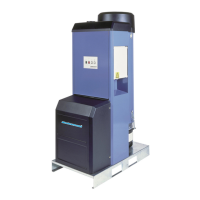
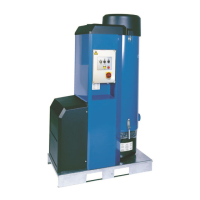
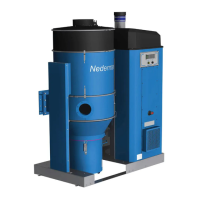
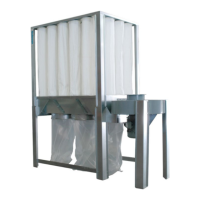
E-PAK 500EN
24
The E-PAK 500 start and control unit is prepared for the connection of external accessories
or signals. The signals/accessories are connected according to the electric circuit diagram, see
Figure 17. See also ‘Table 5-1: Accessory terminals’.
The most common accessory is a PS cable, which allows remote start/stop signalling from the
valves on the duct system.
Table 5-1: Accessory terminals
Terminal Accessory/function description
1–2
Permanent 24 V AC of external equipment
3–4 Pilot signal
5–6 Remote start/stop
9–10
CompressedAirSwitch(CAS)
11–12 External emergency stop
23–24 Remote run indicator
25–26 Remote alarm output (red fault indicator light)
6 Before installation
WARNING! Risk of personal injuries.
Always use proper lifting and protective equipment.
WARNING! Risk of tipping.
Consider the centre of gravity and attachments during transport.
NOTE! Always follow local regulations and legislation for all steps of the installation process.
NOTE! Fill in the installation protocol during installation,
see ‘Appendix A: Installation protocol’.
NOTE! Make a layout for the entire system before installing E-PAK 500.
6.1 Delivery checks
Check the unit for any transport damage. In case of damage or parts missing, notify the carrier
and your local Nederman representative immediately.
6.2 Installation requirements
6.2.1 Location
Prepare the location where E-PAK 500 is to be placed before installation.
NOTE! E-PAK 500 needs approximately 1.0 m of free space above the top to facilitate
replacing of the main lter.
NOTE! Keep the area around the unit free to facilitate access to the collector bin, see Figure 2.
6.2.2 Foundation
The unit is to be anchored to a hard, level and rm foundation, such as a reinforced concrete
foundation.
Consider the following when calculating the foundation or supporting structure:
• The total weight of E-PAK 500 with accessories, see
Section ‘4.3 Technical and electrical data’.
• Max. weight of the collected material.


 To Next Page
 Loading...