Driving and operating 161
Regeneration on demand
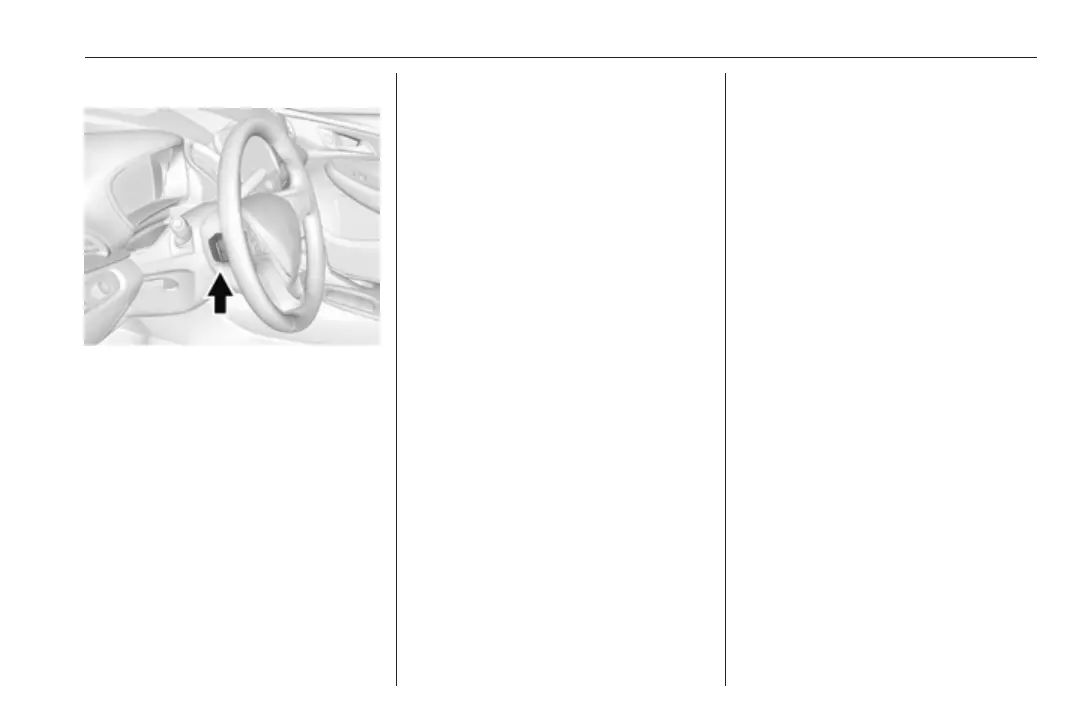
Regeneration on demand allows
increased deceleration by pressing
and holding the steering wheel
paddle. It works in D (Drive) and L
(Low). The accelerator pedal must be
mostly released for it to work.
If regenerative braking is active, the
regenerative active icon with arrows
is shown as green. Regenerative
braking 3 77.
Cruise control will switch off and the
brake lights may come on when this
feature is activated.
If the vehicle is in D (Drive) and is
brought to a complete stop while the
regenerative braking paddle is held,
the vehicle will not creep forward
when the paddle is released. The
accelerator pedal must be pressed to
move the vehicle forward. Refer to
"One-pedal driving” in Electric drive
unit 3 155.
If the vehicle is on a steep gradient,
the brake pedal will be required to
hold the vehicle.
The brake controller applies the
hydraulic brakes using a pump. You
may hear the pump during some
braking manoeuvres, such as rapid
brake application or during
regenerative braking as the vehicle
comes to a stop. This is normal
operation.
Hill Top Reserve
Hill Top Reserve enables you to
maximise regenerative braking
efficiency when driving from a higher
elevation immediately after charging.
When switched on, this feature will
stop the charging process before the
high voltage battery is full, allowing
space for energy from regenerative
braking.
This feature also integrates with the
Location-based charging feature,
allowing you to configure the system
so it is enabled when you are at home
(On – home only) or away (On – away
only). See "Location based charging"
in Programmable charging 3 197.


 To Next Page