Pulsar
2
Service Manual
OPTIKON 2000
Cod. 111004SEN
Rev.C
5-6
5.2 CONTROL BOARD 393200
The 393200 Control board schematics have been logically divided in five sheets:
1. Sheet 1/5 and 2/5 contain the logic part of the board:
- The main microprocessor 18F6520 with its reset circuitry. The 18F6520 is a
powerful single chip processor produced by Microchip. It includes EEPROM for the
control software and for the calibration data, CMOS static RAM, a TTL RS232 high
speed serial interface (used to interface to the GUI), internal timers and oscillators
to generate PWM analog outputs, 8 analog inputs and over 40 digital I/O lines. This
powerful LSI microprocessor integrates in one chip what would require a full board
of standard electronics.
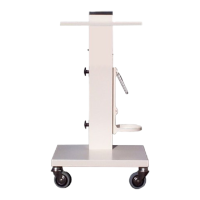
- The I.V. pole interface: the trolley is connected to 15-pin D-sub connector located
on rear panel. Signals exchanged with trolley enter J3 connector of Control board.
Bottle UP control is connected to RC1 bit, whereas DOWN is connected to RC2 bit. A
potentiometer connected to the pole motor reads the pole position. Potentiometer
is powered by Varef., equal to approx. 4.1 V. The potentiometer cursor is read by
microprocessor at AN1 analog input.
- An internal timer of the microprocessor is used to generate the variable frequency
sound associated with the vacuum level.
- The voice processor ISD1730, this voice synthesis circuit allows sending messages to
loudspeaker. Messages are factory-recorded and stored in U2. Microprocessor sends
to the ISD1730 the address of message to be output and U2 delivers an end-of-
message (EOM) signal when the message is over. SP+/- (speaker) lines, are connected
to the loudspeaker via J8 connector. The volume potentiometer, connected to the
same J8 connector, controls the output audio level.
2. Sheet 3/5 contains a series of optocouplers designed to electrically separate the
signal circuitry of the microprocessor from the power Darlington transistors that
drive the various valves of the PULSAR2.
3. Sheet 4/5 contains:
- The electronic driver of the peristaltic pump. The pump is driven by a 12Vdc motor
connected to J12. Q12 (TIP 122) delivers current to the motor for pump rotation
while Q11 (IRF520) short circuits the motor for an immediate pump stop. Speed
control is implemented by U18A: the resistor R64 in series to the motor and resistor
R52 for positive feedback at non-inverting input of U18A act in order that if motor
current consumption increases, the motor driving voltage increases as well (motor
torque control). The microprocessor sets the pump speed by Pulse Width Modulation:


 To Next Page