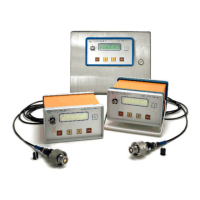
3600 Analyzer for O
2
Measurement—Operator’s Manual 21
3600O2.OM.E9903
Use the “ñ” or “ò” arrow keys to increase or decrease the highlighted digits, and
then press “ENTER” to move to the next digit. First, set up all of the significant
digits of the desired limit without regard for the position of the decimal point or
units. Once the fourth digit is set, press “ENTER” to see the following screen:
H = 43.21 ppm 3
UP/DOWN MODIFIES
In this menu, “H” represents the High Limit value. The rightmost digit on the top
line indicates which range is affected: 1 refers to the lowest range, 2 to the second
range, and so on. Use the “ñ” or “ò” keys to modify this setting, and then press
“ENTER” to save your selection.
The instrument then proceeds to the second set of limit menus (Low Limit in our
example; in the last screen, “L” represents the Low Limit). After you enter the
second limit, the instrument returns to the “Modify Options” menu.
For the “High/High” configuration selection, menu operation is as above, except
that the menus use the abbreviations “H” (for High Limit) and “HH” (for High-
High Limit) in place of the “L” and “H”.
1.4.3.1 Alarms Description
Two alarm relays are provided (“C” and “C1”) in certain instrument models. The
alarms configuration (High/Low, High/High, or General), set using the above
“Alarm Outputs” menus, determines the manner in which the alarm relays
respond to various system or measurement conditions. These alarm conditions
and alarm relay responses are shown in the following table. Note that certain alarm
conditions set both alarm relays.
Configure Condition “C” relay “C1” relay
High/Low No alarm: low limit < O
2
concentration < high limit
Low alarm: O
2
concentration < low limit
High alarm: high limit < O
2
concentration
High/High No alarm: O
2
concentration < high limit
High alarm: high limit < O
2
conc. < high-high limit
High/High alarm: high-high limit < O
2
conc.
General Normal Measurement operation
Overrange, Thermal cutoff, Negative gas signal, Sensor
disconnected, Instrument switched off, or not in
Measurement
Note: This table shows the alarm relay response for the normally open (NO) contacts of each relay
= relay closed, = relay open; the normally closed (NC) contacts are the
reverse state of those shown above.
After a Low, High, or High-High alarm condition is signaled, the instrument clears
the Low alarm when the measured O
2
concentration rises to 1% above the low
limit, or clears the High or High-High alarm when the gas concentration drops to
1% below the high or high-high limit respectively.
See section 2.1.4.5 for alarm relay contacts wiring identification.
1.4.4 Analog Outputs
The instrument provides several analog output signals representing sample
measurements (see section 1.4.4.1 for description of these analog outputs). The
Analog Outputs menus scale the O
2
concentration output signal between any two
custom concentration limits, for use with external equipment such as recorders.


 To Next Page
 Loading...