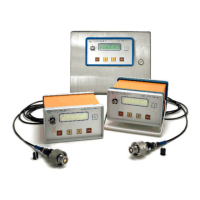
62 3600 Analyzer for O
2
Measurement—Operator’s Manual
3600O2.OM.E9903
Standard Sensor Cable Specifications
Casing Fire-retardant Elastolan
Maximum Temperature 80°C
Cable Diameter 6.1 mm ±0.3 mm. 10 each stranded wires of 26 AWG,
individually insulated with polyethylene, 90% shielded by
tinned copper braid.
Maximum Pulling Tension 7 kg
Resistivity 138 Ω /km
Minimum Bend Radius 15 times cable diameter
3.2 Principle of Operation
The oxygen sensor circuitry performs four functions:
• Applying a constant voltage to the anode,
• Measuring the current flowing through the sensor,
• Compensating this current for sample temperature variations,
• Converting these resulting signals into a scaled current or voltage.
The anode is held positive with respect to the cathode. Current flowing through
the sensor due to oxygen reduction at the cathode is converted to a voltage by an
amplifier, the proportionality between voltage and current being determined by the
feedback resistance of this amplifier.
The output voltage is essentially a function of oxygen activity (partial pressure),
temperature, and membrane permeability. Corrections for variations in membrane
permeability are made when the sensor is calibrated. The temperature
compensation circuit takes care of temperature variations. Hence, the output
voltage varies only with oxygen concentration.


 To Next Page
 Loading...