7
2.1. Disposal information
Units must be disposed of in accordance with local regulations
Information for Users on Collection and Disposal of Old Equipment and Used Batteries
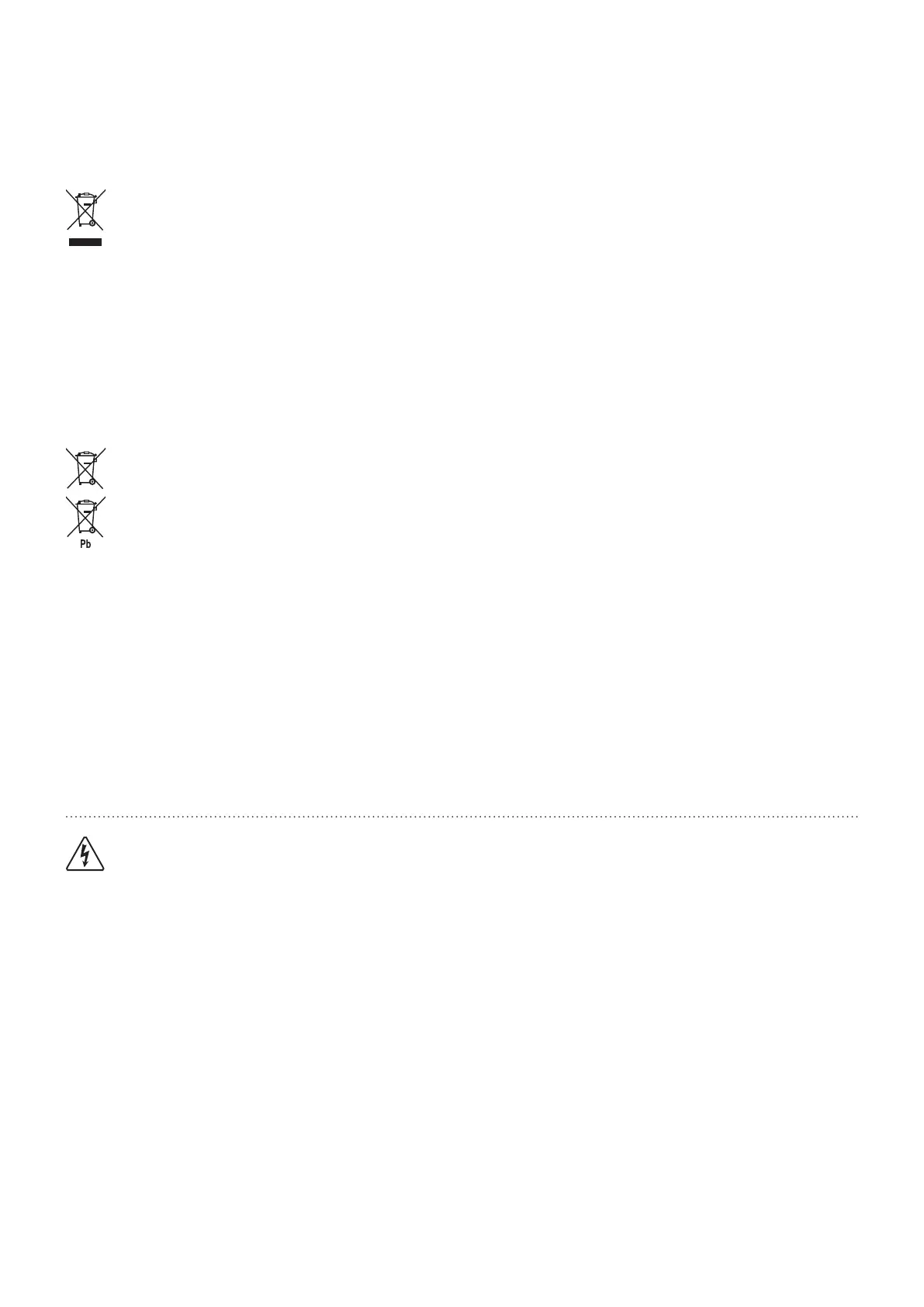
These symbols on the products, packaging, and/or accompanying documents mean that used electrical and electronic products and
batteries should not be mixed with general household waste.
For proper treatment, recovery and recycling of old products and used batteries, please take them to applicable collection points, in
accordance with your national legislation and the Directives 2002/96/EC and 2006/66/EC.
By disposing of these products and batteries correctly, you will help to save valuable resources and prevent any potential negative
effects on human health and the environment which could otherwise arise from inappropriate waste handling.
For more information about collection and recycling of old products and batteries, please contact your local municipality, your waste
disposal service or the point of sale where you purchased the items.
Penalties may be applicable for incorrect disposal of this waste, in accordance with national legislation.
For business users in the European Union
If you wish to discard electrical and electronic equipment, please contact your dealer or supplier for further information.
[Information on Disposal in other Countries outside the European Union]
These symbols are only valid in the European Union. If you wish to discard these items, please contact your local authorities or dealer
and ask for the correct method of disposal.
Note for the battery symbol (bottom two symbol examples):
This symbol might be used in combination with a chemical symbol. In this case it complies with the requirement set by the Directive
for the chemical involved.
3. Warranty
The appliances are delivered fully assembled, factory tested and ready to operate.
Any modifi cation to the units without the manufacturer’s prior approval, shall automatically render the warranty null and void.
The following conditions must be respected in order to maintain the validity of the warranty:
• Commissioning shall be performed by specialised technicians from technical services approved by the manufacturer.
• Maintenance shall be performed by technicians trained for this purpose.
• Only Original Equipment spare parts shall be used.
• All the operations listed in the present manual shall be performed within the required time limits.
THE WARRANTY SHALL BE NULL AND VOID IN THE EVENT OF NON-
COMPLIANCE WITH ANY OF THE ABOVE CONDITIONS.
4. Presentation
All the models in the ECOi-W liquid coolers range are produced to state-of-the-art design and manufacturing standards.
In this way, they offer guarantees of high performance and reliability as well as the capability of adapting to all types of air
conditioning installations operating with both chilled water and glycol solutions (and with hot water for the Heat pump units).
The unit, designed for an outdoor mounted application, is not suitable for any use other than those specifi ed in the present
manual. Improper usage of the unit or a use for purposes other than those originally intended, without the prior approval by the
manufacturer or its agents, could result in the unit functioning outside its safe operating limits and could present risks to both
personnel and property.
ECOi-W are packaged units, optimized for air conditioning applications.
After the units are assembled, the refrigerating and electrical circuits are tested at the factory in order to guarantee correct
operation. The units are fi lled with an operational refrigerant fl uid charge and are subjected to pressure tightness tests.
In cooling operation, the units can produce chilled water at temperatures varying between +18°C to +5°C or chilled water/
glycol solution at temperatures varying between +5°C to -10°C.
For heating operation, the units can produce hot water at temperatures varying between +20°C and +50°C.



 To Next Page