EasyManua.ls Logo

Piper Cherokee Six - Page 131

Piper Cherokee Six
721 pages
Print Icon
To Next Page IconTo Next Page
To Previous Page IconTo Previous Page
Loading...
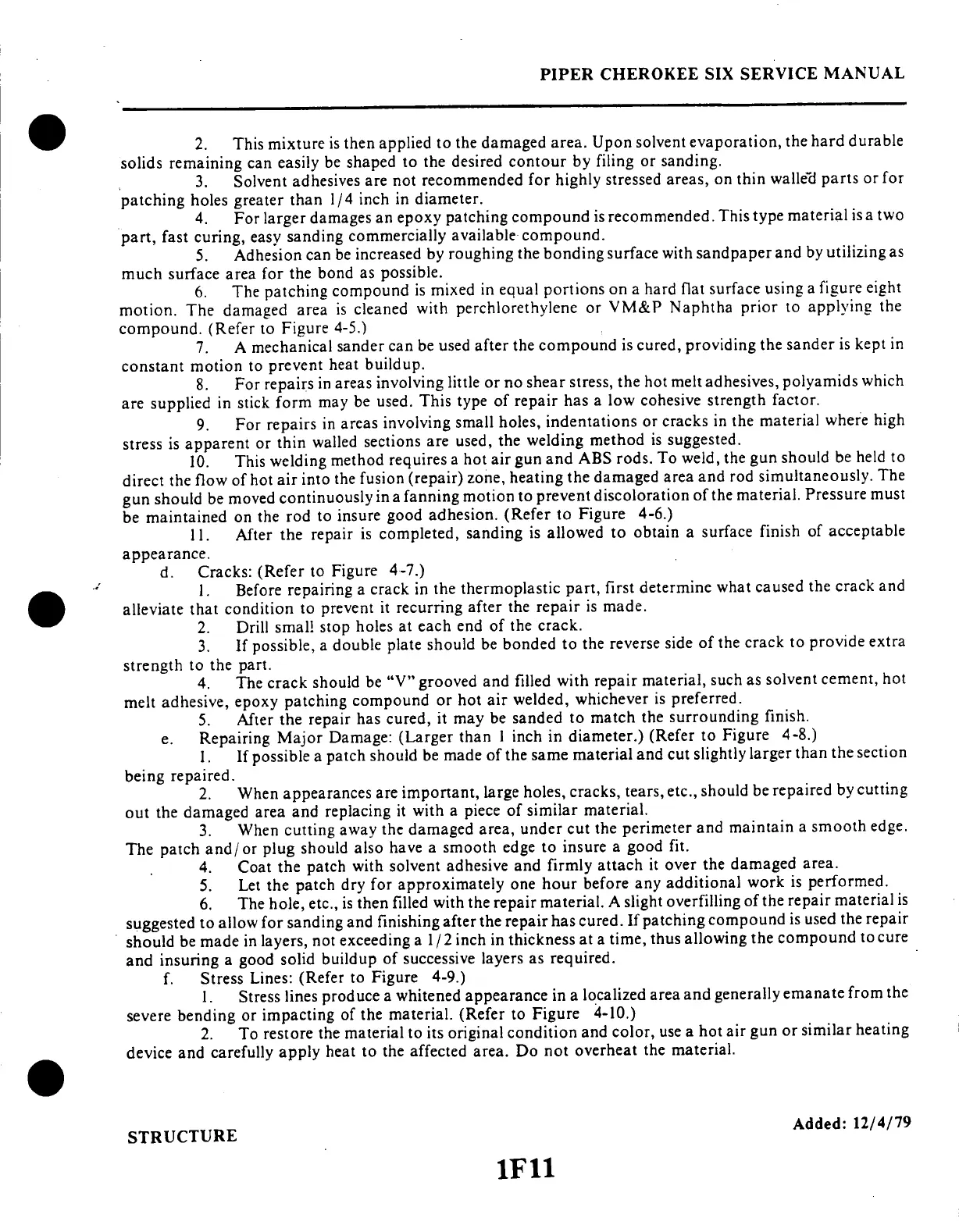
2.
This
mixture
is
then
applied
to the
damaged
area.
Upon
solvent
evaporation,
the
hard
durable
solids
remaining
can
easily
be shaped
to the
desired
contour
by
filing
or
sanding.
3.
Solvent
adhesives
are
not
recommended
for
highly
stressed
areas,
on
thin
walled
parts
or
for
patching
holes
greater
than
1/4
inch
in
diameter.
4.
For
larger
damages
an
epoxy
patching
compound
is
recommended.
This
type
material
is a
two
part,
fast
curing,
easy
sanding
commercially
available
compound.
5.
Adhesion
can
be
increased
by roughing
the
bonding
surface
with
sandpaper
and
by
utilizing
as
much
surface
area
for
the
bond
as
possible.
6.
The
patching
compound
is
mixed
in
equal
portions
on
a hard
flat
surface
using
a
figure
eight
motion.
The
damaged
area
is cleaned
with
perchlorethylene
or
VM&P
Naphtha
prior
to
applying
the
compound.
(Refer
to Figure
4-5.)
7.
A
mechanical
sander
can
be
used
after
the
compound
is cured,
providing
the
sander
is
kept
in
constant
motion
to
prevent
heat
buildup.
8.
For
repairs
in
areas
involving
little
or no
shear
stress,
the
hot
melt
adhesives,
polyamids
which
are
supplied
in stick
form
may
be
used.
This
type
of
repair
has
a low
cohesive
strength
factor.
9.
For
repairs
in
areas
involving
small
holes,
indentations
or
cracks
in
the
material
where
high
stress
is
apparent
or
thin
walled
sections
are
used,
the
welding
method
is suggested.
10.
This
welding
method
requires
a hot
air gun
and
ABS
rods.
To
weld,
the
gun
should
be
held
to
direct
the
flow
of
hot
air
into
the
fusion
(repair)
zone,
heating
the
damaged
area
and
rod
simultaneously.
The
gun
should
be
moved
continuously
in
a fanning
motion
to
prevent
discoloration
of the
material.
Pressure
must
be
maintained
on
the
rod
to
insure
good
adhesion.
(Refer
to
Figure
4-6.)
11.
After
the
repair
is
completed,
sanding
is allowed
to
obtain
a
surface
finish
of
acceptable
appearance.
d.
Cracks:
(Refer
to
Figure
4-7.)
1.
Before
repairing
a crack
in the
thermoplastic
part,
first
determine
what
caused
the
crack
and
alleviate
that
condition
to prevent
it recurring
after
the
repair
is
made.
2.
Drill
small
stop
holes
at
each
end
of
the
crack.
3.
If
possible,
a
double
plate
should
be
bonded
to
the
reverse
side
of
the
crack
to provide
extra
strength
to
the
part.
4.
The
crack
should
be
"V"
grooved
and
filled
with
repair
material,
such
as
solvent
cement,
hot
melt
adhesive,
epoxy
patching
compound
or
hot
air
welded,
whichever
is
preferred.
5.
After
the
repair
has
cured,
it
may
be
sanded
to
match
the
surrounding
finish.
e.
Repairing
Major
Damage:
(Larger
than
I inch
in
diameter.)
(Refer
to
Figure
4-8.)
I.
If
possible
a
patch
should
be
made
of
the
same
material
and
cut
slightly
larger
than
the
section
being
repaired.
2.
When
appearances
are
important,
large
holes,
cracks,
tears,
etc.,
should
be
repaired
by
cutting
out
the
damaged
area
and
replacing
it
with
a
piece
of
similar
material.
3.
When
cutting
away
the
damaged
area,
under
cut
the
perimeter
and
maintain
a smooth
edge.
The
patch
and/or
plug
should
also
have
a smooth
edge
to
insure
a good
fit.
4.
Coat
the
patch
with
solvent
adhesive
and
firmly
attach
it over
the
damaged
area.
5.
Let
the
patch
dry
for
approximately
one
hour
before
any
additional
work
is performed.
6.
The
hole,
etc.,
is then
filled
with
the
repair
material.
A
slight
overfilling
of
the
repair
material
is
suggested
to
allow
for
sanding
and
finishing
after
the
repair
has
cured.
If
patching
compound
is
used
the
repair
should
be
made
in layers,
not
exceeding
a 1/2
inch
in thickness
at
a time,
thus
allowing
the
compound
to
cure
and
insuring
a
good
solid
buildup
of successive
layers
as
required.
f.
Stress
Lines:
(Refer
to
Figure
4-9.)
I.
Stress
lines
produce
a
whitened
appearance
in
a
localized
area
and
generally
emanate
from
the
severe
bending
or
impacting
of the
material.
(Refer
to
Figure
4-10.)
2.
To
restore
the
material
to
its original
condition
and
color,
use
a
hot
air
gun
or
similar
heating
device
and
carefully
apply
heat
to
the affected
area.
Do
not
overheat
the
material.
STRUCTURE
Added:
12/4/79
STRUCTURE
1F11
PIPER
CHEROKEE
SIX SERVICE
MANUAL

Table of Contents

Related product manuals