EasyManua.ls Logo

Piper Cherokee Six - Bench Testing the Alternator; Field Current Draw

Piper Cherokee Six
721 pages
Print Icon
To Next Page IconTo Next Page
To Previous Page IconTo Previous Page
Loading...
PIPER
CHEROKEE
SIX
SERVICE
MANUAL
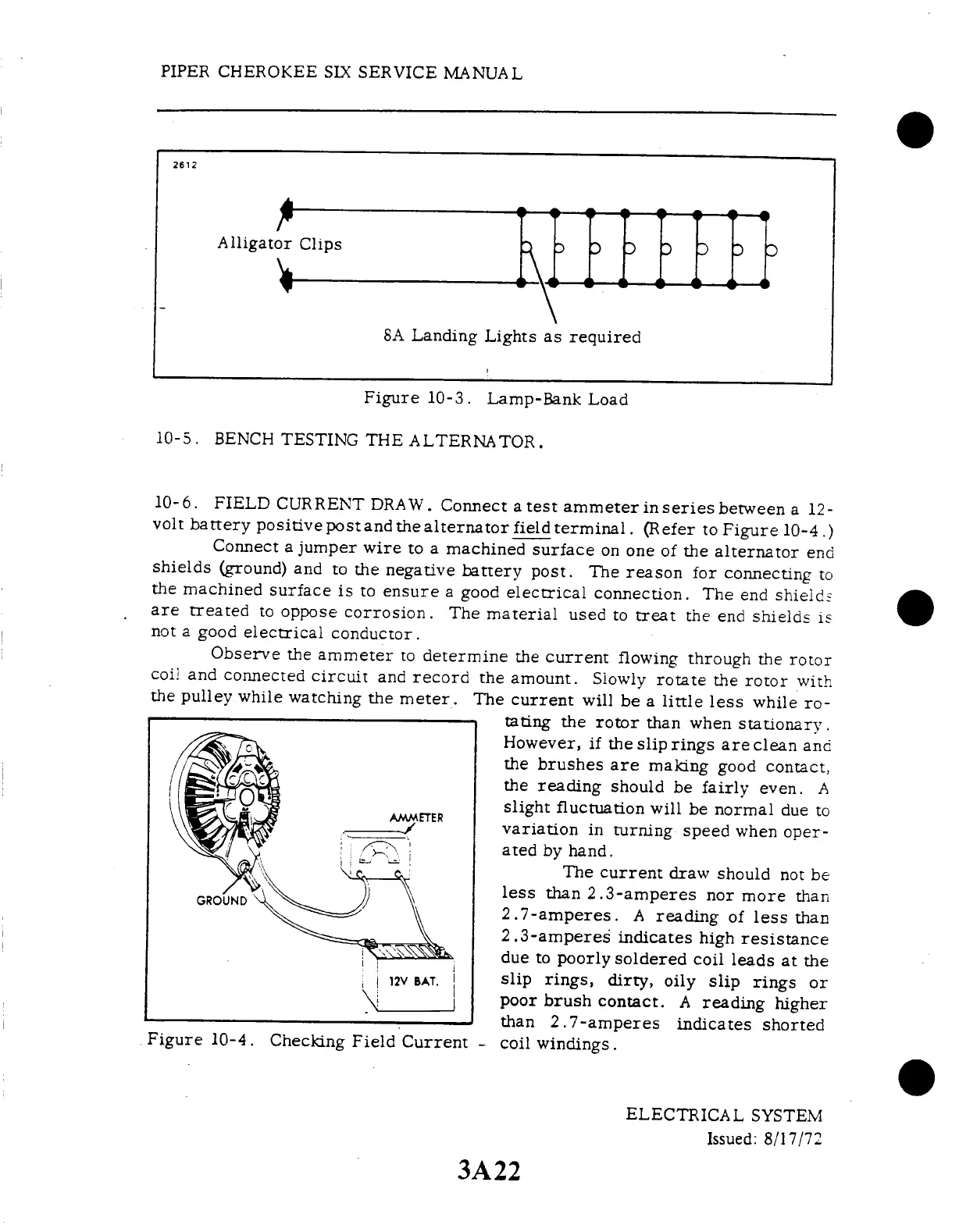
2612
Alligator
Clips
8A
Landing
Lights
as
required
Figure
10-3.
Lamp-Bank
Load
10-5.
BENCH
TESTING
THE
ALTERNATOR.
10-6.
FIELD
CURRENT
DRAW.
Connect
a test
ammeter
in
series
between
a
12-
volt
battery
positive
postand
the
alternator
field
terminal.
(Refer
to
Figure
10-4.)
Connect
a
jumper
wire
to
a
machined
surface
on
one
of
the
alternator
end
shields
(ground)
and
to
the
negative
battery
post.
The
reason
for
connecting
to
the
machined
surface
is
to
ensure
a
good
electrical
connection.
The
end
shields
are
treated
to
oppose
corrosion.
The
material
used
to
treat
the
end
shields
is
not
a
good
electrical
conductor.
Observe
the
ammeter
to
determine
the
current
flowing
through
the
rotor
coil
and
connected
circuit
and
record
the
amount.
Slowly
rotate
the
rotor
with
the
pulley
while
watching
the
meter.
The
current
will
be
a
little
less
while
ro-
tating
the
rotor
than
when
stationary.
However,
if
the
slip
rings
are
clean
and
the
brushes
are making
good
contact,
the reading should be fairly
even. A
AMMETER
slight
fluctuation
will
be
normal
due
to
variation
in
turning
speed
when
oper-
ated
by
hand.
The
current
draw
should
not
be
less than 2.3-amperes nor more than
2
.7-amperes.
A
reading
of
less
than
2.3-amperes
indicates
high
resistance
due
to
poorly
soldered
coil
leads
at
the
12V
BAT.
slip
rings,
dirty,
oily
slip
rings
or
poor
brush
contact.
A
reading
higher
than
2
.7-amperes
indicates
shorted
Figure
10-4.
Checking
Field
Current
-
coil
windings.
ELECTRICAL
SYSTEM
Issued:
8/17/72
3A22

Table of Contents

Related product manuals