VIBTOOL 02.2009
31
How are shock pulses actually measured?
Shock pulses excite the measurement accelerometer which
is mounted in the load zone at its resonant frequency,
typically at or around 30 kHz. A high-pass filter is used to
eliminate low-frequency components such as those caused
by shaft misalignment or unbalance. The remaining signal
is processed in order to obtain the various shock pulse
parameters explained on the following pages.
How are shock pulses evaluated?
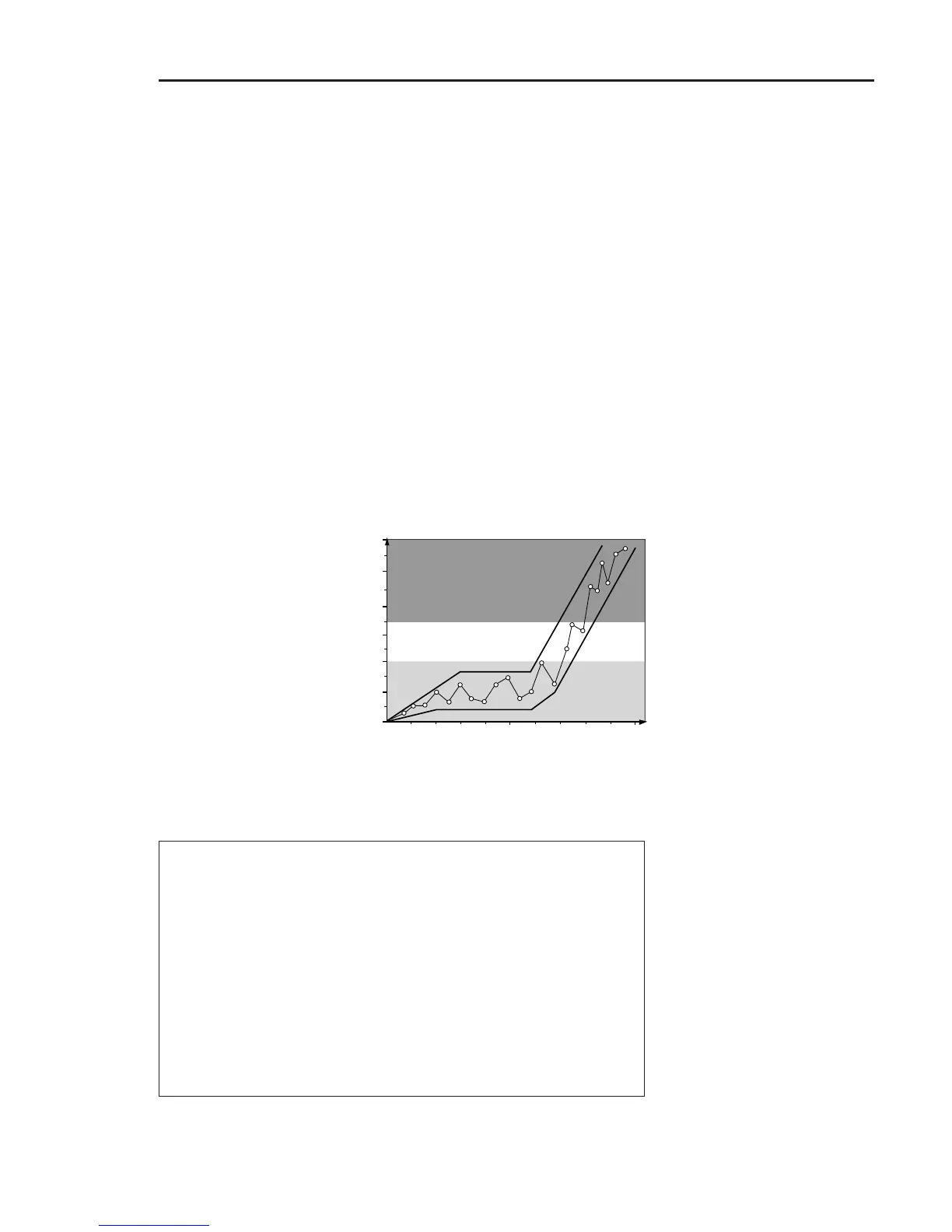
In order for shock pulses to be evaluated, a simple scale has
had to be devised. The following scale indicates the extent
of bearing damage in three categories (ranging from good
to poor):
In this way, it is possible to evaluate bearing condition
without introducing complicated terms and factors.
Since surface roughness is constantly being created
and rolled down during operation, measurement val-
ues can abruptly increase or decrease by considerable
amounts for short periods of time. For this reason, a
single 'snapshot' measurement of bearing condition is
often less useful or reliable than trend measurement
and monitoring over a longer time period.
Due to the many factors involved in shock pulse
measurement, results may vary between instruments
from different manufacturers.
))
))
)
Note
Bearing diagnosis
Poor
Reduced
Good
Lifetime
Here, during the lifetime of
the bearing its condition
can be seen to deteriorate
from good to poor.



 To Next Page