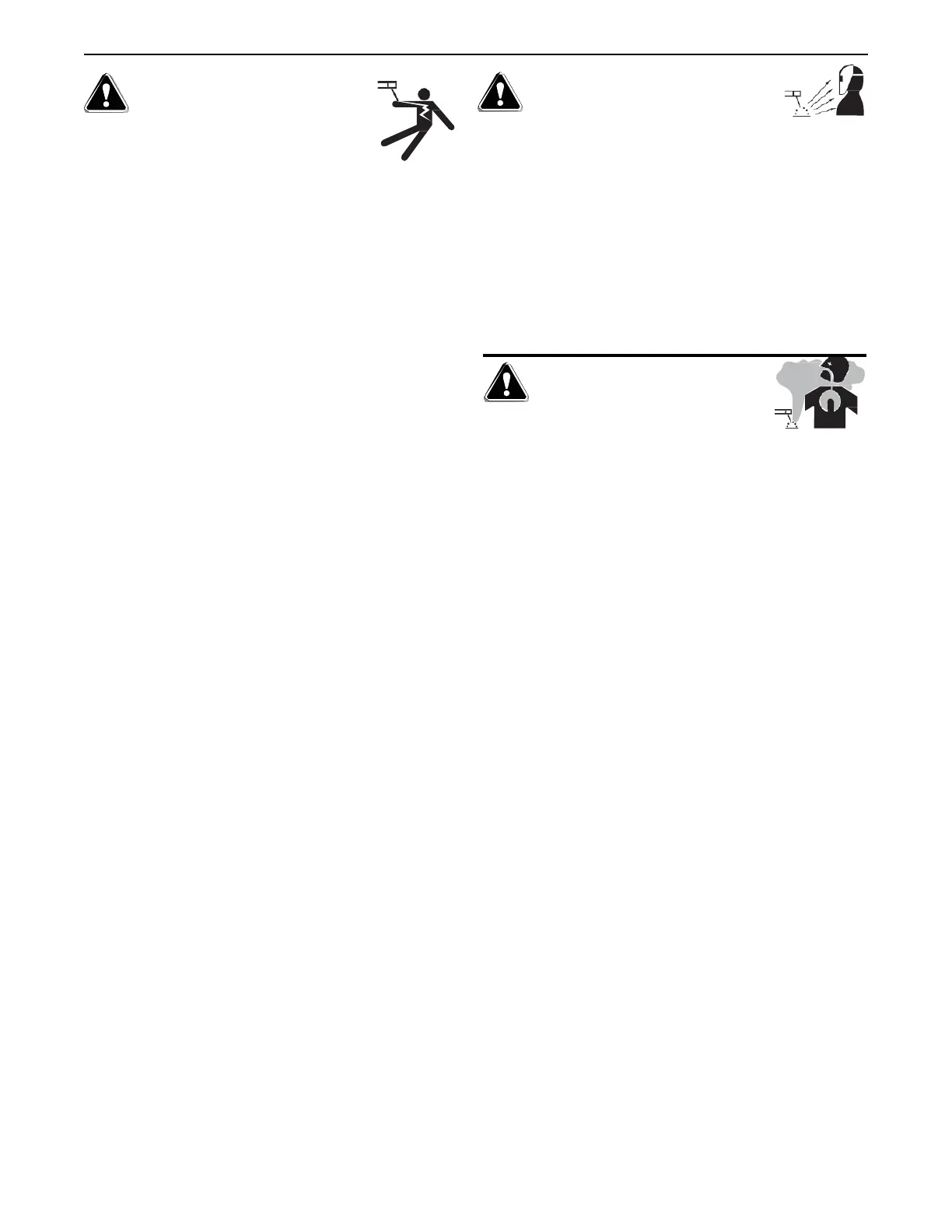
ELECTRIC SHOCK
CAN KILL.
3.a.
The electrode and work (or ground) circuits are
electrically “hot” when the welder is on. Do
not touch these “hot” parts with your bare skin or wet clothing.
Wear dry, hole-free gloves to insulate hands.
3.b.
Insulate yourself from work and ground using dry insulation.
Make certain the insulation is large enough to cover your full
area of physical contact with work and ground.
In addition to the normal safety precautions, if
welding must be performed under electrically
hazardous conditions (in damp locations or while
wearing wet clothing; on metal structures such as
floors, gratings or scaffolds; when in cramped
positions such as sitting, kneeling or lying, if there
is a high risk of unavoidable or accidental contact
with the workpiece or ground) use the following
equipment:
•
Semiautomatic DC Constant Voltage (Wire) Welder.
•
DCManual (Stick) Welder.
•
AC Welder with Reduced Voltage Control.
3.c.
In semiautomatic or automatic wire welding, the
electrode,
electrode reel, welding head, nozzle or
semiautomatic welding
gun are also electrically “hot”.
3.d.
Always be sure the work cable makes a good
electrical
connection with the metal being welded. The
connection should
be as close as possible to the
area being welded.
3.e.
Ground the work or metal to be welded to a good
electrical(earth)
ground.
3.f.
Maintain the electrode holder, work clamp, welding
cable and welding machine in good, safe operating
condition. Replace damaged insulation.
3.g.
Never dip the electrode in water for cooling.
3.h.
Never simultaneously touch electrically“hot”parts of
electrode
holders connected to two welders because
voltage between the
two can be the total of the open
circuitvoltage of both welders.
3.i.
When working above floor level,use a safety belt
to protect yourself from a fall should you get a
shock.
3.j.
Also see Items 6.c. and8.
ARC RAYS CAN BURN.
4.a.
Use a shield with the proper filter and cover plates to protect
your
eyes from sparks and the rays of the arc when welding
or
observing open arc welding . Headshield and filter lens
should
conform to ANSI Z87. I standards.
4.b.
Use suitable clothing made from durable flame-resistant material
to protect your skin and that of your helpers from the arc
rays.
4.c.
Protect other nearby personnel with suitable, non-flammable
screening and/or warn them not to watch the arc nor
expose themselves to the arc rays or to hot spatter or
metal.
FUMESANDGASES
CAN BE DANGEROUS.
5.a. Welding may produce fumes and gases
hazardous to health. Avoid breathing these
fumes and gases. When welding, keep your head out of the fume.
Use enough ventilation and/or exhaust at the arc to keep
fumes
and gases away from the breathing zone. When
welding
hardfacing (see instructions on container
or SDS) or on lead or cadmium plated steel and
othermetals or coatings which produce highly
toxic fumes, keep exposure as low as possible and
within applicable OSHA PEL and ACGIH TLV limits
using local exhaust or mechanical ventilation
unless exposure assessments indicate otherwise.
In confined spaces or in some circumstances,
outdoors, a respirator may also be required.
Additional precautions are also required when
welding
on galvanized steel.
5. b. The operation of welding fume control eq uip ment is
affected by various factors including proper use and
positioning of the equipment, maintenance of the equipment
and the specific
welding procedure and application involved.
Worker exposure
level should be checked upon installation
and periodically thereafter to be certain it is within applicable
OSHA PEL and
ACGIH TLV limits.
5.c. Do not weld in locations near chlorinated hydrocarbon vapors
coming from degreasing, cleaning or spraying operations. The
heat and rays of the arc can react with solvent vapors to form
phosgene, a highly toxic gas, and other irritating products.
5.d. Shielding gases used for arc welding can displace air and cause
injuryordeath.Alwaysuseenoughventilation,especiallyin
confinedareas,toinsurebreathingairissafe.
5.e. Read and understand the manufacturer’s instructions for this
equipment and the consumables to be used, including the
Safety Data Sheet (SDS) and follow your employer’s
safety
practices. SDS forms are available from your
welding
distributor or from the manufacturer.
5.f. Also see item1.b.



 To Next Page