WELDINGANDCUTTING
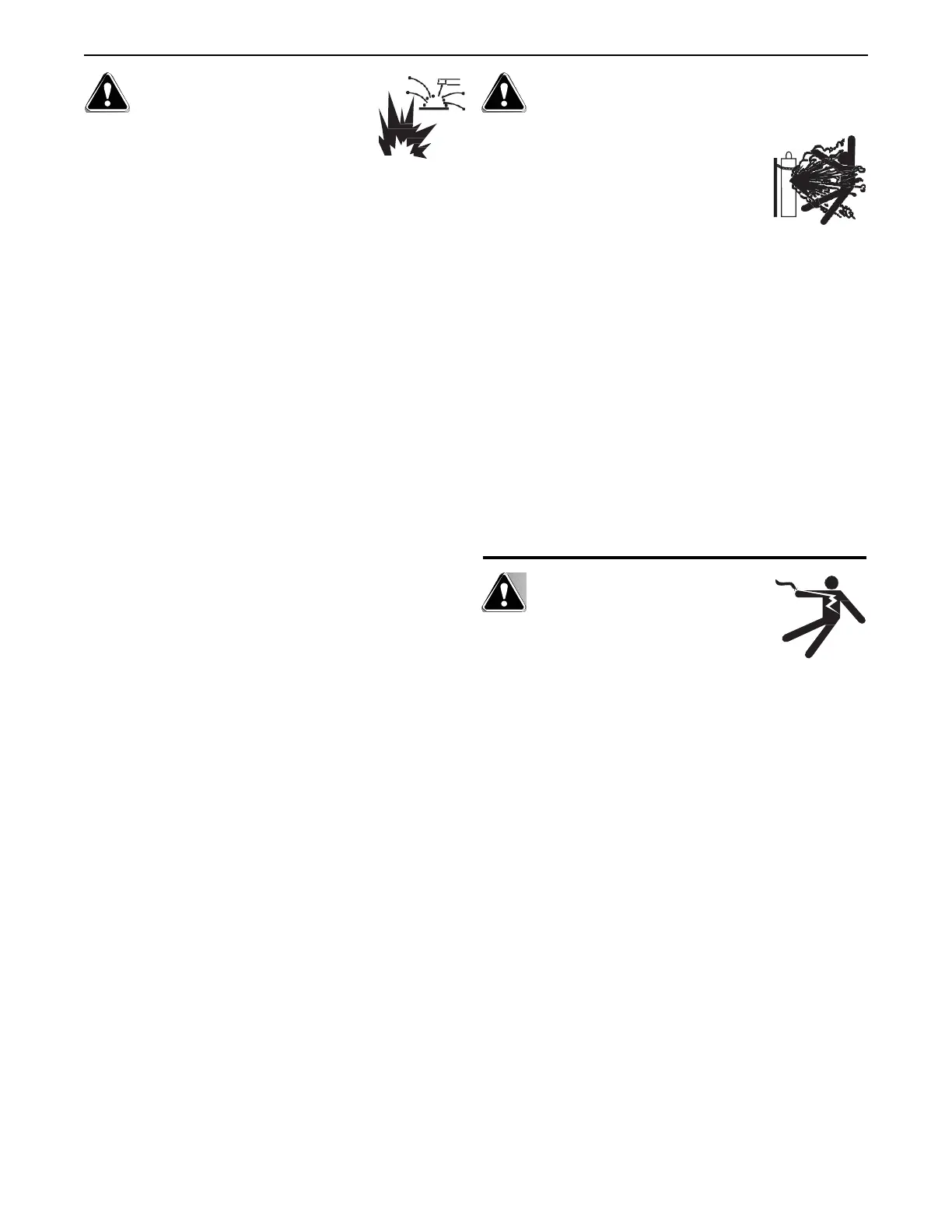
SPARKSCANCAUSE
FIRE OR EXPLOSION.
6.a.
Remove fire hazards from the welding area. If
This is not possible, cover them to prevent the welding
sparks from starting a fire. Remember that welding sparks
and hot materials from welding can easily go through
small cracks and
openings to adjacent areas. Avoid welding
near hydraulic lines. Have a fire extinguisher readily available.
6.b.
Where compressed gases are to be used at the job site, special
precautions should be used to prevent hazardous
situations.
Refer to “Safety in Welding and Cutting” (ANSI
Standard Z49.1) and the operating information for the
equipment being used.
6.c.
When not welding, make certain no part of the electrode
circuit is
touching the work or ground. Accidental contact
cancause
overheating and create a fire hazard.
6.d.
Do not heat, cutor weld tanks,drums or containers until
the
proper steps have been taken to insure that such
procedures will
not cause flammable or toxic vapors from
substances inside.
They can cause an explosioneven
though they havebeen
“cleaned”. For information,
purchase “Recommended Safe
Practices for the
Preparation for Welding and Cutting of
Containers and
Piping That Have Held Hazardous Substances”,
AWS F4.1 from the American Welding Society
(see address above).
6.e.
Vent hollow castings or containers before heating, cutting or
welding. They may explode.
6.f.
Sparks and spatter are thrown from the welding arc. Wear
oil free
protective garments such as leather gloves, heavy shirt,
cuffless
trousers, high shoes and a cap over your hair.
Wear ear plugs when welding out of position or in confined
places. Always wear safety glasses with side shields when
ina welding area.
6.g.
Connect the work cable to the work as close to the welding
area
as practical. Work cables connected to the building
framework or
other locations away from the welding area
increase the
possibility of the welding current passing
through lifting chains,
crane cables or other alternate
circuits.This can create fire
hazards or overheat lifting
chains or cables until they fail.
6.h.
Also see item 1.c.
6.i. Do not use a welding power source for pipe thawing.
CYLINDER MAY EXPLODE IF
DAMAGED.
7.a.
Use only compressed gas cylinders containing
the correct shielding gas for the process
used
and properly operating regulators
designed for
the gas andpressure used. All
hoses,fittings, etc. should be suitable for the
application and
maintained in goodcondition.
7.b.
Always keep cylinders in an upright position securely chained
to an undercarriage or fixed support.
7.c.
Cylinders should be located:
•
Away from areas where they may be struck or subjected
to physical damage.
•
A safe distance from arc welding or cutting operations
and any other source of heat,sparks, or flame.
7.d.
Never allow the electrode, electrode holder or any other
electrically “hot” parts to touch a cylinder.
7.e.
Keep your head and face away from the cylinder valve outlet
when opening the cylinder valve.
7.f.
Valve protection caps should always be in place and hand tight
except when the cylinder is in use or connected for use .
FORELECTRICALLY
POWERED EQUIPMENT.
8.a.
Turn off input power using the discon-
nect switch at the fuse box before
working on
the equipment.
8.b.
Install equipment in accordance with the local Electrical Code,
all local codes and the manufacturer’s recommendations.
8.c.
Ground the equipment in accordance with the local
Electrical Code and the manufacturer’s
recommendations.



 To Next Page