Need help?
Do you have a question about the Retsch RS 200 and is the answer not in the manual?
Explains the meaning and use of different safety warning symbols and terms.
Outlines general safety rules for operating the device and responsibilities.
Specifies that repairs must be performed by authorized personnel only.
Information on proper packaging for transport and storage to maintain warranty.
Instructions and warnings regarding safe transport to prevent component damage.
Specifies ambient temperature and conditions for device installation.
Steps for physically installing the device, including height limitations.
Description of the information provided on the device's type plate.
Details on connecting the device to the power supply safely and correctly.
Instructions for establishing an interface connection for data communication.
Guidelines for using and removing the transportation lock for safe movement.
Steps for securing the device, including locking transport rollers.
Detailed steps for releasing the transport lock before operation.
Describes the device's purpose and essential safety precautions for operation.
Details the available nominal volumes for various grinding jar materials.
Guidance on maximum feed grain size based on grinding jar volume.
Specifies the device's power rating and electrical connection requirements.
Information on the adjustable motor rotation speed range.
Details on device emissions and measured noise levels during operation.
Information on the device's degree of protection and required protective equipment.
Physical specifications including dimensions, weight, and required floor space.
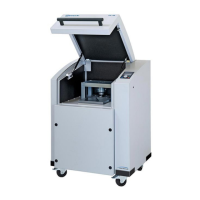
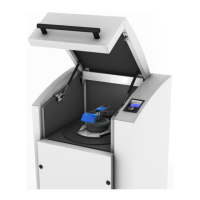
Visual identification of the main components of the device.
A table listing all parts of the device and their functions.
Details on the control panel's buttons, rotary control, and display.
Step-by-step instructions for opening and closing the device's grinding chamber.
Procedure for manually unlocking the device in emergency situations.
Instructions on how to properly insert and secure the grinding jar.
Steps for preparing the grinding jar, including positioning discs and rings.
Information on different inserts for grinding jar carriers based on material and volume.
Overview of the display unit's features and operation.
Explanation of the various symbols and icons used on the display unit.
Instructions on how to navigate through the device's menu system.
Guide on how to switch between different operating modes like Manual and Program.
Procedure for directly accessing the language selection menu.
A visual representation of the device's menu hierarchy.
Describes the available operating modes: Manual, Program, and Basic Settings.
Details on setting grinding duration and speed within Manual Mode.
Instructions for setting a start delay countdown and saving parameters.
How to set grinding duration, speed, and change existing programs.
Procedure for deleting saved grinding programs.
Configuring automatic lid opening and selecting the user interface language.
Settings for display brightness, date, time, and acoustic warning signals.
Accessing service information like operating hours and software versions.
List of error codes, their descriptions, and recommended corrective measures.
Information notes that may briefly interrupt operation but do not indicate faults.
Instructions for safely cleaning the device, emphasizing power disconnection.
Procedure for safely replacing the device's fuses.
Safety warnings regarding electrical shock and required waiting times after power off.
Lubricate rubber springs on guide bolts every 250 operating hours. Use specific grease.
Information on replacing specific wearing parts like rubber springs and pads.
Guidelines for returning the device for repair, maintenance, or calibration.
Information on the proper disposal of electrical and electronic equipment.
 General
| Size Reduction Principle | Impact and friction |
|---|---|
| Number of Grinding Stations | 1 |
| Drive | Electric motor |
| Power Connection | single-phase |
| Application | homogenization of powders, mixing of powders |
| Feed Material | Brittle, hard materials |
| Material Feed Size | < 15 mm |
| Grinding Chamber Volume | 50 ml |
| Setting of Grinding Time | Digital timer |
| Suitable Grinding Tools | Steel, hardmetal, tungsten carbide, agate, ceramic, etc. |
| Grinding Jar Material | Stainless steel, tungsten carbide, agate, zirconium oxide, hardened steel |
| Material | Stainless steel |
| Electrical Supply Data | 230 V, 50/60 Hz |

 To Next Page