Need help?
Do you have a question about the Revopoint POP and is the answer not in the manual?
Lists documents and tutorials recommended before the first scan.
Provides access to discussions, tutorials, and showcases.
Links to download the Handy Scan software for various platforms.
Overview of the POP 3D scanner's technology and capabilities.
Instructions for connecting the POP 3D scanner to a PC via USB.
Guide on establishing a wireless connection using a smartphone hotspot.
Details the minimum system requirements for installing the software.
Overview of the Handy Scan software's main interface elements.
Describes the different scanning modes available in Handy Scan.
Explains how to adjust settings like exposure and gain for scanning.
Step-by-step guide on initiating a new scanning project.
Instructions on initiating, pausing, and completing a scan session.
Explains the processes of converting point clouds to meshes and applying textures.
Guide on exporting scanned models in various file formats.
Addresses 'Miss Track' and 'Too Few Points' errors during scanning.
Covers 'Detect Plane' prompts, 'Undo' function, and continuing scans.
Explains keyboard shortcuts for controlling the scanning process.
Describes post-processing individual 3D models.
Details the process of aligning and merging multiple 3D models.
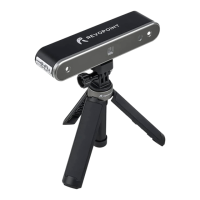
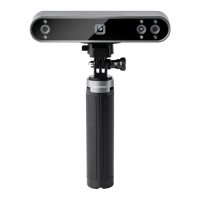
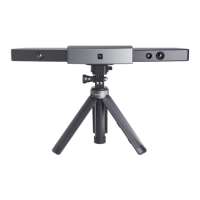
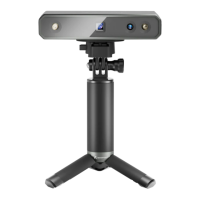
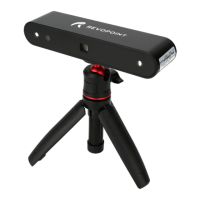
The Revopoint POP 3D Scanner is a handheld device designed for accurate and fast 3D scanning, suitable for a range of applications including product development, prototyping, 3D printing, and artistic creation. It utilizes Binocular Structured Light technology, incorporating a proprietary 3D camera module and an embedded chip to achieve high-precision 3D point cloud data. The scanner is compact and portable, offering multi-mode scanning capabilities.
The core function of the POP 3D Scanner is to capture the three-dimensional shape and, optionally, the texture of objects. It achieves this through a set of depth cameras, comprising two IR sensors and one projector, which quickly obtain the 3D shape. An additional RGB camera is used to capture texture information, allowing for the generation of vivid 3D models directly. The device supports both high-precision and texture scanning modes.
The scanner's operation is managed through the "Handy Scan" software, which provides a user interface for controlling the scanning process. This software allows users to define new projects, select scan modes (Feature, Marker, Face, Body, or Dark), and choose whether to capture color data. It also enables users to input previously scanned 3D models, start or pause scanning, and stop/complete projects. Upon completion, the software can fuse point cloud data, mesh the model, apply textures, and export the final 3D model in various formats such as PLY, OBJ, and STL.
For post-processing, the "Handy Studio" software (Windows only) is available. This application allows for the modification of individual 3D models created by Handy Scan and the alignment and merging of multiple 3D models into a new, combined model. Handy Studio offers features such as converting point clouds into meshed objects, clipping model planes, filling holes, smoothing surfaces, undoing operations, generating mirror images, and exporting models.
The Revopoint POP 3D Scanner offers several features to enhance its usability and adaptability to different scanning scenarios:
While the manual primarily focuses on operational features, some aspects touch upon maintenance and best practices:
The Revopoint POP 3D Scanner is designed to be a versatile and user-friendly tool for 3D data acquisition, offering robust features for both novice and experienced users in various creative and technical fields.
 General
| Technology | Structured Light |
|---|---|
| Scan Accuracy | Up to 0.3mm |
| Single Capture Range | 210mm x 130mm |
| Output Formats | PLY, OBJ, STL |
| Weight | 200g |
| Working Distance | 150mm to 400mm |
| Connectivity | USB 3.0 |
| Scan Speed | 8 fps |
| Minimum Scan Volume | 50mm x 50mm x 50mm |
| Compatibility | Windows, Android, macOS |
| Dimensions | 154.6mm x 38.2mm x 25.6mm |

 To Next Page