Ricoma Quick Start Guide
61
Top thread fiber choices
Spun polyester has a number of benets that make it the number one bobbin ber choice of many. Its
texture is similar to cotton, without the lint problem. It is also the most economical. Spun polyester
bobbins require less plate pressure. However, they leave a lint build up in the bobbin case, which needs
to be removed and maintained.
One reason that it has been overlooked is that many people mistakenly believe that a size “L” bobbin
will hold only 94 yards of this thread. While that’s true of size 100 spun polyester, several suppliers
carry size 120 spun polyester. This size yields 120 yards per bobbin, only seven yards shy of continuous
lament polyester.
SPUN POLYESTER
Size 60, 70, and 80 threads are lightweight threads. This
specialty thread is used on ne fabrics, small delicate
details and small fonts. If you are using this type of thread,
increase the density by 5 to 10 percent.
Size 30 and 40 threads are medium-weight threads. This
specialty thread can be used to ll large embroideries with
fewer stitches. If you are using this type of thread, decrease
the stitch count by 15 percent. This will save production
time. Size 35 threads are commonly used for multi-color
threads. Your welcome kit includes size 40 threads.
Size 12 threads are heavyweight threads. This specialty
thread creates the look of hand embroidery. If you are using
this type of thread, use long oating stitches. There is
special set-up time required for this thread. We recommend
adjusting the tension when using this type of thread.
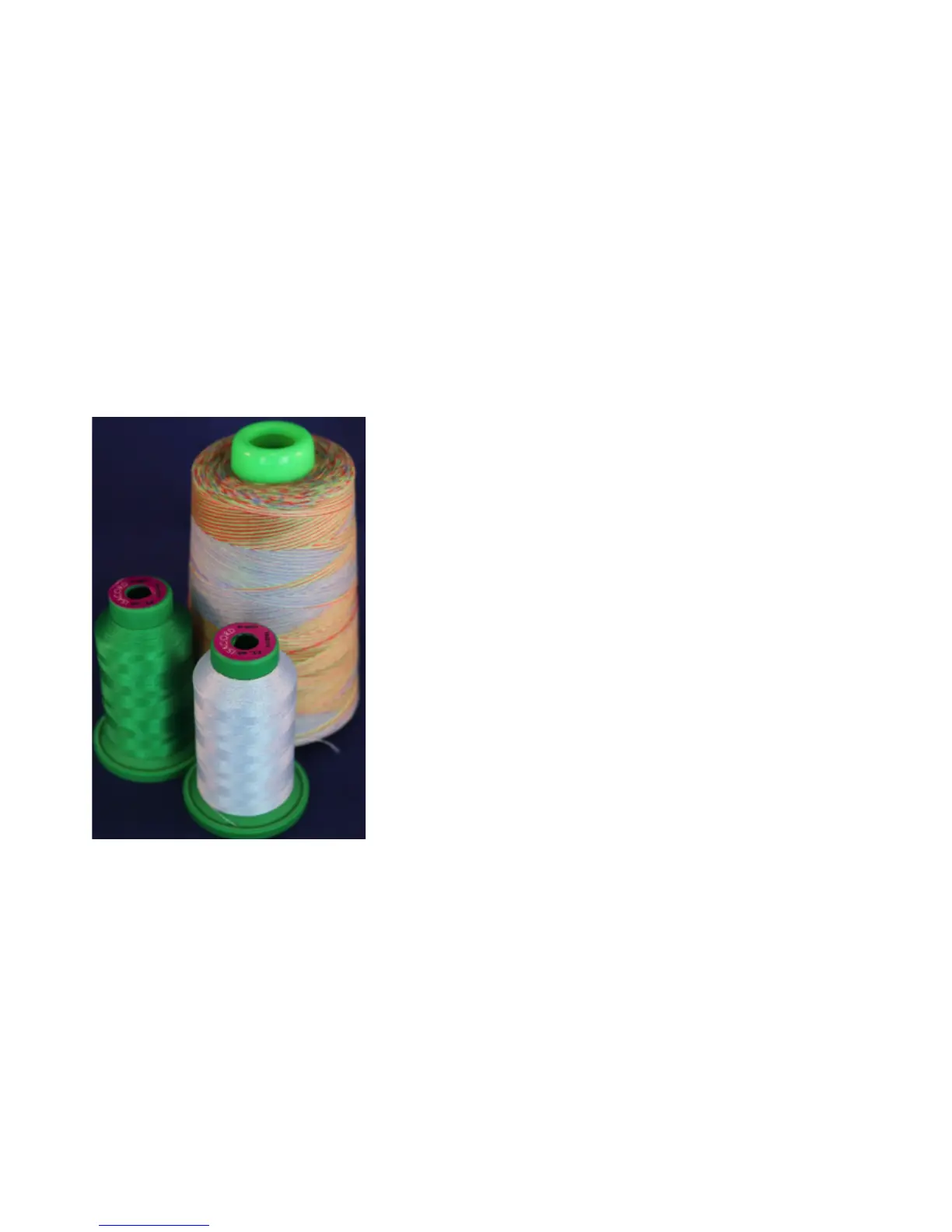
Figure 127
RAYON THREAD
Rayon thread is widely used by U.S. embroiderers. It is available in sizes 30, 40 and 60. Rayon is a
very beautiful, supple and natural ber made from cellulose. Its handling properties are superior to
other bers used for embroidery thread, and it looks very rich when sewn onto fabric. Unfortunately,
it is not one of the stronger bers. Even slight equipment problems may cause an unacceptable
number of thread breaks when using rayon thread. Rayon is more expensive than other bers and
is susceptible to damage by environmental factors, such as temperature and light. Black and white
Rayon threads tend to break more frequently because of the bleaching and dying processes. White is
heavily bleached to reach its brilliant white color, and black is weakened by the amount of pigment it
must absorb to obtain its rich black color.


 To Next Page