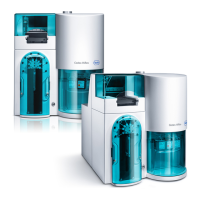
The 91xx pH/Electrolyte Analyzers, including the 9110 pH Analyzers and the 9120, 9130, 9140, 9180, and 9181 Electrolyte Analyzers, are in vitro diagnostic medical devices designed for the measurement of pH and electrolytes in various biological samples. This service manual provides comprehensive information for the maintenance and repair of these instruments, ensuring their full functionality and accurate performance.
Function Description
The 91xx pH/Electrolyte Analyzers are designed to measure pH, sodium (Na+), potassium (K+), chloride (Cl-), calcium (Ca2+), and lithium (Li+) in whole blood, serum, plasma, and QC solutions. The 9180 and 9181 models also support dialysate and urine samples. The measurement principle relies on ion-selective electrodes (ISE) for electrolyte determination and a pH-sensitive flow-through glass capillary electrode for pH measurement.
The fluidic system is controlled by a peristaltic pump and a series of solenoid valves. Samples are aspirated through a sample needle into the electrode module, where the measurements take place. Calibration is fully automatic, with a 1-point calibration performed with each sample and a 2-point calibration every 3 or 4 hours (depending on the model). The instrument includes a reference system with an open liquid junction, flow-through electrode.
The 9110 pH Analyzer specifically measures pH in the range of 6.00 to 8.00 pH units with a resolution of 0.001 pH units. The 9120, 9130, 9140, 9180, and 9181 Electrolyte Analyzers measure Na+ (40-205 mmol/L, 0.1 mmol/L resolution), K+ (1.5-15 mmol/L, 0.01 mmol/L resolution), Cl- (50-200 mmol/L, 0.1 mmol/L resolution), Ca2+ (0.2-5.0 mmol/L, 0.01 mmol/L resolution), and Li+ (0.1-6.0 mmol/L, 0.001 mmol/L resolution) in blood/serum/plasma. For urine samples, Na+ (1-300 mmol/L, 1.0 mmol/L resolution), K+ (4.5-120 mmol/L, 0.1 mmol/L resolution), and Cl- (1-300 mmol/L, 1.0 mmol/L resolution) are measured. Calcium and Lithium are not measured in urine samples, and Lithium is not measured in dialysate samples.
The instrument is microprocessor-controlled and features an integral thermal printer for outputting results. Data can also be transmitted via an RS232C serial port, with 9180/9181 models offering a data link to COMPACT 2/3 blood gas analyzers for combined reports.
Important Technical Specifications
- Sample Types:
- 9110: Whole blood, Serum, Plasma, QC solutions
- 9120, 9130, 9140, 9180, 9181: Whole blood, Serum, Plasma, Urine, Dialysate (acetate or bicarbonate), QC solutions
- Sample Device: Syringe, sample cup, capillary, Roche MICROSAMPLER
- Sample Size:
- 9110: 25 µL
- 9120, 9130, 9140, 9180, 9181: 95 µL
- Analysis Time:
- 9110: 70 seconds
- 9120, 9130, 9140, 9180, 9181: 50 seconds
- Sample Rate:
- 9110: 40 per hour with printout, 50 per hour without printout
- 9120, 9130, 9140, 9180, 9181: 45 per hour with printout, 60 per hour without printout
- Calibration: Fully automatic, 1 point with each sample, 2 points every 3 hours (9180/9181 every 4 hours)
- Warm-up Time: 10 minutes
- Temperature: Room temperature, 15 - 32°C, 60 - 90°F
- Humidity: Maximum 85% relative humidity, non-condensing
- Data Management: Quality control memory storage (3 levels, 35 values), calculation of mean, standard deviation, and coefficient of variation (CV)
- Display: LCD dot-matrix, 2 lines, 16 characters per line
- Printer: Integral thermal printer, 16 characters width
- Autosampler (9181 only): Integral turntable, 18 positions, 2 mL or 0.25 mL sample cups
- Interface: RS232C serial port, 9600 Baud fixed, 8 data bits, 2 stop bits
- Electrical Requirements: 100 - 240 VAC, 50/60 Hz (90 - 250 VAC for 9110), self-adjusting
- Nominal Power Consumption: 50 W
- Dimensions: Height 335 mm (12.2"), Width 315 mm (12.4"), Depth 295 mm (12.0")
- Weight: Approx. 6 kg (13 lbs)
- Safety Category: I
- Device Type: B (according to ÖVE-MG/EN 60601-1, IEC 601-1)
- Mode of Operation: Continuous operation
- Protection Classification: IP 20
- Explosion Protection: Not designed for operation in explosive environments.
- Approvals: CSA, CE, FCC Class B, CLIA Complexity Category: Moderate, Test System Code: 04739
Usage Features
The analyzers are operated via YES/NO selections on the front panel, guided by a clear display. Software operation flows are provided for each model (9110, 9120/9130/9140, 9180, 9181), detailing main menus, measurement sequences, print functions, QC/standard/urine sample menus, daily maintenance, operator functions, program instrument menus, service functions, and calibration sequences.
Sample Handling:
- For 9110, 9120, 9130, 9140, and 9180 models, the front door can be removed for easier access to internal components. The 9181 front panel can be tilted and lifted.
- Sample needles and fill ports are designed for easy user replacement without tools on most models.
- The 9110 fluid detection uses three sample contacts to sense standard solution draws and fluid presence.
- The 9180/9181 models include a SnapPak Sensor to detect if the ISE SnapPak™ is in place.
Software Features:
- Service Functions: A dedicated menu provides diagnostic tests for electrodes, sample sensors, SnapPak sensors (9180/9181), language switch (9180/9181), sample door (except 9181), probe (9181), autosampler (9181), pump, pinch valves, interface, and amplifier.
- Service Codes: Allow access to additional programming features, such as enabling Ca2+ values during automatic measurements, clearing service codes, additional display resolution, economy mode, printing electrode voltages, displaying error messages, displaying mg/dL for Ca2+ (9140/9180/9181), disabling the beep (9180/9181), direct ISE measurement for QC values, SnapPak counter input (9180/9181), setting leasing counter, toggling needle height (9181), and displaying pH results in H+ ion concentration.
- Data Deletion: Allows resetting the sample count to 0 or resetting the analyzer software to default values, which deletes all QC data, statistics, and programming.
- Warm-up Bypass: A function to bypass the instrument warm-up sequence.
Maintenance Features
The manual outlines a structured maintenance schedule to ensure optimal performance and longevity of the analyzers.
Daily Maintenance:
- Perform cleaning cycle.
- Perform conditioning cycle.
Weekly Maintenance:
- Clean sample probe and fill port.
- Clean analyzer surfaces.
Monthly Maintenance:
- Clean reference electrode housing.
- Check level of pH Filling Solution (9110 only).
Six-Month Maintenance:
- Replace peristaltic pump tubing.
Annual Preventive Maintenance:
- Replace complete tubing set.
- Replace peristaltic pump tubing.
- Replace intake tubing (9110 only).
- Replace fill port assembly.
- Replace sample probe.
- Replace sample sensor Quad-ring (9120/30/40/80/81 only).
- Replace preheater Quad-ring (9110 only).
- Check sample sensor voltage (9120/30/40/80/81 only).
- Check sample contact voltage (9110 only).
- Check sample temperature (9140/80/81 only).
Adjustments:
- Sample Contacts Adjustment (9110 only): Involves adjusting R10 on the Display Board for a reading of 140 after removing the electrode and disconnecting the intake tube and sample contact plug.
- Sample Sensor Adjustment (9120/9130/9140/9180/9181 only): Requires adjusting R93 Sample Sensor Adjust on the ISE SBC card to a value of 100, then verifying the reading increases to 150 or greater when aspirating clear fluid.
- Temperature Adjustment (9110/9140/9180/9181 only): Involves using a Temperature Adjustment Test Plug or a quality thermometer to adjust R54 on the SBC Board (for 3000 mV display) and R20 on the display board (for 37.0±0.1°C on 9110, or matching room temperature on other models).
Troubleshooting:
The manual provides detailed guidance for various error messages and status LEDs, including possible causes and remedies. These cover issues such as calibration failures, fluid detection problems, printer defects, electrode issues, and sampler malfunctions. ESD protection measures are also emphasized for handling electronic components.

 Need help?
 General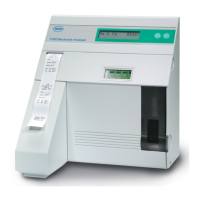


 To Next Page