EasyManua.ls Logo

Rockwell Commander 112 - Aileron Trim Tab; Wing Flaps

Rockwell Commander 112
293 pages
Print Icon
To Next Page IconTo Next Page
To Previous Page IconTo Previous Page
Loading...
SECTION
VII
FLIGHT CONTROLS
MAINTENANCE
MANUAL
ROCKWELL
COMMANDER
112/B/TC/TCA
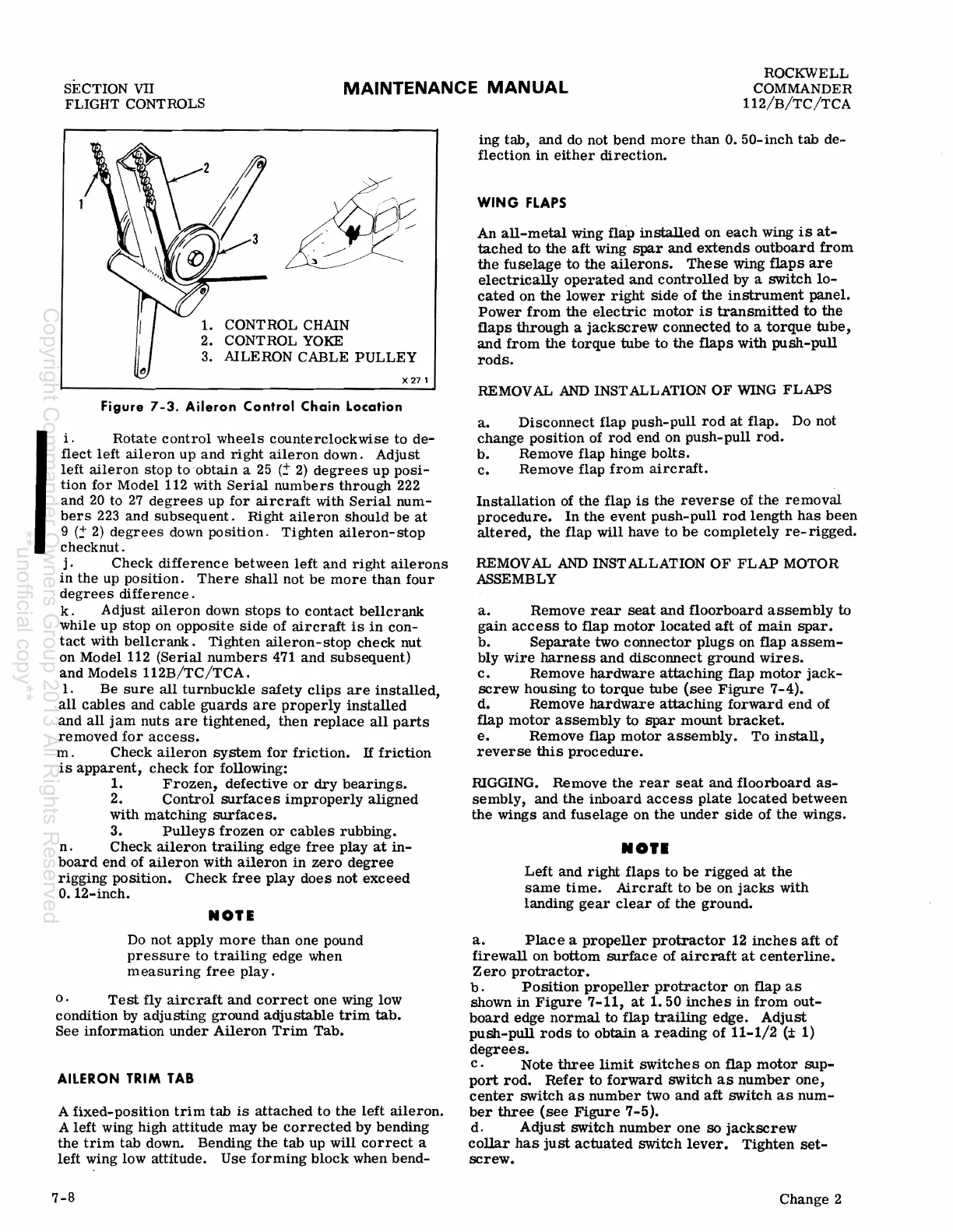
CONTROL CHAIN
CONTROL
YOKE
AILERON CABLE PULLEY
X271
Figure
7-3.
Aileron
Control
Chain Location
i.
Rotate
control
wheels
counterclockwise
to
de-
flect
left
aileron
up
and
right
aileron
down. Adjust
left
aileron
stop
to . obtain a
25
(2-
2)
degrees
up
posi-
tion
for
Model 112 with
Serial
numbers
through 222
and
20
to
27
degrees
up
for
aircraft
with
Serial
num-
bers
223
and
subsequent.
Right
aileron
should
be
at
9
(2-
2)
degrees
down
position.
Tighten
aileron-
stop
checknut.
j.
Check
difference
between
left
and
right
ailerons
in
the up
position.
There
shall
not
be
more
than
four
degrees
difference.
k.
Adjust
aileron
down
stops
to
contact
bellcrank
while up stop on
opposite
side
of
aircraft
is
in
con-
tact
with
bellcrank.
Tighten
aileron-stop
check nut
on Model 112
(Serial
numbers
471
and
subsequent)
and
Models
112B/TC/TCA.
1. Be
sure
all
turnbuckle
safety
clips
are
installed,
all
cables
and
cable
guards
are
properly
installed
and
all
jam
nuts
are
tightened,
then
replace
all
parts
removed
for
access.
m . Check
aileron
system
for
friction.
If
friction
is
apparent,
check
for
following:
1.
Frozen,
defective
or
dry
bearings.
2.
Control
surfaces
improperly
aligned
with
matching
surfaces.
3.
Pulleys
frozen
or
cables
rubbing.
n. Check
aileron
trailing
edge
free
play
at
in-
board
end of
aileron
with
aileron
in
zero
degree
rigging position.
Check
free
play
does
not
exceed
0.l2-inch.
NOTE
Do
not apply
more
than one pound
pressure
to
trailing
edge when
measuring
free
play.
o.
Test
fly
aircraft
and
correct
one wing low
condition
by
adjusting
ground
adjustable
trim
tab.
See
information
under
Aileron
Trim
Tab.
AILERON TRIM
TAB
A
fixed-position
trim
tab
is
attached
to
the left
aileron.
A
left
wing high attitude may
be
corrected
by bending
the
trim
tab down. Bending
the
tab up will
correct
a
left wing low attitude.
Use
forming
block
when
bend-
7-8
ing tab, and do not bend
more
than
O.
50-inch
tab
de-
flection
in
either
direction.
WING
FLAPS
An
all-metal
wing flap
installed
on
each
wing
is
at-
tached
to
the
aft
wing
spar
and
extends
outboard
from
the
fuselage
to
the
ailerons.
These
wing
flaps
are
electrically
operated
and
controlled
by a switch
lo-
cated
on
the
lower
right
side
of
the
instrument
panel.
Power
from
the
electric
motor
is
transmitted
to
the
flaps
through a
jackscrew
connected
to
a
torque
tube,
and
from
the
torque
tube
to
the
flaps
with
push-pull
rods.
REMOV
AL
AND
INST ALLATION
OF
WING
FLAPS
a.
Disconnect
flap
push-
pull
rod
at
flap. Do not
change position of
rod
end on
push-pull
rod.
b. Remove flap hinge
bolts.
c. Remove flap
from
aircraft.
Installation
of the flap
is
the
reverse
of the
removal
procedure.
In
the event
push-
pull
rod
length
has
been
altered,
the flap will have to
be
completely
re-
rigged.
REMOV
AL
AND
INST ALLATION
OF
FLAP
MOTOR
ASSEMBLY
a.
Remove
rear
seat
and
floorboard
assembly
to
gain
access
to
flap
motor
located
aft
of
main
spar.
b.
Separate
two
connector
plugs
on flap
assem-
bly
wire
harness
and
disconnect
ground
wires.
c.
Remove
hardware
attaching
flap
motor
jack-
screw
housing
to
torque
tube
(see
Figure
7-4).
d. Remove
hardware
attaChing
forward
end
of
flap
motor
assembly
to
spar
mount
bracket.
e.
Remove flap
motor
assembly.
To
install,
reverse
this
procedure.
RIGGING. Remove
the
rear
seat
and
floorboard
as-
sembly,
and
the
inboard
access
plate
located
between
the wings
and
fuselage
on the
under
side
of
the
wings.
110'.
Left
and
right
flaps
to
be
rigged
at
the
same
time.
Aircraft
to
be
on
jacks
with
landing
gear
clear
of the ground.
a.
Place
a
propeller
protractor
12
inches
aft
of
firewall
on
bottom
surface
of
aircraft
at
centerline.
Zero
protractor.
b.
Position
propeller
protractor
on flap
as
shown
in
Figure
7-11,
at
1.50
inches
in
from
out-
board
edge
normal
to flap
trailing
edge.
Adjust
push-pull
rods
to
obtain a
reading
of
11-1/2
l)
degrees.
c.
Note
three
limit
switches
on flap
motor
sup-
port
rod.
Refer
to
forward
SWitch
as
number
one,
center
switch
as
number
two
and
aft
switch
as
num-
ber
three
(see
Figure
7-5).
d.
Adjust
switch
number
one so
jackscrew
collar
has
just
actuated
switch
lever.
Tighten
set-
screw.
Change 2
Copyright Commander Owners Group 2013 All Rights Reserved
**unofficial copy**

Table of Contents