EasyManua.ls Logo

Rockwell Commander 112 - HYDRAULIC POWER PACK

Rockwell Commander 112
293 pages
Print Icon
To Next Page IconTo Next Page
To Previous Page IconTo Previous Page
Loading...
ROCKWELL
COMMANDER
112/B/TC/TCA
MAINTENANCE MANUAL
SECTION III
HYDRAULICS
REMOVAL
a.
Jack
aircraft
as
outlined
in
Section
II.
b.
Disconnect
hydraulic
lines
from
actuating
cylinders
and
plug
or
cap
open
lines
and
fittings
to
prevent
contamination.
c.
Remove
attaching
bolts
from
cylinder
and
landing
gear.
NOTE
Do not
disturb
the
setting
of
the
rod
end
on
the
shaft.
d.
Remove
actuating
cylinder.
MODEL 112
(Serial
numbers
thru
380).
DISASSEMBLY
AND
REPAIR.
Disassembly
procedures
apply
to
both
main
and
nose
gear
actuating
cylinders.
Repair
is
limited
to
cleaning
and
inspection
of
the
parts
and
re-
placement
of
worn
or
damaged
parts
and
a-rings.
a.
Loosen
setscrew
s
and
remove
end
caps
and
end
plugs
(see
Figure
3-4).
b.
Withdraw
shaft
and
piston
from
actuator
housing.
c.
Remove
detent
cylinder
valve
body.
d.
Remove
snap
ring,
cover
plate,
spring
and
de-
tent
from
detent
cylinder
valve
body.
e.
Remove
and
discard
aU
a-rings.
f.
Inspect
and
clean
all
parts
in
dry
cleaning
solvent
and
dry
thoroughly.
g.
Inspect
all
internal
parts
and
cylinder
bore
for
\vear
and
damage.
Replace
worn
or
damaged
parts.
h. Wipe new
a-rings
with
MIL-H-5606
hydraulic
fluid
prior
to
installation
in
actuator
housing.
i.
When
reassembling
cylinders,
install
detent
cylinder
valve
body
after
shaft
and
piston
has
been
installed.
MODEL 112
(Serial
numbers
381
and
subsequent).
MODELS
112B/TC/TCA.
Disassembly
procedures
apply
to
both
main
and
nose
gear
actuating
cylinders.
Repair
is
limited
to
cleaning
and
inspection
of
the
parts
and
replacement
of
worn
or
damaged
parts
and
0-
rings.
a.
Loosen
setscrews
and
remove
end
caps
and
end
plugs
(see
Figure
3-4).
b.
Withdraw
shaft
and
piston
from
actuator
housing.
c.
Remove
and
discard
all
a-rings.
d.
Inspect
and
clean
all
parts
in
dry
cleaning
sol-
vent
and
dry
thoroughly.
e .
Inspect
all
internal
parts
and
cylinder
bore
for
wear
and
damage.
Replace
worn
or
damaged
parts.
f.
Wipe new
a-rings
with
MIL-H-5606
hydraulic
fluid
prior
to
installation
in
actuator
housing.
NOI.
When
installing
O-ring,
verify
that
a-ring
is
evenly
stretched
around
circumference
of
actuator
housing
and
is
not
twisted
in
retaining
groove.
INST ALLATION.
a.
Place
actuator
in
pOSition
on
landing
gear
and
install
attaching
hardware.
Change
4
NOI.
Small
end
of
tapered
spacer
must
contact
actuator
cylinder
bearing.
b.
Assure
swivel
fittings
are
free
to
rotate.
c .
Connect
hydraulic
lines
to
actuators.
d.
Operate
hydraulic
power
pack
to
purge
system
of
air
as
necessary
and
check
fluid
level
in
reservoir.
e.
Fill
reservoir
as
needed.
f.
Pressurize
actuator
and
check
for
external
leakage
.
g.
Make
preload
adjustment
as
outlined
in
Section
VI.
h.
Perform
a
functional
test
on
landing
gear
(see
Functional
Test
Procedures
in
this
section).
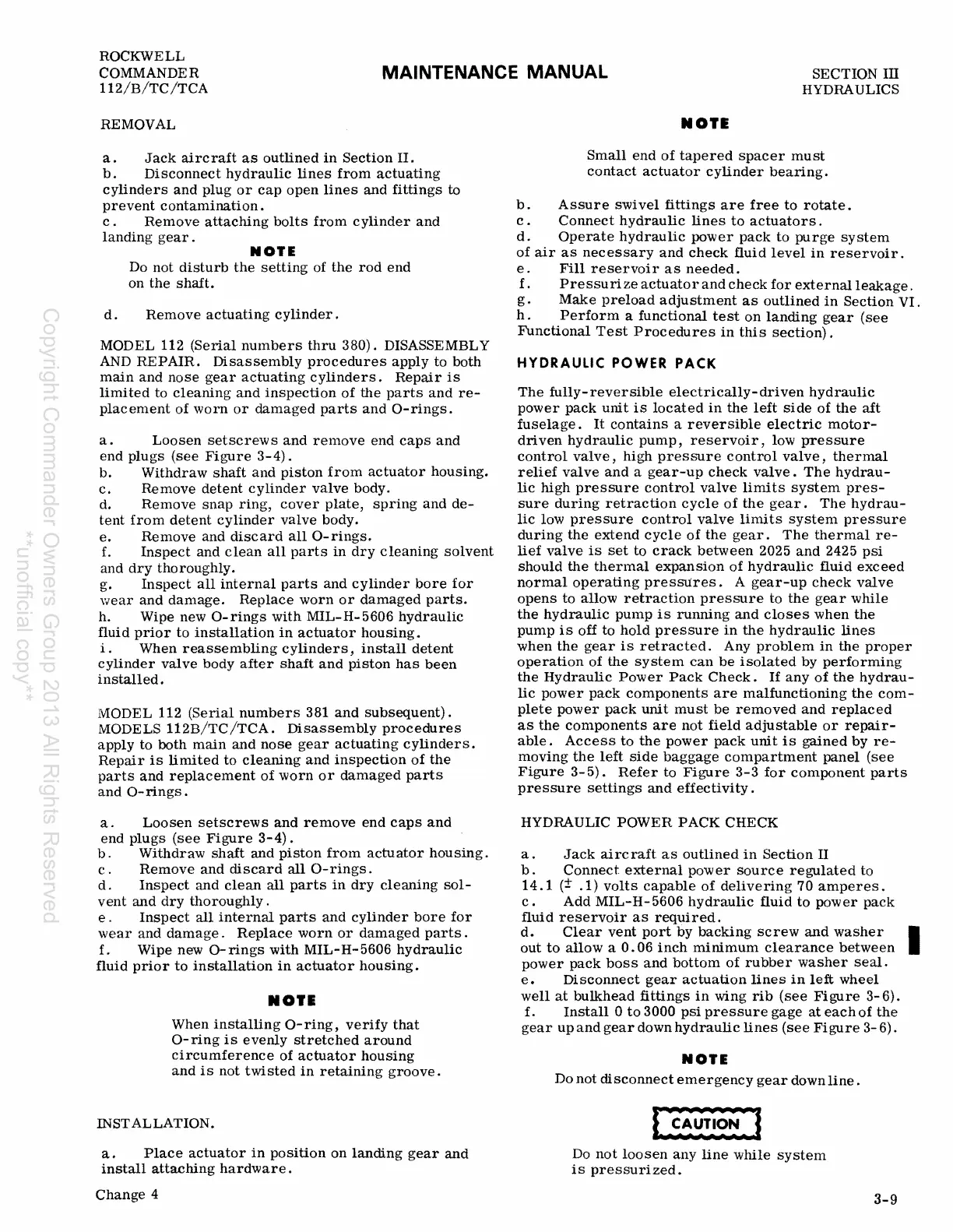
HYDRAULIC POWER PACK
The
fully-reversible
electrically-driven
hydraulic
power
pack
unit
is
located
in
the
left
side
of
the
aft
fuselage.
It
contains
a
reversible
electric
motor-
driven
hydraulic
pump,
reservoir,
low
pressure
control
valve,
high
pressure
control
valve,
thermal
relief
valve
and
a
gear-up
check
valve.
The
hydrau-
lic
high
pressure
control
valve
limits
system
pres-
sure
during
retraction
cycle
of
the
gear.
The
hydrau-
lic
low
pressure
control
valve
limits
system
pressure
during
the
extend
cycle
of
the
gear.
The
thermal
re-
lief
valve
is
set
to
crack
between
2025
and
2425
psi
should
the
thermal
expansion
of
hydraulic
fluid
exceed
normal
operating
pressures.
A
gear-up
check
valve
opens
to
allow
retraction
pressure
to
the
gear
while
the
hydraulic
pump
is
running
and
closes
when
the
pump
is
off to
hold
pressure
in
the
hydraulic
lines
when
the
gear
is
retracted.
Any
problem
in
the
proper
operation
of
the
system
can
be
isolated
by
performing
the
Hydraulic
Power
Pack
Check.
If
any
of
the
hydrau-
lic
power
pack
components
are
malfunctioning
the
com-
plete
power
pack
unit
must
be
removed
and
replaced
as
the
components
are
not
field
adjustable
or
repair-
able.
Access
to
the
power
pack
unit
is
gained
by
re-
moving
the
left
side
baggage
compartment
panel
(see
Figure
3-5).
Refer
to
Figure
3-3
for
component
parts
pressure
settings
and
effectivity.
HYDRAULIC
POWER
PACK CHECK
a.
Jack
aircraft
as
outlined
in
Section
II
b.
Connect.
external
power
source
regulated
to
14.1
.1)
volts
capable
of
delivering
70
amperes.
c.
Add
MIL-H-5606
hydraulic
fluid
to
power
pack
fluid
reservoir
as
required.
d.
Clear
vent
port
by
backing
screw
and
washer
I
out
to
allow
a
0.06
inch
minimum
clearance
between
power
pack
boss
and
bottom
of
rubber
washer
seal.
e.
Disconnect
gear
actuation
lines
in
left
wheel
well
at
bulkhead
fittings
in
wing
rib
(see
Figure
3-6).
f.
Install
0
to
3000
psi
pressure
gage
at
each
of
the
gear
up
and
gear
down
hydraulic
lines
(see
Figure
3-
6).
NOTE
Do not
disconnect
emergency
gear
down
line
.
Do
not
loosen
any
line
while
system
is
pressurized.
3-9
Copyright Commander Owners Group 2013 All Rights Reserved
**unofficial copy**

Table of Contents