EasyManua.ls Logo

Rockwell Commander 112 - GROUND EMERGENCY PROCEDURES

Rockwell Commander 112
293 pages
Print Icon
To Next Page IconTo Next Page
To Previous Page IconTo Previous Page
Loading...
SECTION
IT
SERVICING
MAINTENANCE
MANUAL
ROCKWELL
COMMANDER
112/B/TC/TCA
AND
INSPECTION
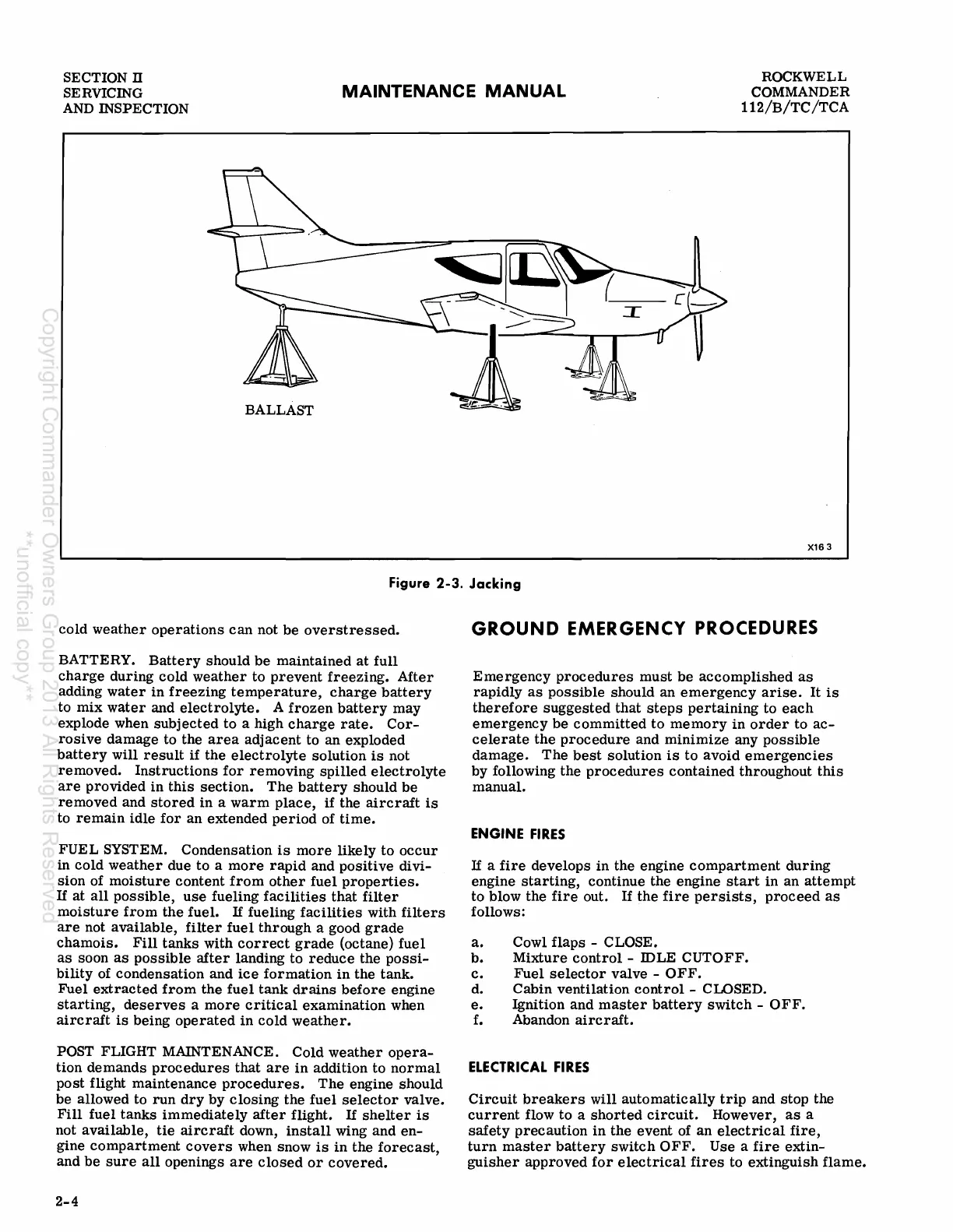
BALLAST
X163
Figure 2-3. Jacking
cold
weather
operations
can
not be
overstressed.
BATTERY.
Battery
should be maintained
at
full
charge
during cold
weather
to
prevent
freezing.
After
adding
water
in
freezing
temperature,
charge
battery
to
mix
water
and
electrolyte.
A
frozen
battery
may
explode when
subjected
to a high
charge
rate.
Cor-
rosive
damage to the
area
adjacent to an exploded
battery
will
result
if
the
electrolyte
solution
is
not
removed.
Instructions
for
remOving
spilled
electrolyte
are
provided in
this
section.
The
battery
should be
removed
and
stored
in
a
warm
place,
if the
aircraft
is
to
remain
idle
for
an extended
period
of
time.
FUEL SYSTEM. Condensation
is
more
likely to
occur
in
cold
weather
due
to
a
more
rapid
and
positive
divi-
sion of
moisture
content
from
other
fuel
properties.
If
at
all
pOSSible,
use
fueling
facilities
that
filter
moisture
from
the
fuel.
If
fueling
facilities
with
filters
are
not available,
filter
fuel
through
a good
grade
chamois.
Fill
tanks
with
correct
grade
(octane) fuel
as
soon
as
possible
after
landing to
reduce
the
possi-
bility
of condensation and
ice
formation
in
the tank.
Fuel
extracted
from
the
fuel
tank
drains
before
engine
starting,
deserves
a
more
critical
examination
when
aircraft
is
being
operated
in
cold
weather.
POST FLIGHT MAINTENANCE. Cold
weather
opera-
tion
demands
procedures
that
are
in
addition to
normal
post flight maintenance
procedures.
The
engine should
be allowed to
run
dry
by clOSing the fuel
selector
valve.
Fill
fuel
tanks
immediately
after
flight.
If
shelter
is
not
available,
tie
aircraft
down,
install
wing and
en-
gine
compartment
covers
when snow
is
in
the
forecast,
and be
sure
all
openings
are
closed
or
covered.
2-4
GROUND
EMERGENCY
PROCEDURES
Emergency
procedures
must
be
accomplished
as
rapidly
as
possible
should an
emergency
arise.
It
is
therefore
suggested
that
steps
pertaining
to
each
emergency
be
committed
to
memory
in
order
to
ac-
celerate
the
procedure
and
minimize
any
possible
damage.
The
best
solution
is
to avoid
emergenCies
by following the
procedures
contained throughout
this
manual.
ENGINE
FIRES
If
a
fire
develops in the engine
compartment
during
engine
starting,
continue the engine
start
in an
attempt
to blow the
fire
out.
If
the
fire
persists,
proceed
as
follows:
a.
Cowl
flaps
- CLOSE.
b. Mixture
control
- IDLE CUTOFF.
c.
Fuel
selector
valve -
OFF.
d. Cabin ventilation
control
- CLOSED.
e.
Ignition and
master
battery
switch
-
OFF.
f. Abandon
aircraft.
ELECTRICAL
FIRES
Circuit
breakers
will
automatically
trip
and stop the
current
flow to a
shorted
circuit.
However,
as
a
safety
precaution
in
the event of an
electrical
fire,
turn
master
battery
switch
OFF.
Use a
fire
extin-
guisher
approved
for
electrical
fires
to extinguish
flame.
Copyright Commander Owners Group 2013 All Rights Reserved
**unofficial copy**

Table of Contents