EasyManua.ls Logo

Rockwell Commander 112 - Air Bleed Nozzles; Flow Divider Valve

Rockwell Commander 112
293 pages
Print Icon
To Next Page IconTo Next Page
To Previous Page IconTo Previous Page
Loading...
SECTION
IV
POWER PLANT
AND
PROPE~LER
MAINTENANCE MANUAL
ROCKWELL
COMMANDER
112/B/TC
/TCA
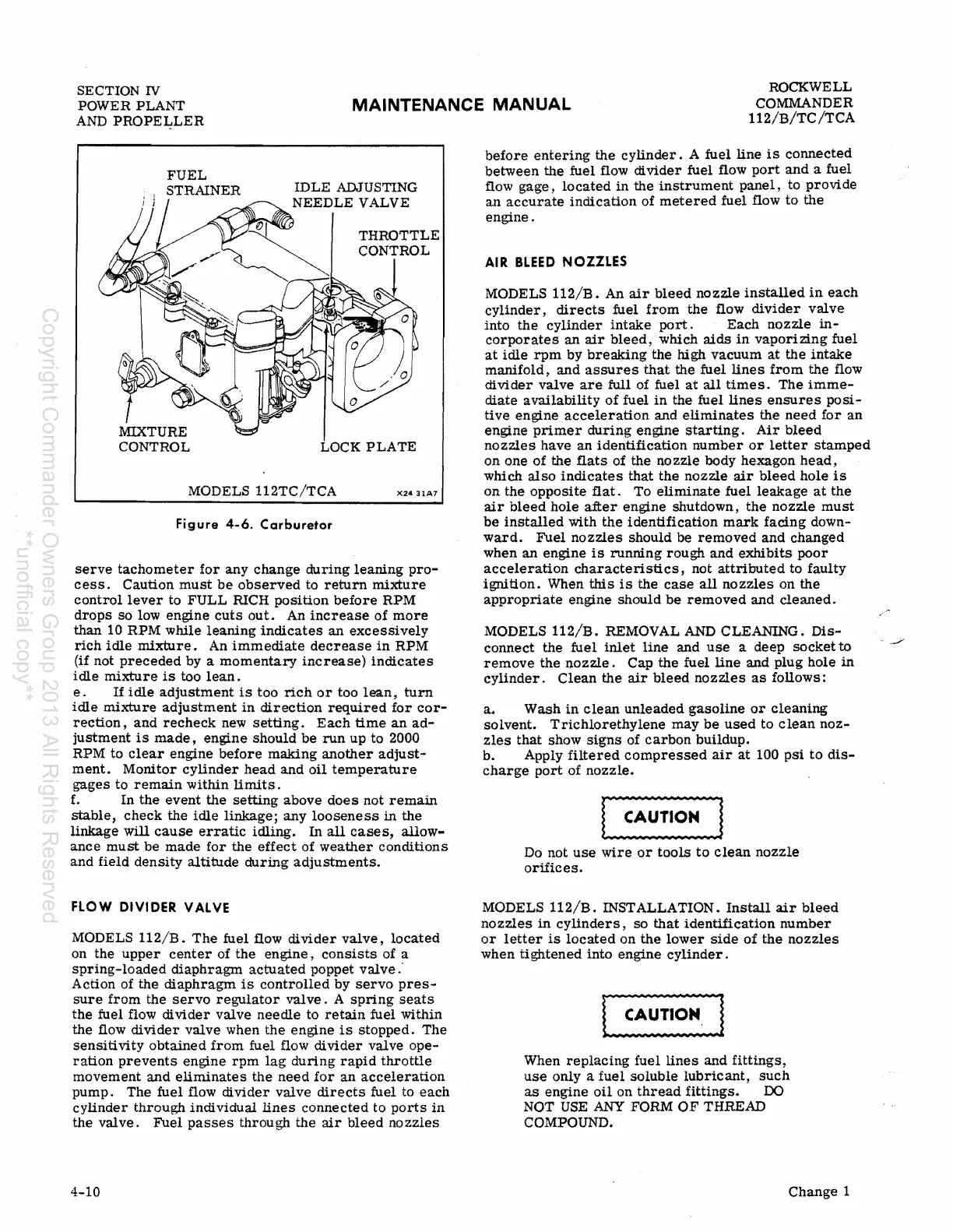
FUEL
STRAINER
IDLE
ADJUSTING
NEEDLE VALVE
LOCK
PLATE
MODELS
112TC/TCA
X2431A7
Figure
4-6.
Carburetor
serve
tachometer
for
any
change
during
leaning
pro-
cess.
Caution
must
be
observed
to
return
mixture
control
lever
to FULL RICH
position
before
RPM
drops
so
low engine
cuts
out.
An
increase
of
more
than 10 RPM
while
leaning
indicates
an
excessively
rich
idle
mixture.
An
immediate
decrease
in
RPM
(if
not
preceded
by a
momentary
increase)
indicates
idle
mixture
is
too
lean.
e.
If
idle
adjustment
is
too
rich
or
too
lean,
turn
idle
mixture
adjustment
in
direction
required
for
cor-
rection,
and
recheck
new
setting.
Each
time
an
ad-
justment
is
made,
engine
should
be
run
up to 2000
RPM to
clear
engine
before
making
another
adjust-
ment.
Monitor
cylinder
head
and
oil
temperature
gages
to
remain
within
limits.
f.
In
the
event
the
setting
above
does
not
remain
stable,
check
the
idle
linkage;
any
looseness
in
the
linkage
will
cause
erratic
idling.
In
all
cases,
allow-
ance
must
be
made
for
the
effect
of
weather
conditions
and
field
density
altitude
during
adjustments.
FLOW DIVIDER VALVE
MODELS
112/B.
The
fuel flow
divider
valve,
located
on
the
upper
center
of
the
engine,
consists
of a
spring-loaded
diaphragm
actuated
poppet valve'-
Action of
the
diaphragm
is
controlled
by
servo
pres-
sure
from
the
servo
regulator
valve.
A
spring
seats
the
fuel flow
divider
valve
needle
to
retain
fuel within
the
flow
divider
valve
when
the
engine
is
stopped.
The
sensitivity
obtained
from
fuel flow
divider
valve
ope-
ration
prevents
engine
rpm
lag
during
rapid
throttle
movement
and
eliminates
the
need
for
an
acceleration
pump.
The
fuel
flow
divider
valve
directs
fuel to
each
cylinder
through
individual
lines
connected
to
ports
in
the
valve.
Fuel
passes
through
the
air
bleed
nozzles
4-10
before
entering
the
cylinder.
A
fuel
line
is
connected
between
the fuel flow
divider
fuel flow
port
and
a fuel
flow
gage,
located
in
the
instrument
panel,
to
provide
an
accurate
indication
of
metered
fuel flow
to
the
engine.
AIR
BLEED
NOZZLES
MODELS
112/B.
An
air
bleed
nozzle
installed
in
each
cylinder,
directs
fuel
from
the
flow
divider
valve
into
the
cylinder
intake
port.
Each
nozzle
in-
corporates
an
air
bleed,
which
aids
in
vaporizing
fuel
at
idle
rpm
by
breaking
the
high
vacuum
at
the
intake
manifold,
and
assures
that
the
fuel
lines
from
the flow
divider
valve
are
full of fuel
at
all
times.
The
imme-
diate
availability
of
fuel
in
the fuel
lines
ensures
posi-
tive
engine
acceleration
and
eliminates
the
need
for
an
engine
primer
during
engine
starting.
Air
bleed
nozzles
have
an
identification
number
or
letter
stamped
on one
of
the
flats
of the
no
zzle body hexagon
head,
which
also
indicates
that
the
nozzle
air
bleed
hole
is
on
the
opposite
flat.
To
eliminate
fuel
leakage
at
the
air
bleed
hole
after
engine shutdown,
the
nozzle
must
be
installed
with
the
identification
mark
facing
down-
ward.
Fuel
nozzles
should be
removed
and
changed
when
an
engine
is
running
rough
and
exhibits
poor
acceleration
characteristics,
not
attributed
to
faulty
ignition.
When
this
is
the
case
all
nozzles
on the
appropriate
engine should
be
removed
and
cleaned.
MODELS
112/B.
REMOVAL
AND
CLEANING.
Dis-
connect
the
fuel
inlet
line
and
use
a deep
socket
to
remove
the
nozzle.
Cap
the
fuel
line
and
plug
hole
in
cylinder.
Clean
the
air
bleed
nozzles
as
follows:
a.
Wash
in
clean
unleaded
gasoline
or
cleaning
solvent.
Trichlorethylene
may
be
used
to
clean
noz-
zles
that
show
signs
of
carbon
buildup.
b. Apply
filtered
compressed
air
at
100
psi
to
dis-
charge
port
of
nozzle.
Do not
use
wire
or
tools
to
clean
nozzle
orifices.
MODELS
112/B.
INSTALLATION.
Install
air
bleed
nozzles
in
cylinders,
so
that
identification
number
or
letter
is
located
on
the
lower
side
of
the
nozzles
when
tightened
into engine
cylinder.
[~
When
replacing
fuel
lines
and
fittings,
use
only a
fuel
soluble
lubricant,
such
as
engine
oil
on
thread
fittings.
00
NOT
USE
ANY
FORM
OF
THREAD
COMPOUND.
Change 1
Copyright Commander Owners Group 2013 All Rights Reserved
**unofficial copy**

Table of Contents