EasyManua.ls Logo

Rockwell Commander 112 - Jacking; Mooring; Parking; Taxiing

Rockwell Commander 112
293 pages
Print Icon
To Next Page IconTo Next Page
To Previous Page IconTo Previous Page
Loading...
SECTION II
SERVICING
MAINTENANCE MANUAL
ROCKWELL
COMMANDER
112/B/TC/TCA
AND
INSPECTION
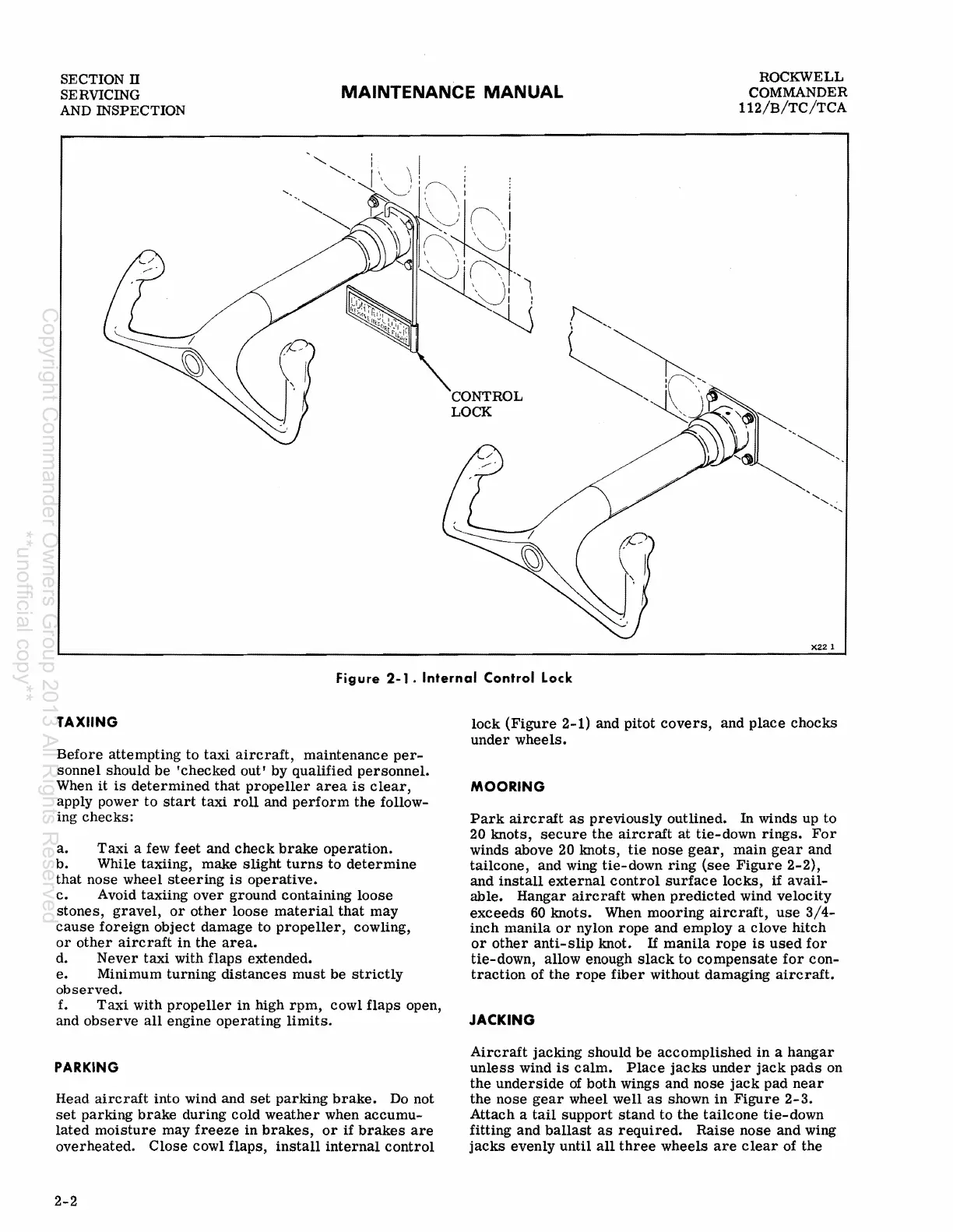
CONTROL
LOCK
X221
Figure
2-1
.
Internal
Control Lock
TAXIING
Before
attempting to taxi
aircraft,
maintenance
per-
sonnel should be
'checked
out' by qualified
personnel.
When
it
is
determined
that
propeller
area
is
clear,
apply power to
start
taxi
roll
and
perform
the follow-
ing checks:
a.
Taxi
a few feet and
check
brake
operation.
b. While taxiing, make
slight
turns
to
determine
that nose wheel
steering
is
operative.
c.
Avoid taxiing
over
ground containing loose
stones,
gravel,
or
other
loose
material
that may
cause
foreign
object damage to
propeller,
cowling,
or
other
aircraft
in
the
area.
d.
Never
taxi with flaps extended.
e.
Minimum turning
distances
must
be
strictly
observed.
f.
Taxi
with
propeller
in
high
rpm,
cowl flaps open,
and
observe
all
engine
operating
limits.
PARKING
Head
aircraft
into wind and
set
parking
brake.
Do
not
set
parking
brake
during cold
weather
when accumu-
lated
moisture
may
freeze
in
brakes,
or
if
brakes
are
overheated. Close cowl
flaps,
install
internal
control
2-2
lock
(Figure
2-1) and pitot
covers,
and
place
chocks
under
wheels.
MOORING
Park
aircraft
as
previously
outlined. In winds up to
20 knots,
secure
the
aircraft
at
tie-down
rings.
For
winds above 20 knots,
tie
nose
gear,
main
gear
and
tailcone, and wing tie-down
ring
(see
Figure
2-2),
and
install
external
control
surface
locks,
if
avail-
able. Hangar
aircraft
when
predicted
wind velocity
exceeds
60
knots. When mooring
aircraft,
use
3/4-
inch
manila
or
nylon
rope
and employ a clove hitch
or
other
anti-slip
knot.
If
manila
rope
is
used
for
tie-down, allow enough
slack
to
compensate
for
con-
traction
of the rope
fiber
without damaging
aircraft.
JACKING
Aircraft
jacking should
be
accomplished
in
a
hangar
unless
wind
is
calm.
Place
jacks
under
jack
pads
on
the
underside
of
both wings and nose
jack
pad
near
the nose
gear
wheel well
as
shown in
Figure
2-3.
Attach a
tail
support
stand
to the tailcone tie-down
fitting and
ballast
as
required.
Raise
nose and wing
jacks
evenly until
all
three
wheels
are
clear
of the
Copyright Commander Owners Group 2013 All Rights Reserved
**unofficial copy**

Table of Contents