EasyManua.ls Logo

Rockwell Commander 112 - Cold Weather Maintenance Hints; Cold Weather Operation; Leveling

Rockwell Commander 112
293 pages
Print Icon
To Next Page IconTo Next Page
To Previous Page IconTo Previous Page
Loading...
ROCKWELL
COMMANDER
112/B/TC/TCA
MAINTENANCE
MANUAL
SECTION
IT
SERVICING
AND INSPECTION
XIS
2A
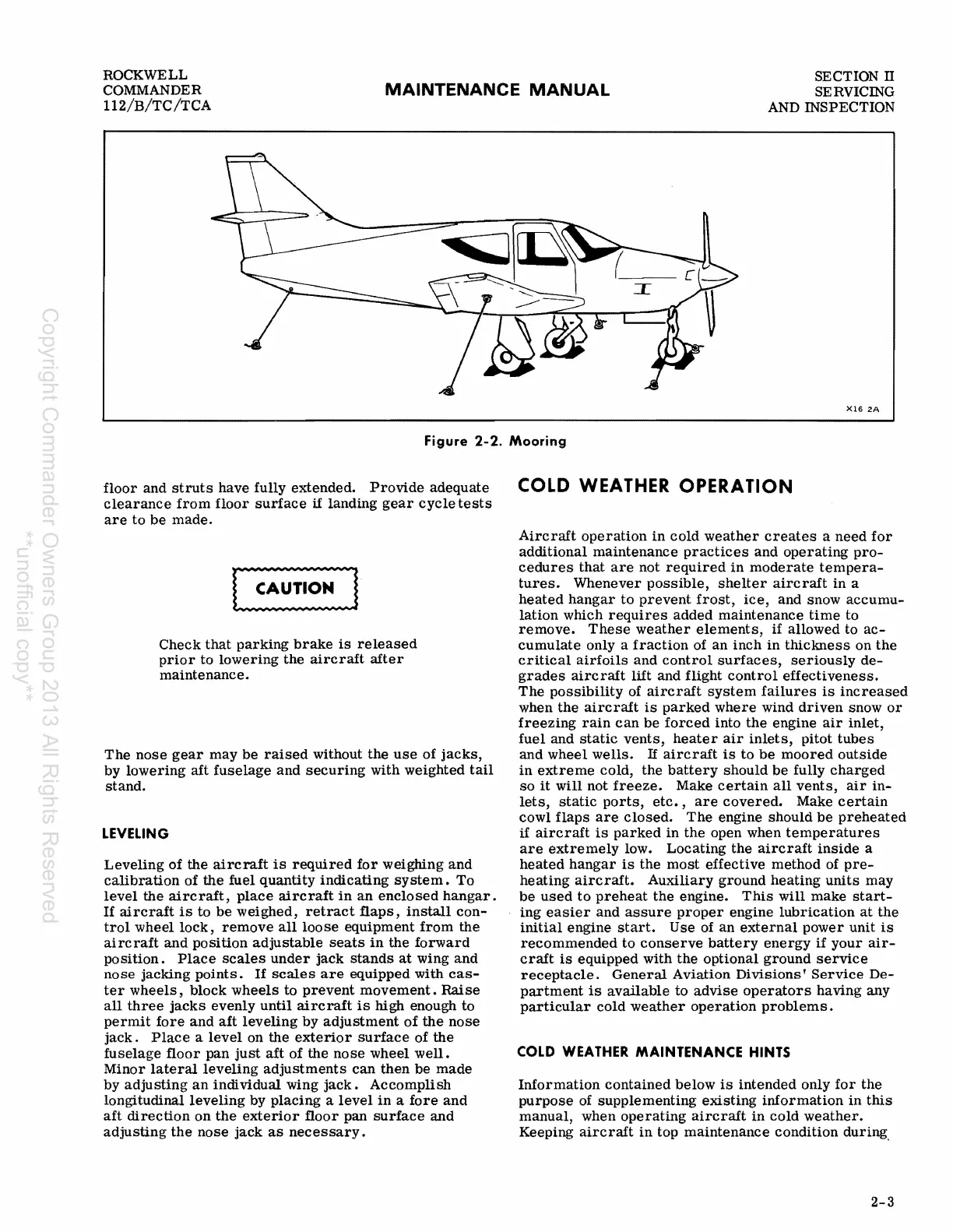
Figure
2-2.
Mooring
floor
and
struts
have fully extended.
Provide
adequate
clearance
from
floor
surface
if landing
gear
cycle
tests
are
to
be
made.
Check
that
parking
brake
is
released
prior
to lowering the
aircraft
after
maintenance.
The
nose
gear
may be
raised
without the
use
of
jacks,
by lowering aft
fuselage
and
securing
with weighted
tail
stand.
LEVELING
Leveling
of
the
aircraft
is
required
for
weighing
and
calibration
of
the
fuel
quantity
indicating
system.
To
level
the
airc
raft,
place
airc
raft
in
an
enclo
sed
hangar.
If
aircraft
is
to
be
weighed,
retract
flaps,
install
con-
trol
wheel
lock,
remove
all
loose
equipment
from
the
aircraft
and pOSition
adjustable
seats
in
the
forward
position.
Place
scales
under
jack
stands
at
wing
and
nose
jacking
points.
If
scales
are
equipped with
cas-
ter
wheels,
block
wheels
to
prevent
movement.
Raise
all
three
jacks
evenly
until
aircraft
is
high enough to
permit
fore
and
aft
leveling
by
adjustment
of
the
nose
jack.
Place
a
level
on the
exterior
surface
of
the
fuselage
floor
pan
just
aft
of the
nose
wheel
well.
Minor
lateral
leveling
adjustments
can
then
be
made
by
adjusting
an
individual wing
jack.
Accomplish
longitudinal
leveling
by
placing
a
level
in
a
fore
and
aft
direction
on
the
exterior
floor
pan
surface
and
adjusting
the
nose
jack
as
necessary.
COLD
WEATHER
OPERATION
Aircraft
operation
in
cold
weather
creates
a
need
for
additional maintenance
practices
and
operating
pro-
cedures
that
are
not
required
in
moderate
tempera-
tures.
Whenever
possible,
shelter
aircraft
in
a
heated
hangar
to
prevent
frost,
ice,
and snow
accumu-
lation which
requires
added maintenance
time
to
remove.
These
weather
elements,
if allowed to
ac-
cumulate
only a
fraction
of an inch in
thickness
on
the
critical
airfoils
and
control
surfaces,
seriously
de-
grades
aircraft
lift and flight
control
effectiveness.
The
possibility
of
aircraft
system
failures
is
increased
when the
aircraft
is
parked
where
wind
driven
snow
or
freezing
rain
can
be
forced
into
the
engine
air
inlet,
fuel
and
static
vents,
heater
air
inlets,
pitot
tubes
and wheel
wells.
H
aircraft
is
to
be
moored
outside
in
extreme
cold, the
battery
should
be
fully
charged
so
it
will
not
freeze.
Make
certain
all
vents,
air
in-
lets,
static
ports,
etc.,
are
covered.
Make
certain
cowl
flaps
are
closed.
The
engine should
be
preheated
if
aircraft
is
parked
in the open when
temperatures
are
extremely
low. Locating the
aircraft
inSide a
heated
hangar
is
the
most
effective method of
pre-
heating
aircraft.
Auxiliary
ground heating
units
may
be
used
to
preheat
the
engine.
This
will
make
start-
ing
easier
and
assure
proper
engine
lubrication
at
the
initial
engine
start.
Use of
an
external
power unit
is
recommended
to
conserve
battery
energy
if
your
air-
craft
is
equipped with
the
optional
ground
service
receptacle.
General
Aviation
Divisions
f
Service
De-
partment
is
available
to
advise
operators
having any
particular
cold
weather
operation
problems.
COLD
WEATHER
MAINTENANCE
HINTS
Information
contained
below
is
intended only
for
the
purpose
of supplementing
existing
information
in
this
manual, when
operating
aircraft
in
cold
weather.
Keeping
aircraft
in
top
maintenance
condition during.
2-3
Copyright Commander Owners Group 2013 All Rights Reserved
**unofficial copy**

Table of Contents