Once a message as passed all filters, and possible down-sampling, the R60 selects a
slot for transmission. First available FATDMA slots (see 6.14.3) are checked. If no
reserved FATDMA slots are available the repeater uses RATDMA, provided it is enabled
(see General
Enable RATDMA in Table 6-12). If neither is available, the message will
not be repeated.
A message is always repeated onto the same channel as it was received on.
6.14.2 Configure > Repeater > General
This category contains general settings for the repeater function, like enabling or
disabling of the feature, etc.
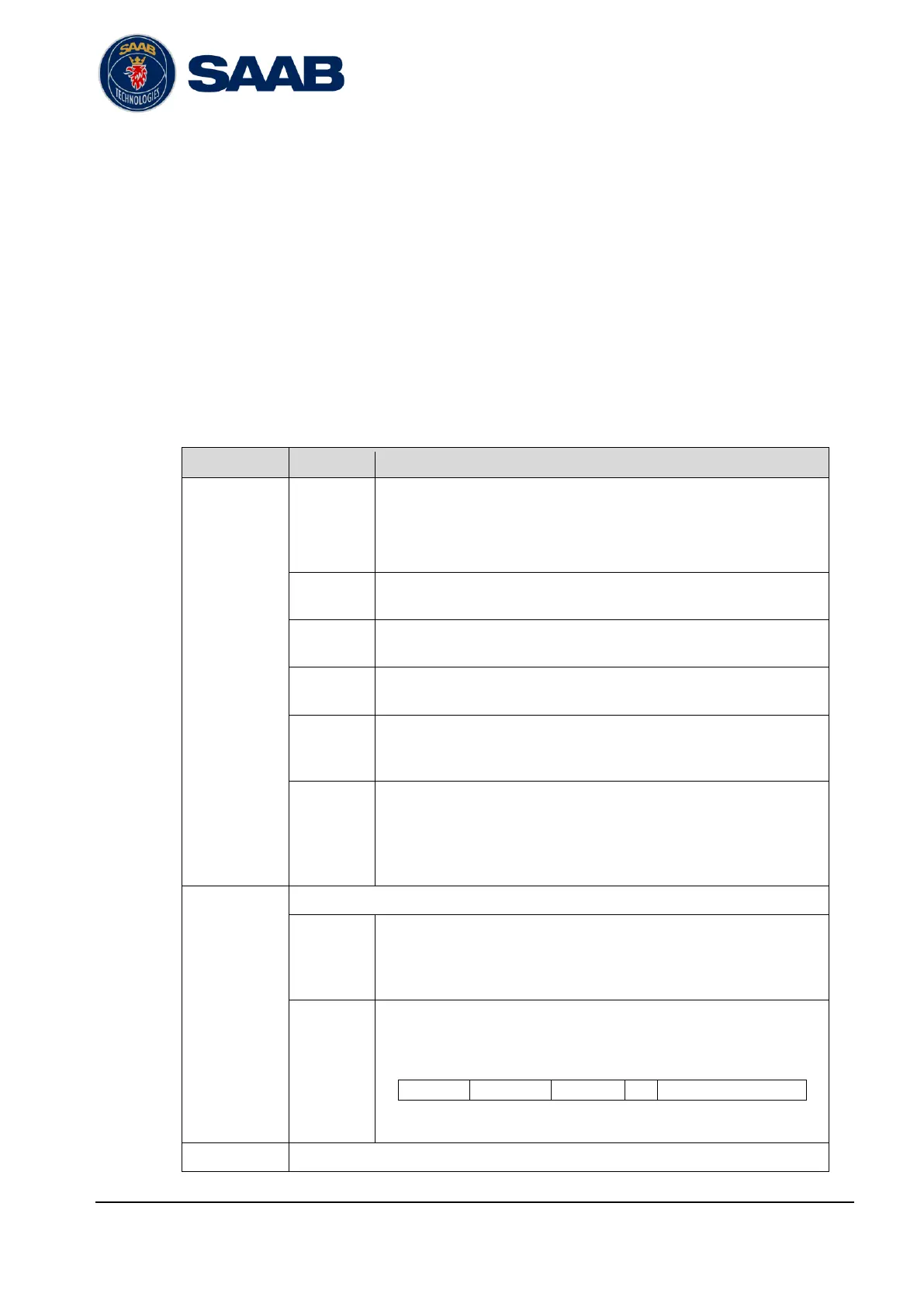
The General repeater settings are described in Table 6-12 below.
Enables or disables the repeater function of the base station.
Please note that additional conditions must be fulfilled for the
repeater to function, but if it is disabled using this parameter nothing
will be repeated.
The MMSI number for the repeater report. Must be non-zero to
enable the repeater.
Select to allow the R60 to use RATDMA access to VDL when repeating
messages.
Enable repetition of AIS SART test messages. Should not be enabled
normally.
Maximum number of slots allowed to be used per frame for repeated
messages. Range: 0 – 400. Setting this value too low will in effect
disable the repeater.
Encryption key used for configuration of the repeater via the VDL in
accordance with the repeater standard. It is recommended to set this
to all zero which disables the over-the-air configuration.
The only parameter that can be configured over-the-air is the
repeater enable, and to do this external software is required.
The position used in the repeater report.
The position source can be:
Surveyed – the position is defined by the Latitude and Longitude
parameters below.
Internal – the position of the internal GNSS of the R60 is used.
If the position source is selected to be surveyed in the previous
parameter, then the position is typed in here.
The coordinates format is:
Example: Latitude = 16N12.9823, meaning 16° North and 12.9823'
Repeater report transmission settings.


 To Next Page