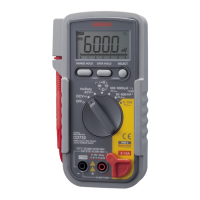
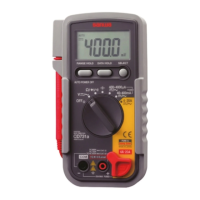
1
[1] Warnings for Safe Use of Multimeter
(Be sure to read this section before using the multimeter.)
The instructions given in the text under
Warning and Caution must be observed to prevent
burns, electric shocks and other similar accidents.
1-1 Explanation of symbols
The symbols and their meanings used on the PC20TK and the instruction manual are shown below:
: Indicates information that is particularly important for safe use.
• A warning message is given to prevent burns, electric shock and other accidents resulting in
injury or death.
• A cautionary message is given relating to any possibility of damaging this product.
: Indicates that this part is potentially dangerous because it may be charged with high voltage.
:
Double insulation or reinforced insulation
: Fuse
: Buzzer + : Positive
: Ground : AC : Diode - : Negative
Ω : Resistance
: DC : Capacitor
1-2 Warning messages
The following warning messages are given to prevent accidents resulting in injury or death owing
to burns, electric shock or other. Be sure to observe these instructions along with the ones
included in this instruction manual.
1. Do not use the PC20TK with any power line exceeding 6 kVA.
2. Be careful about voltage of 33 VAC rms (46.7 Vpeak) or 70 VDC minimum because it is
dangerous to the human body.
3. Do not input any signal exceeding the maximum rated input value.
4. Do not try to measure a line (e.g., to a motor) where induced voltage or surge voltage may
occur, because the maximum overload input value might be exceeded.
5. Do not use the PC20TK if its main body or test lead is damaged or broken.
6. Do not use the PC20TK with its case removed.
7. Do not use any substitute for a fuse or connect wire for non-electrical use.
8. During measurement, do not hold any portion of the test pin beyond the test lead.
9. Do not input voltage to the current measurement connector. Inputting voltage to that connector
will result in a short-circuit, blowing out the built-in fuse. However, this may involve a danger.
10. Do not change over to any other mode during measurement.
11. Ensure that you have selected the proper range and mode for each measurement run.
12. Use the specified type (TL-21) of test lead.
13. Do not try to make a measurement with the PC20TK or your hand being wet.
14. Use the PC20TK indoors.
15. Check the appearance and the display of each mode (range) at least once a year.
Warning
The PC20TK is not provided with an automatic power-off capability. Be sure to turn OFF the Function
switch after measurement has been finished, because the batteries will otherwise run out earlier.
Caution
Prior to the assembling of the PC20TK, check the parts in accordance with paragraph (2) in "4-5
Preparations for assembling."
Note


 To Next Page