20
[4] Assembling
4-1 Soldering
Soldering is important work in assembling the multimeter. Incomplete soldering of parts can cause
a problem by causing the multimeter to fail to operate or malfunction during use. Solder is alloy
with a low melting point, which uses lead and tin as main ingredients to electrically and
mechanically connect metal to metal (a component to a component). Solder wire is solder alloy
formed into wire, which includes flux to ensure and facilitate successful soldering. Flux reduces and
removes oxides on the metal surface to be soldered and improves the affinity between solder and
metal. Precautionary instructions on the soldering work are given below:
1. Remove foreign matter and rust on the surface of the metal to be soldered, by using cloth or
abrasive paper.
2. Control the temperature of the soldering iron.
Use the following criteria to determine whether the temperature of the tip is appropriate:
• Too high temperature: The tip is blackened with oxidization in several minutes and cannot be
coated with solder.
• Too low temperature: Solder melts too slowly and the soldering tip becomes sharp-pointed or
dull-colored.
To control the temperature of a soldering iron that has no automatic temperature control, use a
voltage regulator or change the length of the exposed tip of the soldering iron. In controlling the
temperature with the length of the tip, longer length of the exposed portion decreases the
temperature, while shorter one increases the temperature.
3. If the tip of a soldering iron is dirty or coated with excessive solder, soldering cannot be
performed properly. Use wet cloth or the like to wipe off foreign matter and then carry out
soldering.
4. If the tip is difficult to coat with solder, apply preliminary solder to the tip to ensure efficient
soldering.
Memo: Soldering is work that is done to joint metal to metal by applying solder to the part to be
soldered. Hold the soldering iron tip on the metal surface, wait for the temperature of
the surface to become high enough to melt solder, and then apply solder. This will result
in successful soldering. In other words, feed solder a little later than making the
soldering iron tip contact with the metal surface.
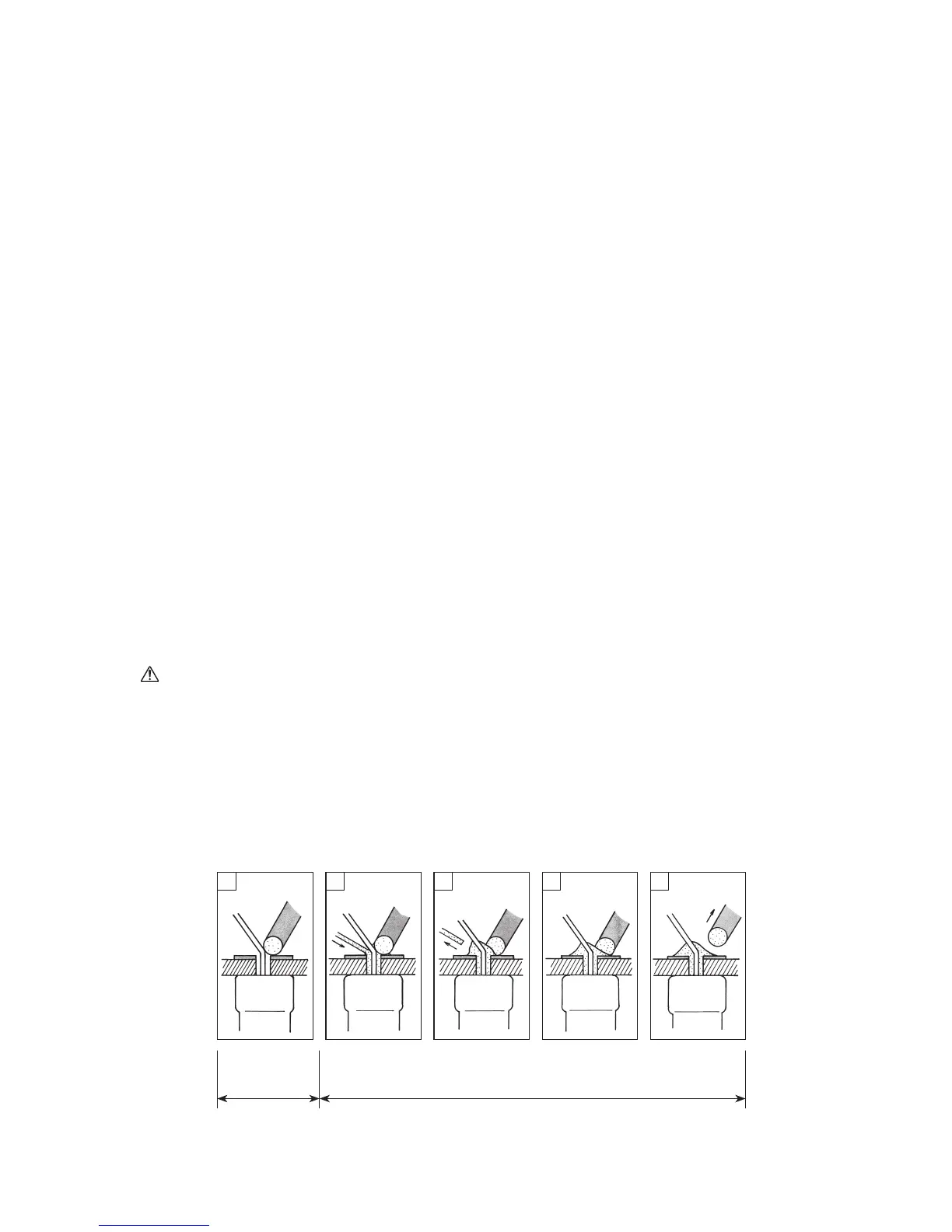
4-2 Soldering procedure
Successful soldering results in forming a crest with a glossy surface.
1. Component with lead wire
Heat
Melt solder by 2-3
mm in length
Separate solder
Wait for solder
to spread
Separate the
soldering iron tip
1 second 1 second
Soldering
iron tip
Lead wire
Substrate
Component
Fig. 4-1
1
2 3 4 5


 To Next Page