ST94-21 C/Ku-Band TVRO Determine Internal Tracking Receiver Settings
6. Determine Internal Tracking Receiver Settings
This lesson contains some general information on how to determine, obtain, and enter the antenna control units tracking
receiver settings.
6.1. IF Tracking Frequency
The IF Tracking parameter is a calculated value entered into the ACU’s FREQ Sub-Menu. The value itself is calculated
by using the formula RF- LO = IF.
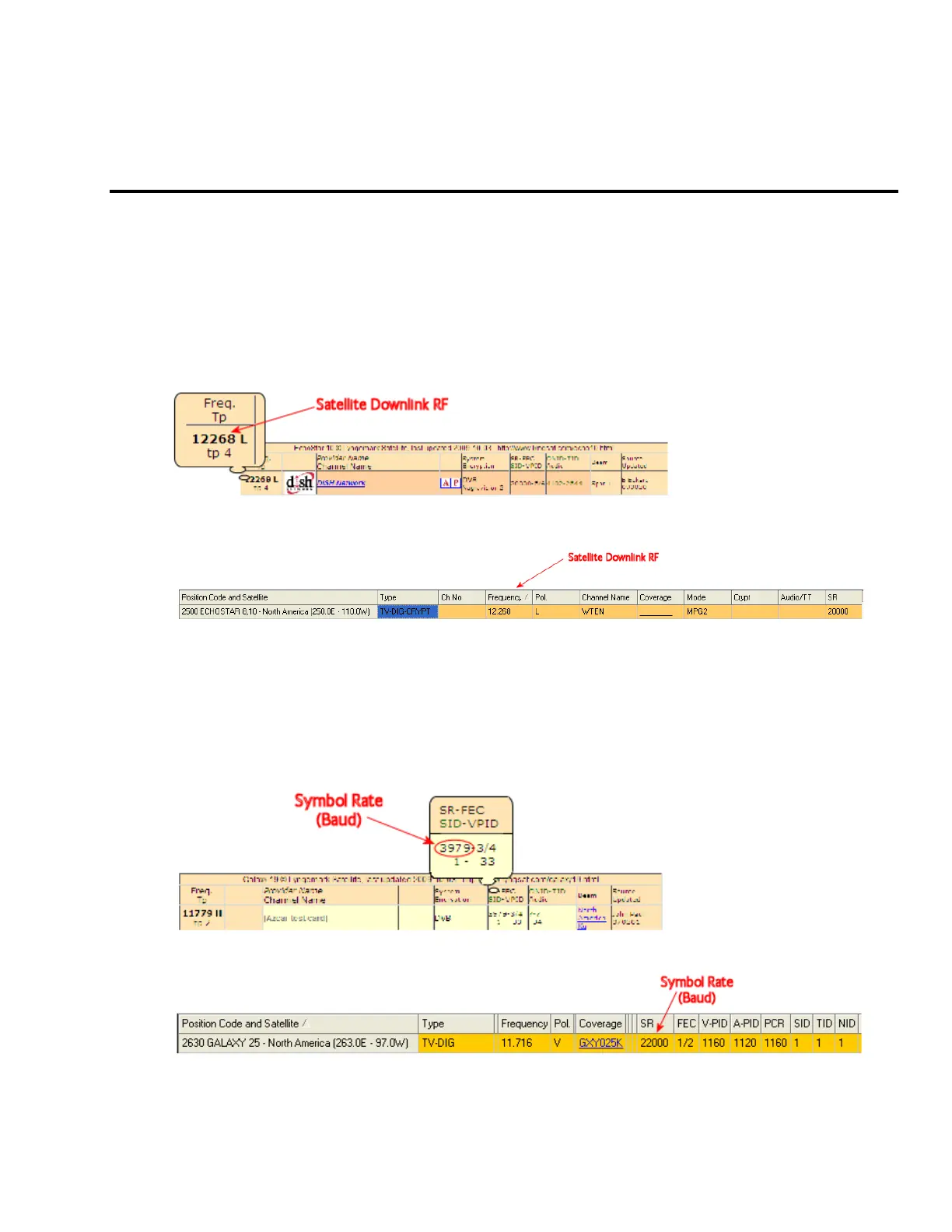
When you take the Satellite Transponder Downlink RF value and subtract the LNB’s Local Oscillator (LO) Value, the
resultant value will equal the Intermediate Frequency (IF). It is this IF value that will be entered into the ACU for
tracking purposes. Example assuming an LNB LO value of 11.25GHz: 12268-11250 = 1018 MHz IF
Identifying the Downlink RF using Capture from Lyngsat.com
Identifying the Downlink RF using WWW.Lyngsat.com
6.2. Baud Rate
The Baud rate entered into the ACU is an absolute value based on the Downlink RF from the satellite and thus no
calculations by the onboard technician are required. Prior to, or during, the commissioning process, the NOC should
provide the operator/technician with the required Baud rate value. When using a Public Satellite Reference Site such as
Lyngsat.com or Satellite Reference Software such as WWW.Lyngsat.com, Baud Rate is defined as Symbol Rate (SR).
Identifying the Baud Rate using Lyngsat.com
Identifying the Baud Rate using WWW.Lyngsat.com
EAR Controlled - ECCN EAR99


 To Next Page