XT Controllers for NLV-CN Compressors
Page 30 / 31
4.6.
Compressor
Capacity Control
The purpose of this function is to calculate the requested compressor capacity that is needed to cool down
or maintain the correct cabinet temperature during normal temperature control.
During the pull up/down of the cabinet, after the initial start or after a defrosting sequence, the capacity
controller will be overruled by predefined capacity requests.
Functional description:
The reference “T
ref
” for the controller is given by the reference function, based upon either the temperature
sensor S1, S2, or a mix of both.
The actual requested compressor capacity is determined based on a PI controller that compares the
actual temperature with the reference temperature. The greater the deviation in temperature, the faster
the adaptation of the compressor capacity is performed.
The compressor can be speed controlled in the range from 45% to 100%, corresponding to 2,000 to 4,500
revolutions per min. If the requested compressor capacity is less than 45%, the compressor will start and
stop at 2,000 RPM on a PWM basis. As default, the “Compressor Period Time” (g05) is set to 15 minutes.
This means that the compressor will be running for a shorter or longer time within this period.
The capacity controller contains compressor protection settings to prevent the start/stop of the
compressors from occurring too often (g03 and g04).
After initial start, the compressor capacity will be set to 100%, until the reference temperature T
ref
has
been reached. In some applications it might be an advantage to run the compressor at the pull-down
capacity for some extra time. Although the air temperature in the cabinet has reached the set point, the
goods will still be too warm. For that reason, the pull-down period can be extended, until the “T
act
below
T
ref
to end Pull Down” (n48) has been reached. After this the PI controller will be preset to a default value,
depending on whether the controller is in day or night mode (n53 and n54).
Depending on the size of the deviation between the reference temperature T
ref
and the actual temperature,
the requested capacity will now be increased or decreased faster or slower. The speed of adapting the
requested capacity depends on the settings for the PI controller.
Requested Compressor Capacity Compressor Speed, Period Time = 15 minutes
0% Compressor constantly stopped
22%
Pulse width modulation, PWM
7,5 minutes ON (2000 RPM)
7,5 minutes OFF
45% Compressor constantly running 2,000 RPM
100% Compressor constantly running 4,500 RPM
Due to different load profiles for the different applications, the controller has a “smart setting for PI
control” (n30) application. The default setting is medium control, but if a faster adaptation of the requested
compressor capacity is needed, this can be changed to fast or even very fast control. On the other hand,
this can also be set to slow or very slow, if the cooling application requests this. In situations, where one
of these settings is not suitable for the application, the PI settings can be adjusted by the customer (n35
to n43). Contacting the supplier of the controller is recommended for optimal adjustment. Although, the
right smart setting or individual adaptation of the PI controller has been chosen, a cabinet temperature
exceeding a pre-defined minimum or maximum limit, compared to the temperature reference T
ref
could
occur.
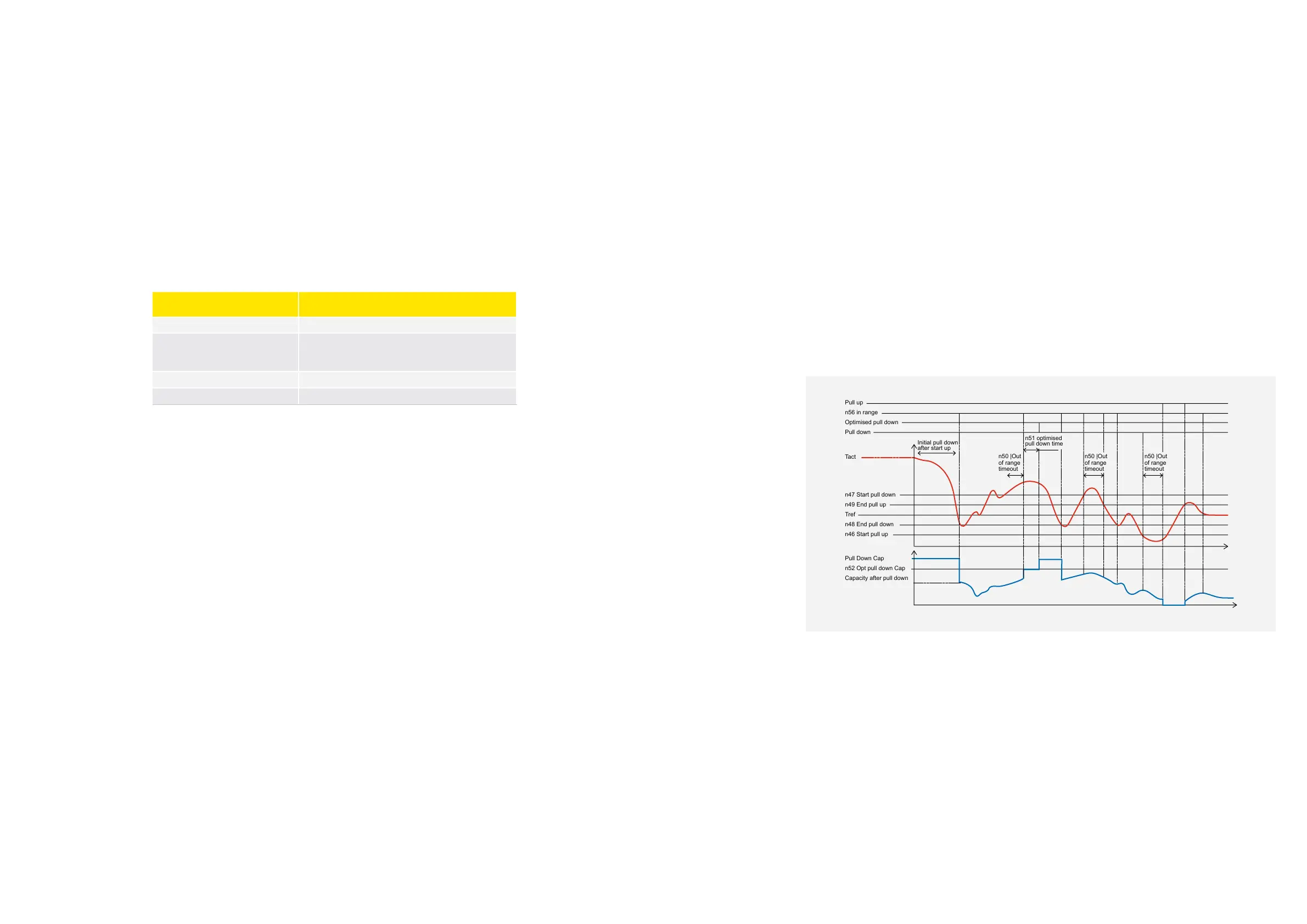
As soon as the temperature reaches the limit of “T
act
above c to start Pull Down limit” (n47) or the limit
of “T
act
below T
ref
to start pull up limit” (n46), a timer “Temperature out of range timeout” (n50) begins.
After this timer has elapsed, a forced pull-up or pull-down starts. The timer will be reset as soon as the
temperature is back within the min. and max. limits.
If a pull down is requested, the compressor capacity will be preset to "Optimized pull down capacity" (n52).
This capacity will be applied, until the time "Optimized pull down time" (n51) has elapsed. Hereafter, the
compressor will run at 100%, until the set point has been reached.
If a forced pull-up has been initiated, the compressor will stop, until the temperature exceeds “T
act
above
T
ref
to end pull-up” (n49).
If the digital input DI1 is defined to be used as a door switch, it is possible to stop the evaporator fan when
the doors are open. It is also possible to override the capacity controller at the same time. The compressor
can be stopped “Compressor capacity switching on door open” (n22) or the compressor capacity can
be preset by “Compressor capacity at door open” (n23). As soon as the door is shut again, the capacity
controller will resume with the same capacity as prior to the door opening.
Defrosting:
The PI controller is suspended during a defrosting sequence. Prior to defrosting, the actual requested
compressor capacity is stored in the memory. Once defrosting is complete and after pull-down of the
temperature to a set point, the normal capacity control is resumed, based upon the previous stored
capacity.
Emergency cooling:
In the event of sensor errors, the capacity controller stops and the compressor capacity is preset to a
customer specified value, “Emergency cooling capacity during S1/S2 error” (n21). For more information,
please refer to the chapter Emergency Cooling Function.
Pull up
n56 in range
Optimised pull down
Pull down
Initial pull down
after start up
n51 optimised
pull down time
n50 |Out
of range
timeout
n50 |Out
of range
timeout
n50 |Out
of range
timeout
Pull Down Cap
n52 Opt pull down Cap
Capacity after pull down
Tact
n47 Start pull down
n49 End pull up
Tref
n48 End pull down
n46 Start pull up



 To Next Page