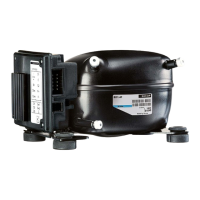
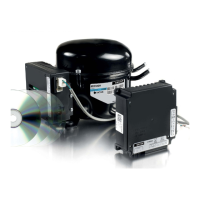
XT Controllers for NLV-CN Compressors
Page 66 / 67
7.2.
Installation
Cable length
With the recommended usage of RJ-45 and CAT-5 cables, a maximum cable length of 600 m can be
reached without additional equipment. A cable length of 1,000 m is possible when choosing other cables,
but this solution is normally much more expensive in material and installation. The possible cable length
depends on the installation quality and type of termination.
Knot count
The knot count depends on the properties of each connected knot and from the quality of the installation.
At least 32 knots are always guaranteed (without repeater) by the specification, but this requires a proper
installation. The properties of the knots are defined by their driver capabilities. There are “full”, “1/2”,
“1/4”, and “1/8” available on the market. Full transceivers make 32 knots possible. With “1/2” transceivers
up to 64 knots are possible and so on. The weakest transceiver holds the maximum possible knot count.
When there is only one “full” transceiver in a bunch of “1/4” transceivers the bus is limited to max 32
units. With “1/8” transceivers it is possible to build a network with up to 256 knots, but this requires good
network equipment and a proper installation. With more than 32 knots a repeater could be necessary.
When more than 31 controllers are used, a repeater is recommended.
Data rate
The controller is supporting a data rate of 9.6 kbit and 19.2 kbit, 19.2 kbit being the default. Further data
rates are not supported.
Wiring
The wiring is a one-to-one connection of the used lines, so all D1 lines are connected to one wire,
similarly D0 lines and all commons (see also “Pin Assignments”). D1 and D0 must be together in a twisted
pair. This is guaranteed with the recommended equipment. The recommended topology is the “bus”
structure with passive taps and a derivation cable to the controller. The standard allows a maximum length
for passive taps of 20 m and with multi-port taps of 40 m, but the derivation cables should be as short as
possible to reduce problems and increase performance.
This solution is the simplest way to install a cheap network with low risk of error. The recommended
equipment is the standard parts for computer networks.
Polarization
The communication with the controllers requires line polarization, the controller as a passive device isn’t
prepared to do this. Both bus lines must be pulled to a stable state which represent its logical idle state
D1 = 1 (type 5 V) and D0 = 0 (COM/PE). The specification requires a value of 450 Ω to 650 Ω for each. These
balancing resistors must only be installed once on the bus. Often the master will have these resistors built
in; otherwise it should be close to the master.
Termination
The specification requires a resistor of 150 Ω (0.5 W) at either end or a 120 Ω (0.25 W) resistor with a
1nF (25 V) capacitor in series between D1 and D0. The bus termination is a very important point when
the knot count is high and/or the cable is very long. The termination must be placed on both ends of the
communication line.
It is possible that other Modbus equipment has built in termination, these terminators must be disabled
(these additional terminators will increase the bus load and limit the possible length of the bus and knot
count). Only the terminators at the ends of the Modbus are allowed. The general rule is to reduce the
resistance or to decrease the current. A reduction of the current by using a RC terminator instead of a
simple resistor is one of the safest ways. Please note, it’s possible that the terminations inside the bus
master only have a resistor. In these cases it is recommended to disable the internal termination and add
a RC terminator external. This solution has the benefit of the lowest power consumption in bus idle state.
A bus configuration with a normal resistor termination should only be used if there are only a few knots
and a relative short bus.
Common line
The common line is required to bring together all transceivers which are connected to the bus. This line
should have only one direct connection to PE, which should be close to the bus master. In some cases the
master has a common port which has a direct PE connection. If this internal PE connection is optional a
direct connection to a PE rail would be the better choice. Further PE connections (such as contact to the
chase of the fridge) will establish loops which could have influence on the communication quality. Non
isolated bus knots are in general not allowed.
Shield
The cables used must be shielded. The requirements are the same as for the common pin. The shield
must be connected to PE at only one point. Best case would be the same point as the common (when
common is directly connected to PE), but the common and shield should have no further connection to
each other. A connection to PE via a pigtail will decrease the performance; a metal cable clamp on a PE
rail is the preferable solution. All cables and connectors should be shielded. The shield of the female
connector must be connected to the other female connectors in the Y-adaptors or in the D-shells.
Pin assignments
If an RJ-45 or a 9-pin D-shell connector is used for a standard Modbus device, the pin outs hereafter must
be respected for every implemented circuit.



 To Next Page