EasyManua.ls Logo

Sequential prophet 5 - Program Selection and Editing

Sequential prophet 5
141 pages
Print Icon
To Next Page IconTo Next Page
To Previous Page IconTo Previous Page
Loading...
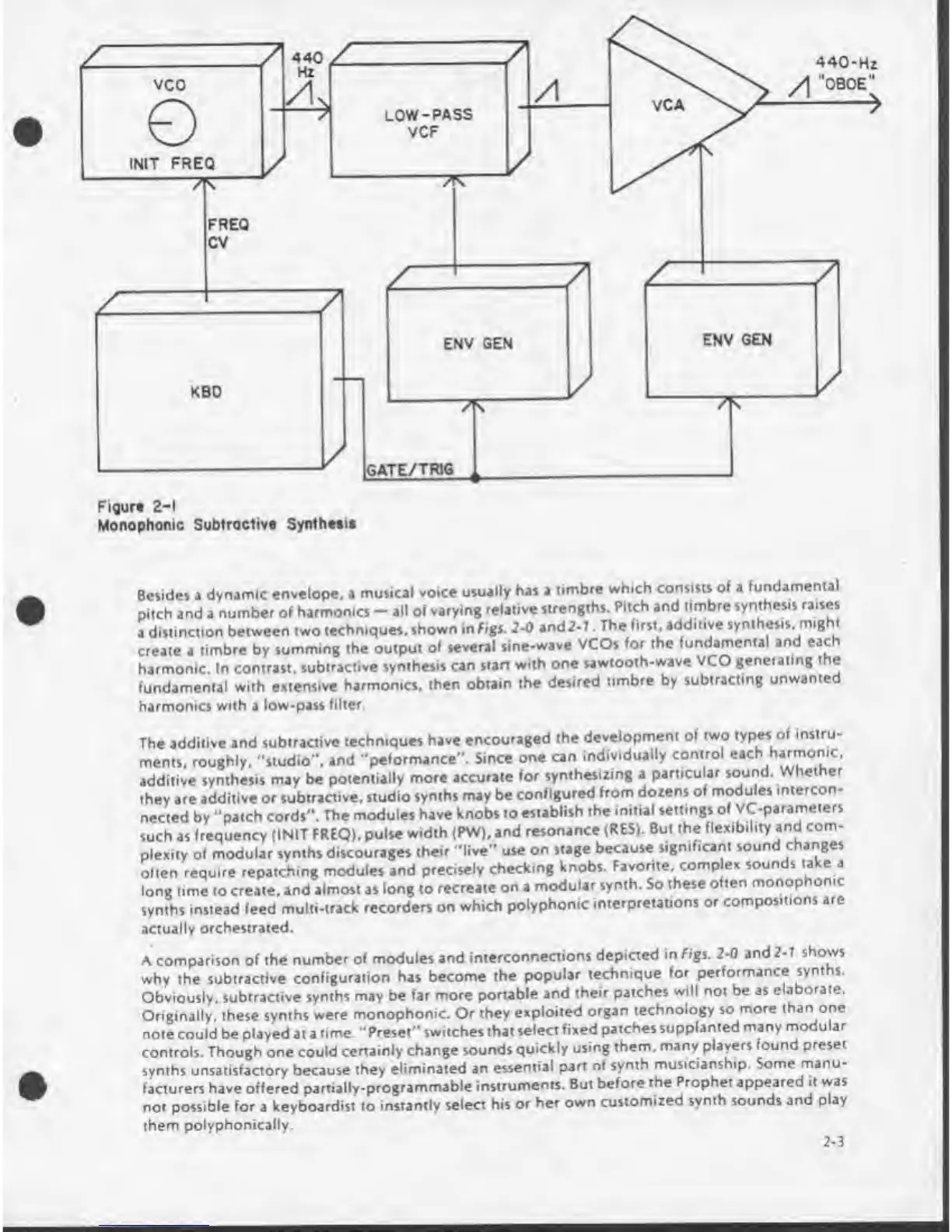
Figure
2-1
Monophonic
Subtractive
Synthesis
Besides
a
dynamic
envelope,
a
musical
voice
usually
has
a
timbre
which
consists
of
a
fundamental
pitch
and
a
number
of
harmonics
-
all
of
varying
relative
strengths.
Pitch
and
timbre
synthesis
raises
a
distinction
between
two
techniques,
shown
in
figs.
2-0
and
2-7.
The
first
additive
synthesis
might
create
a
timbre
by
summing
the
output
of
several
sine-wave
VCOs
for
the
fundamental
and
each
harmonic.
In
contrast,
subtractive
synthesis
can
start
with
one
sawtooth-wave
VCO
generating
the
fundamental
with
extensive
harmonics,
then
obtain
the
desired
timbre
by
subtracting
unwanted
harmonics
with
a
low-pass
filter.
The
additive
and
subtractive
techniques
have
encouraged
the
development
of
two
types
ot
instru¬
ments.
roughly,
"studio",
and
"peformance".
Since
one
can
individually
control
each
h
f
r
^°"
,c
'
additive
synthesis
may
be
potentially
more
accurate
for
synthesizing
a
particular
sound.
Whether
they
are
additive
or
subtractive,
studio
synths
may
be
configured
from
dozens
of
modules
intercon¬
nected
by
"patch
cords".
The
modules
have
knobs
to
establish
the
initial
settings
of
VC-parameters
such
as
frequency
(INIT
FREQ),
pulse
width
(PW).
and
resonance
(RES).
But
the
flexibility
and
com¬
plexity
of
modular
synths
discourages
their
"live"
use
on
stage
because
significant
sound
changes
often
require
repatching
modules
and
precisely
checking
knobs.
Favorite,
comp
ex
sounds
take
a
long
time
to
create,
and
almost
as
long
to
recreate
on
a
modular
synth.
So
these
often
monophonic
synths
instead
feed
multi-track
recorders
on
which
polyphonic
interpretations
or
compositions
are
actually
orchestrated.
A
comparison
of
the
number
of
modules
and
interconnections
depicted
in
figs.
2-0
and2-T
shows
why
the
subtractive
configuration
has
become
the
popular
technique
for
performance
synt
s.
Obviously,
subtractive
synths
may
be
far
more
portable
and
their
patches
will
not
be
as
elaborate.
Originally,
these
synths
were
monophonic.
Or
they
exploited
organ
technology
so
more
than
one
note
could
be
played
at
a
time.
"Preset"
switches
that
select
fixed
patches
supplanted
many
modular
controls.
Though
one
could
certainly
change
sounds
quickly
using
them,
many
players
found
preset
synths
unsatisfactory
because
they
eliminated
an
essential
part
of
synth
musicianship.
Some
manu¬
facturers
have
offered
partially-programmable
instruments.
But
before
the
Prophet
appeared
it
was
not
possible
for
a
keyboardist
to
instantly
select
his
or
her
own
customized
synth
sounds
and
play
them
polyphonically.
2-3

Table of Contents

Other manuals for Sequential prophet 5

Related product manuals