EasyManua.ls Logo

Sequential prophet 5 - Tune

Sequential prophet 5
141 pages
Print Icon
To Next Page IconTo Next Page
To Previous Page IconTo Previous Page
Loading...
U
5
J
6
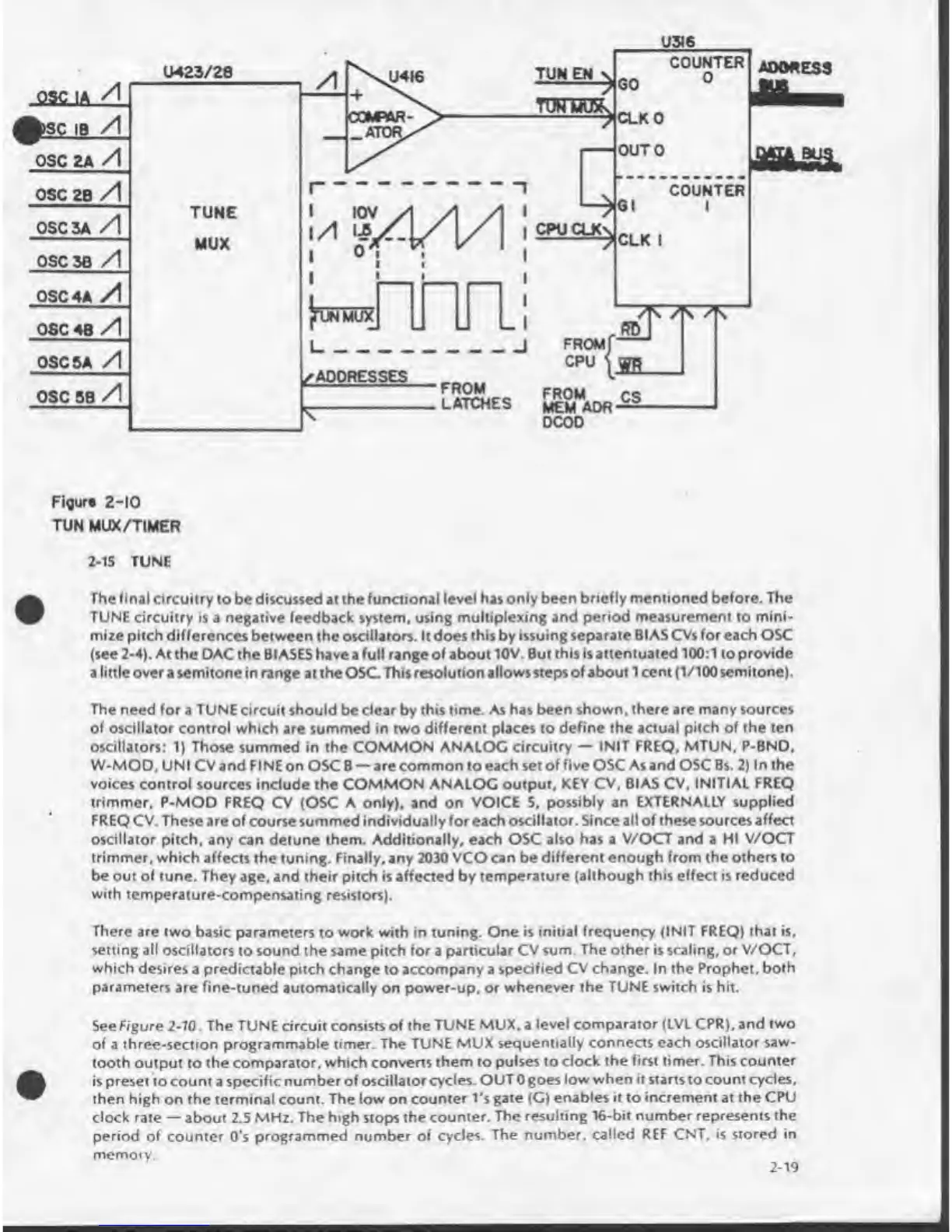
Figure
2-10
TUN
MUX/TIMER
2-1S
TUNE
The
final
circuitry
to
be
discussed
at
the
functional
level
has
only
been
briefly
mentioned
before.
The
TUNE
circuitry
is
a
negative
feedback
system,
using
multiplexing
and
period
measurement
to
mini¬
mize
pitch
differences
between
the
oscillators.
It
does
this
by
issuing
separate
BIAS
CVs
for
each
OSC
(see
2-4).
At
the
DAC
the
BIASES
have
a
full
range
of
about
10V.
But
this
is
attentuated
100:1
to
provide
a
little
over
a
semitone
in
range
at
the
OSC
This
resolution
allows
steps
of
about
1
cent
(1/100
semitone).
The
need
for
a
TUNE
circuit
should
be
clear
by
this
time.
As
has
been
shown,
there
are
many
sources
of
oscillator
control
which
are
summed
in
two
different
places
to
define
the
actual
pitch
of
the
ten
oscillators:
1)
Those
summed
in
the
COMMON
ANALOG
circuitry
INIT
FREQ,
MTUN,
P-BND,
W-MOO,
UNI
CV
and
FINE
on
OSC
B
are
common
to
each
set
of
five
OSC
As
and
OSC
Bs.
2)
In
the
voices
control
sources
include
the
COMMON
ANALOG
output,
KEY
CV,
BIAS
CV,
INITIAL
FREQ
trimmer,
P-MOD
FREQ
CV
(OSC
A
only),
and
on
VOICE
5.
possibly
an
EXTERNALLY
supplied
FREQ
CV.
These
are
of
course
summed
individually
for
each
oscillator.
Since
all
of
these
sources
affect
oscillator
pitch,
any
can
detune
them.
Additionally,
each
OSC
also
has
a
V/OCT
and
a
HI
V/OCT
trimmer,
which
affects
the
tuning.
Finally,
any
2030
VCO
can
be
different
enough
from
the
others
to
be
out
of
tune.
They
age,
and
their
pitch
is
affected
by
temperature
(although
this
effect
is
reduced
with
temperature-compensating
resistors).
There
are
two
basic
parameters
to
work
with
in
tuning.
One
is
initial
frequency
(INIT
FREQ)
that
is,
setting
all
oscillators
to
sound
the
same
pitch
for
a
particular
CV
sum.
The
other
is
scaling,
or
V/OCT,
which
desires
a
predictable
pitch
change
to
accompany
a
specified
CV
change.
In
the
Prophet,
both
parameters
are
fine-tuned
automatically
on
power-up,
or
whenever
the
TUNE
switch
is
hit.
See
Figure
2-10.
The
TUNE
circuit
consists
of
the
TUNE
MUX.
a
level
comparator
(LVL
CPR),
and
two
of
a
three-section
programmable
timer.
The
TUNE
MUX
sequentially
connects
each
oscillator
saw¬
tooth
output
to
the
comparator,
which
converts
them
to
pulses
to
clock
the
first
timer.
This
counter
is
preset
to
count
a
specific
number
of
oscillator
cycles.
OUT
0
goes
low
when
it
starts
to
count
cydes,
then
high
on
the
terminal
count.
The
low
on
counter
l’s
gate
(G)
enables
it
to
increment
at
the
CPU
clock
rate
about
2.5
MHz.
The
high
stops
the
counter.
The
resulting
16-bit
number
represents
the
period
of
counter
0's
programmed
number
of
cycles.
The
number,
called
REF
CNT,
is
stored
in
memory.
2-19

Table of Contents

Other manuals for Sequential prophet 5

Related product manuals