EasyManua.ls Logo

Sequential prophet 5 - The Prophet

Sequential prophet 5
141 pages
Print Icon
To Next Page IconTo Next Page
To Previous Page IconTo Previous Page
Loading...
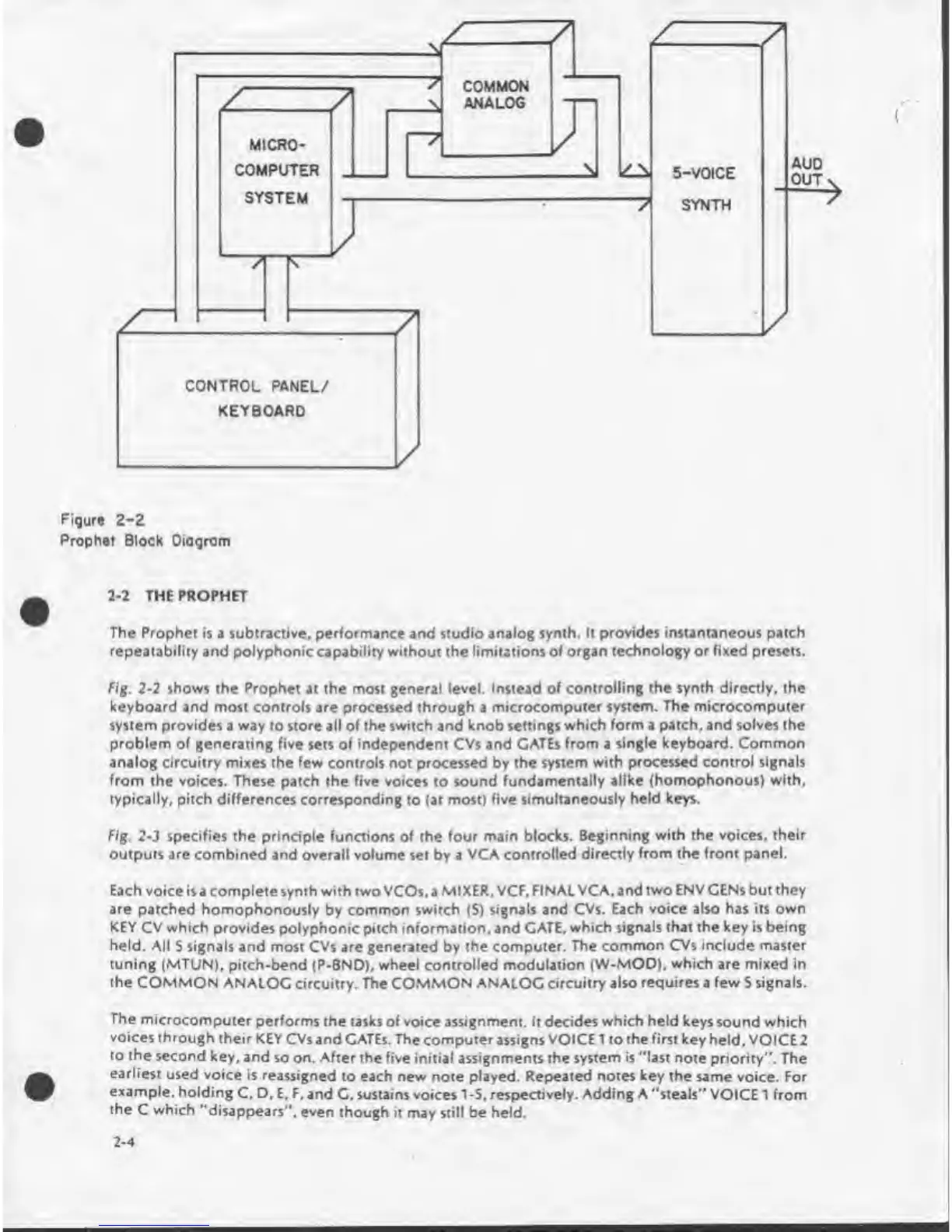
Figure
2-2
Prophet
Block
(Diagram
THE
PROPHET
The
Prophet
is
a
subtractive,
performance
and
studio
analog
synth.
It
provides
instantaneous
patch
repeatability
and
polyphonic
capability
without
the
limitations
of
organ
technology
or
fixed
presets.
Fig.
2-2
shows
the
Prophet
at
the
most
general
level.
Instead
of
controlling
the
synth
directly,
the
keyboard
and
most
controls
are
processed
through
a
microcomputer
system.
The
microcomputer
system
provides
a
way
to
store
all
of
the
switch
and
knob
settings
which
form
a
patch,
and
solves
the
problem
of
generating
five
sets
of
independent
CVs
and
GATEs
from
a
single
keyboard.
Common
analog
circuitry
mixes
the
few
controls
not
processed
by
the
system
with
processed
control
signals
from
the
voices.
These
patch
the
five
voices
to
sound
fundamentally
alike
(homophonous)
with,
typically,
pitch
differences
corresponding
to
(at
most)
five
simultaneously
held
keys.
Fig.
2-3
specifies
the
principle
functions
of
the
four
main
blocks.
Beginning
with
the
voices,
their
outputs
are
combined
and
overall
volume
set
by
a
VCA
controlled
directly
from
the
front
panel.
Each
voice
is
a
complete
synth
with
two
VCOs.
a
MIXER.
VCF.
FINAL
VCA.
and
two
ENV
GENs
but
they
are
patched
homophonously
by
common
switch
(S)
signals
and
CVs.
Each
voice
also
has
its
own
KEY
CV
which
provides
polyphonic
pitch
information,
and
GATE,
which
signals
that
the
key
is
being
held.
All
S
signals
and
most
CVs
are
generated
by
the
computer.
The
common
CVs
include
master
tuning
(MTUN),
pitch-bend
(P-8ND),
wheel
controlled
modulation
(W-MOD),
which
are
mixed
in
the
COMMON
ANALOG
circuitry.
The
COMMON
ANALOG
circuitry
also
requires
a
few
S
signals.
The
microcomputer
performs
the
tasks
of
voice
assignment.
It
decides
which
held
keys
sound
which
voices
through
their
KEY
CVs
and
GATEs.
The
computer
assigns
VOICE
1
to
the
first
key
held,
VOICE
2
to
the
second
key.
and
so
on.
After
the
five
initial
assignments
the
system
is
“last
note
priority’'.
The
earliest
used
voice
is
reassigned
to
each
new
note
played.
Repeated
notes
key
the
same
voice.
For
example,
holding
C.
D,
E,
F,
and
G.
sustains
voices
1-5,
respectively.
Adding
A
"steals”
VOICE
1
from
the
C
which
"disappears”,
even
though
it
may
still
be
held.
2-4

Table of Contents

Other manuals for Sequential prophet 5

Related product manuals