Page 8-di/of 40
4. Installation.
The heat pump must be installed and commissioned by specialised technicians and in keeping
with current national system regulations.
Installation must be conducted evaluating all the specific site factors: vicinity and height of
walls, public accessibility, etc.
4.1. Inspection.
Upon receiving the heat pump, check packaging integrity. The machine should come with
complete manuals, for the user and for installation.
4.2. Handling.
The unit is equipped with suitable protections to protect the heat pump for any damages
during handling. Avoid exerting pressure on the sides of the packaging.
Once the heat pump is unpacked, avoid exerting pressure on the body, plate heat
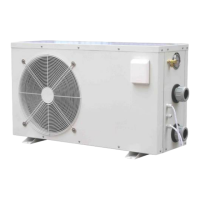
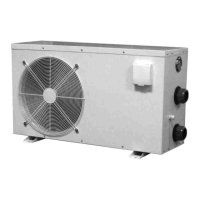
exchanger and fan protection net. See Figure 1.
4.3. Positioning.
The heat pump must be positioned by specialised technicians and in keeping with current
national system regulations.
The heat pump must be carefully positioned considering the following aspects:
• Dimensions and origin of hydraulic tubes.
• Location of the power supply.
• Support and its location.
• Necessary clearance.
• Noise wave and vibration echo.
• Condensation discharge.
4.3.1. Support and its location.
The heat pump must be installed outdoors. It cannot be installed indoors and
must be at least 3.5 [m] from the pool surface (zone 2
16
).
During normal operations, the heat pump plate heat exchanger produces
condensation. The amount of condensation produced varies according to
ambient conditions. The higher the air humidity, the higher the amount of
condensation produced. The heat pump comes with a condensation drain.
Make sure there are no obstacles to condensation draining.
The heat pump must be positioned to avoid damages attributable to any water or
condensation leaks. If necessary, install suitable discharge outlets or collection
containers.
The heat pump must be installed on a solid and level support (cement slab or
prefabricated platform). Avoid positioning the heat pump on instable ground. In this
case, installing a suitably dimensioned support slab or platform is recommended.
The support surface must be slightly tilted to promote correct rain water and
condensation draining from the device base.
Support surface inclination must be a maximum of 2%.
Make sure the pump is not subject to rain water flows from nearby building roofs.
Protruding roofs without gutters could pour significant amounts of water and/or
debris on the heat pump which could damage it. If necessary, install gutters or
discharge outlets to protect the heat pump.
If the heat pump is installed under the pool level, any water leaks could cause
significant water leaks or floods. Shott International SRL is not liable for any
of said leaks, floods or consequent damages.
Make sure the heat pump is not within the range of action of any irrigation systems.
If necessary, install suitable protections.
16
See CEI 64-8/7 for pool zone classifications.



 To Next Page