7828 Density Transmitter Technical Manual Mechanical Installation
78285000_AB 2-3
2.2 BOUNDARY AND VISCOSITY EFFECTS
Unlike Solartron’s tube density sensors, the tines of the 7828 are not totally enclosed. The
walls of the pipe or tank in which the transmitter is installed will introduce boundaries to
the fluid flow, and this will have an effect on the calibration of the sensor. To overcome
this, Solartron calibrate the 7828 under a variety of pre-defined conditions corresponding
to the installation and pipe schedule. This condition is selected when ordering the 7828,
so that, by calibrating the sensor under the same boundary conditions as the installation,
the need for additional on site calibration is eliminated.
2.2.1 BOUNDARY EFFECTS
Any insertion device or transducer can only measure the properties of the fluid within the
region of fluid to which it is sensitive.
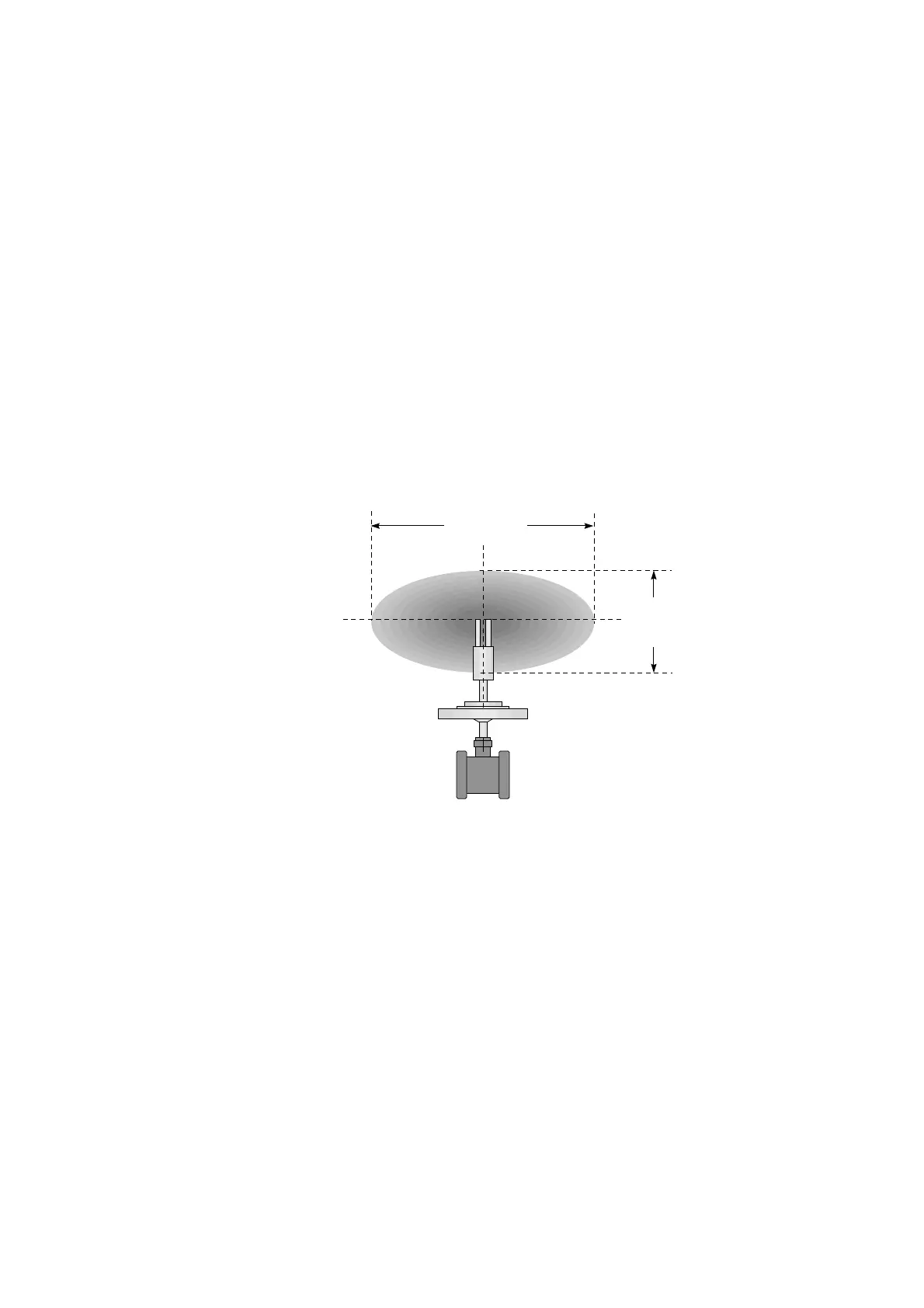
For practical reasons it is helpful to consider the sensitive or effective region for the
transmitter as an three-dimensional ellipse centred on the tips of the tines with its long
axis aligned with the direction in which the tines vibrate, as shown below. The 7828 is
insensitive to the properties of the fluid outside this region.
long axis
short
axis
If part of this volume is taken up by the pipework or fittings there is said to be a boundary
effect; i.e. the intrusion of the pipe walls will alter the calibration.
The diagram below illustrates the 7828 installed in a pocket on the side of a 4” (100mm)
horizontal pipe line (viewed from above). The effective region is completely enclosed
within the pipe line and thus is completely fluid.



 To Next Page