Dubbing a tape
Connect using an S video cable (not supplied) to obtain high-quality pictures
With this connection, you do not need to connect the yellow (video) plug of the A/V
connecting cable. Connect the S video cable (not supplied) to the S video jacks on both
your camcorder and the TV or the VCR. This connection produces higher quality DV
format pictures.
If you use a LANC cable
You can edit precisely by connecting a LANC cable (not supplied) to this camcorder
and other video equipment having a fine synchro editing fimction, using this
camcorder as a player.
Using an i.LINK cable (DV connecting cable)
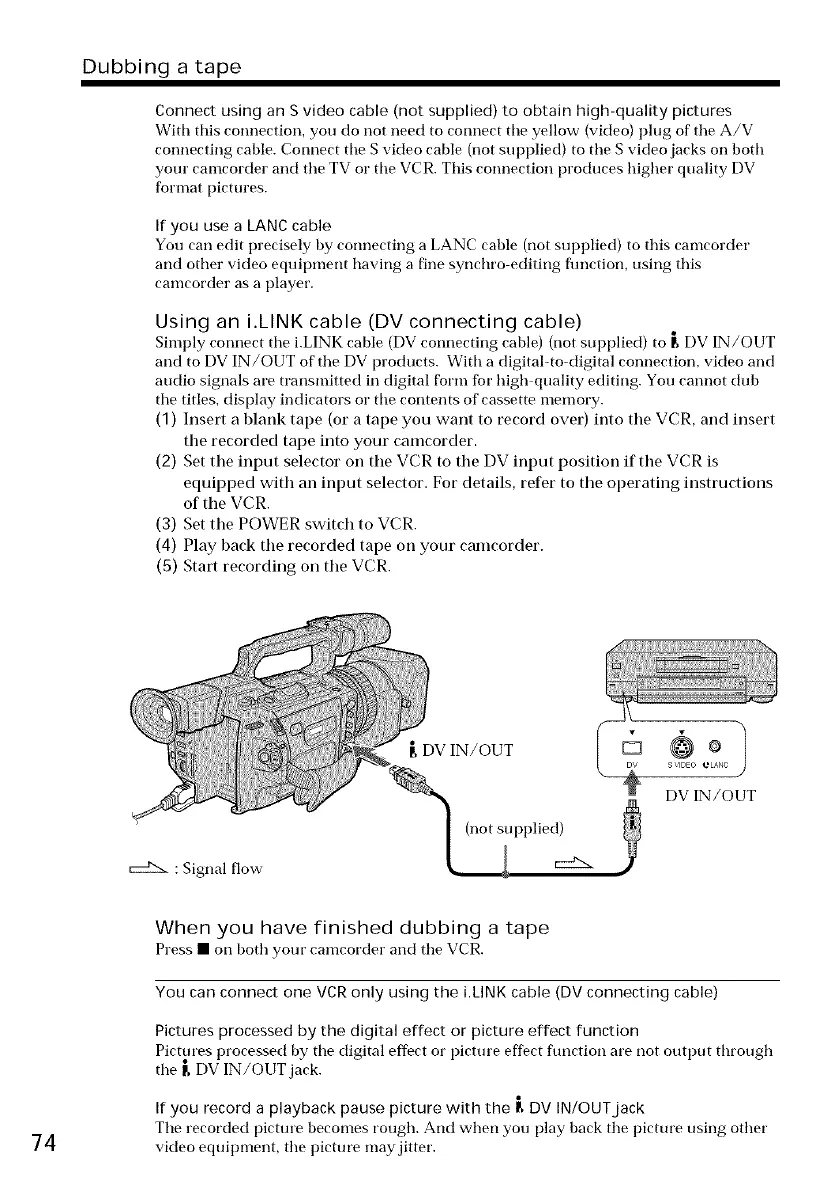
Simply connect the i.LINK cable (DV connecting cable) (not supplied) to _ DV IN/OUT
and to DV IN/OUT of the DV products. With a digital-to-digital connection, video and
audio signals are transmitted in digital form for high quality editing. You cannot dub
the titles, display indicators oi" the contents of cassette memory.
(1) Insert a blank tape (or a tape you want to record over) into the VCR, and insert
the recorded tape into your camcorder.
(2) Set the input selector on the VCR to the DV input position if the VCR is
equipped with an input selector. For details, refer to the operating instructions
of the VCR.
(3) Set the POWER switch to VCR.
(4) Play back the recorded tape on your camcorder.
(5) Start recording on the VCR.
: Signal flow
[ DV IN/OUT
(not supplied)
74
When you have finished dubbing a tape
Press • on both yore" camcorder and the VCR.
You can connect one VCR only using the i.LINK cable (DV connecting cable)
Pictures processed by the digital effect or picture effect function
Pictures processed by tile digital effbct or pictm'e effect function are not output tilrough
the r, DV IN/OUT jack.
If you record a playback pause picture with the [ DV IN/OUT jack
The recorded pictm'e becomes rough. And when you play back the picture using other
video equipment, the picture may jitter.




 To Next Page