
 To Next Page


D
Darryl BellAug 28, 2025
What to do if my 3D image is not displayed on Sony STR-DA2800ES Receiver?
- Zzachary72Aug 29, 2025
If a 3D image is not displayed on your Sony Receiver, check the 3D image formats supported by the receiver.

What to do if my 3D image is not displayed on Sony STR-DA2800ES Receiver?
If a 3D image is not displayed on your Sony Receiver, check the 3D image formats supported by the receiver.
Why is multi-channel sound not outputting from my Sony Receiver?
If multi-channel sound cannot be output from your Sony Receiver, and “Control for HDMI” is set to “On,” “Audio Out” may be automatically set to “AMP.” In this case, set “Audio Out” to “AMP.”
How to fix severe hum or noise on Sony STR-DA2800ES Receiver?
If you are experiencing severe hum or noise with your Sony Receiver, check that the speakers and equipment are connected correctly. Ensure connecting cords are away from transformers, motors, TVs, or fluorescent lights. Move your TV away from the audio equipment. If the plugs and jacks are dirty, wipe them with a cloth slightly moistened with alcohol.
How to fix Sony STR-DA2800ES when a test tone is not output from the speakers?
If a test tone is not output from the speakers of your Sony Receiver, check to see if the speaker cords are connected securely and cannot be disconnected by pulling on them slightly. The speaker cords may have the short-circuit problem.
What to do if no picture is output when selecting media options on Sony STR-DA2800ES Receiver?
Select “BD” or “DVD” using INPUT SELECTOR on the receiver once, then set “Playback Resolution” to “480i/576i” or “480p/576p” in the Video Settings menu using the GUI, and select the content again.
What to do if when the Zone2 Out function is enabled and you select the same HDMI input for both the main zone and zone 2, there may be some interference on the audio with my Sony Receiver?
To avoid possible interference in the main zone, you can place priority on the main zone for HDMI input selection.
What to do if the Universal Remote Control function does not work on my Sony Receiver?
Make sure the connections required are made. Press ?/1 on the remote control to turn the receiver off and then on again. Hold down ?/1 on the receiver until the lamp above the button flashes in green to reboot the receiver. If the remote sensor of the receiver and that of another Sony product face the same direction, interference may occur. In this case, set the remote sensors so that they face different directions or use an IR shield on the other Sony product to shield the IR from interference from the receiver IR remote.
How to resolve when a specific type of image is not output or corrupted on Sony STR-DA2800ES Receiver?
If a specific type of image is not output or is corrupted on your Sony Receiver, select the appropriate resolution on the receiver, as the resolution of output signals from the COMPONENT VIDEO OUT jacks may not be supported by your TV. The resolution of the signals output to the COMPONENT VIDEO MONITOR OUT jacks is converted up to 480p/576p because COMPONENT VIDEO MONITOR OUT jacks have restrictions on resolution when the resolution of video signals protected by copyright technology is converted.
What to do if my Sony Receiver is overheating?
If the top of your Sony Receiver is hot, this is specific to this amplifier and is not a malfunction.
Why does my Sony STR-DA2800ES Receiver turn on automatically?
If your Sony Receiver is turning on automatically, it might be due to the “Control for HDMI” being set to “On” or “Pass Through” being set to “Off.” In this case, the receiver may be turned on by operating other equipment connected to it.
Essential safety guidelines to prevent hazards like fire and electric shock.
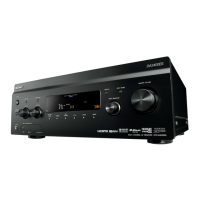
Identification and function of the receiver's front panel components.
Details on digital, antenna, LAN, RS232C, and control jacks on the rear.
Identification and function of buttons on the RM-AAU155 remote control.
Essential steps and information before connecting any equipment to the receiver.
Explains different speaker setups like 7.1, 5.1 channels, and their configurations.
Detailed diagrams and instructions for connecting speaker wires to receiver terminals.
Steps and diagrams for connecting a TV using an HDMI cable.
How to connect devices with HDMI output jacks to the receiver's HDMI inputs.
Explanation of HDMI audio/video support, Control for HDMI, and high-resolution formats.
How to connect audio equipment with HDMI output jacks to the receiver.
How to properly connect the AC power cord to the receiver and wall outlet.
Using the on-screen Easy Setup for initial receiver configuration.
How to access and navigate the main home menu options.
Steps to select, play, and control audio/video content from connected devices.
Steps to connect a USB device and play back video, music, or photo files.
How to connect and control iPod/iPhone for music, video, and photo playback.
How to choose and apply different sound field modes for audio playback.
Specific sound fields optimized for movie playback like HD-D.C.S. and Dolby/DTS modes.
How to select and switch between different AV equipment for remote operation.
Explains enjoying audio/video in a zone other than the main zone.
Explanation of Sony's BRAVIA Sync feature and its reliance on HDMI CEC.
Procedure to clear all settings and reset the receiver to its original factory defaults.
Steps to enter and navigate the main settings menu on the TV screen.
Overview of settings related to initial setup and speaker configuration options.
Re-running the Easy Setup process for basic receiver configuration.
Using the Digital Cinema Auto Calibration for automatic speaker setup and matching.
Calibrating speaker phase characteristics for better surround sound imaging.
Manually adjusting the volume level for each individual speaker.
Converting analog video input signals to various resolutions for output.
Enabling HDMI control and signal pass-through functions.
Customizing input display names, icons, and visibility in menus.
Safety guidelines for handling objects, power sources, and heat buildup.
Solutions for automatic power changes, no picture/sound, and hot receiver issues.
 General
| Bi-amping | Yes |
|---|---|
| Night mode | No |
| Sample rate | 192 kHz |
| Product color | Black |
| Connector contacts plating | Nickel |
| Case or master carton weight | 15 kg |
| Power consumption (standby) | 0.5 W |
| Power consumption (typical) | 290 W |
| Dimensions (WxDxH) | 500 x 258 x 487 mm |
| Total Harmonic Distortion (THD) | 0.09 % |
 Weight and Dimensions
| Weight | 12400 g |
|---|