8.3.7 One Touch Setting
One Touch Setting (O.T.S. or one-key operation) is a convenient function that allows
you to immediately recongure all settings with just one single key press. This is
about rhythm-based compilations of instrument voices. With this function, four
parameter types (M1 to M4) can be loaded.
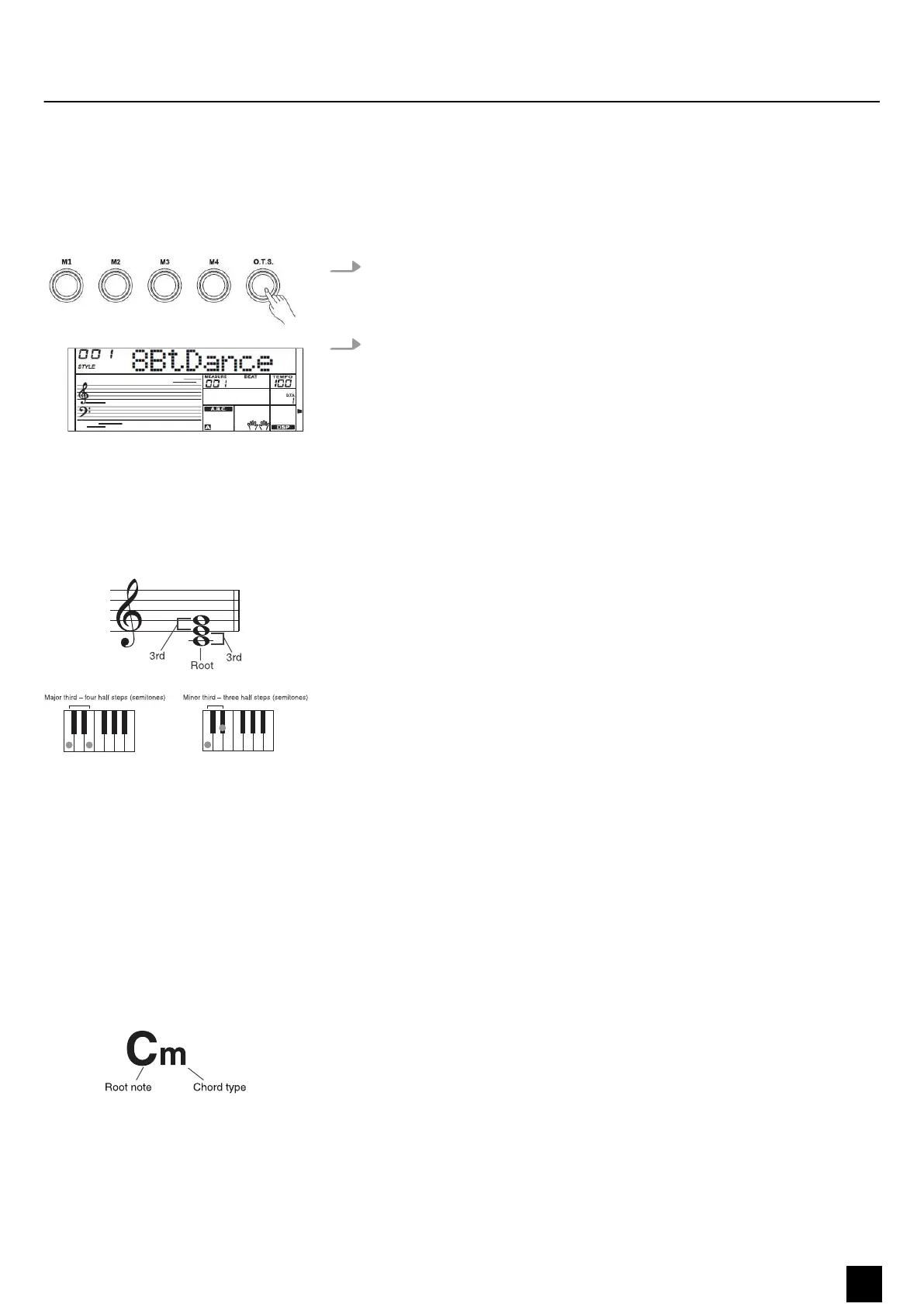
1. Press the [O.T.S.] button to enter this mode. ‘O.T.S.’ appears on the display. If
you press one of the keys [M1] to [M4], the device loads the corresponding
parameter types that match the current style. A.B.C. mode is automatically
turned on in the process.
2. Press the [O.T.S.] button again to exit O.T.S. mode.
8.3.8 Chord recognition and ngering techniques
The manner in which chords are played or displayed for the left hand in the auto
accompaniment on your keyboard is referred to as chord ngering. A distinction is
made between single and multi-nger chords on one hand and the chord detection
over the entire keyboard range.
n Chord basics
A chord consists of three or more notes played together. The most commonly
used chord is the triad consisting of three notes: Root, third and fth of the corre‐
sponding scale. The C major chord for example is formed from the notes C (root),
E (the third note of the C major scale), and G (the fth note of the C major scale).
In the C major chord shown, the lowest note is the root (this is the basic form of
the chord - if you play other notes of the chord as the lowest note, this is called
“chord inversion”). The root is the central sound of the chord on which the other
chord notes are built upon. The interval between adjacent notes and the root
determines whether the result is a major or minor third.
n Chord structure
The lower interval in our triad (between root and third) determines whether the
result is a major or minor triad. In addition, we can shift the highest note by a half
step up or down to produce two additional chords.
The basic characteristic of the triad remains even if we change the order of the
notes to create dierent inversions. Consecutive chords can be softly connected
in a chord progression, e.g. by choosing suitable chord inversions (also called
“voicings”).
n Chord names
Chord names will tell you everything you need to know about a chord. Through
the chord name, you know the root, whether it is a major, minor, or diminished
chord, whether a large or atted seventh is needed and what changes or ten‐
sions are used - all at a glance.
Functions
MK-300
21
Keyboard


 To Next Page